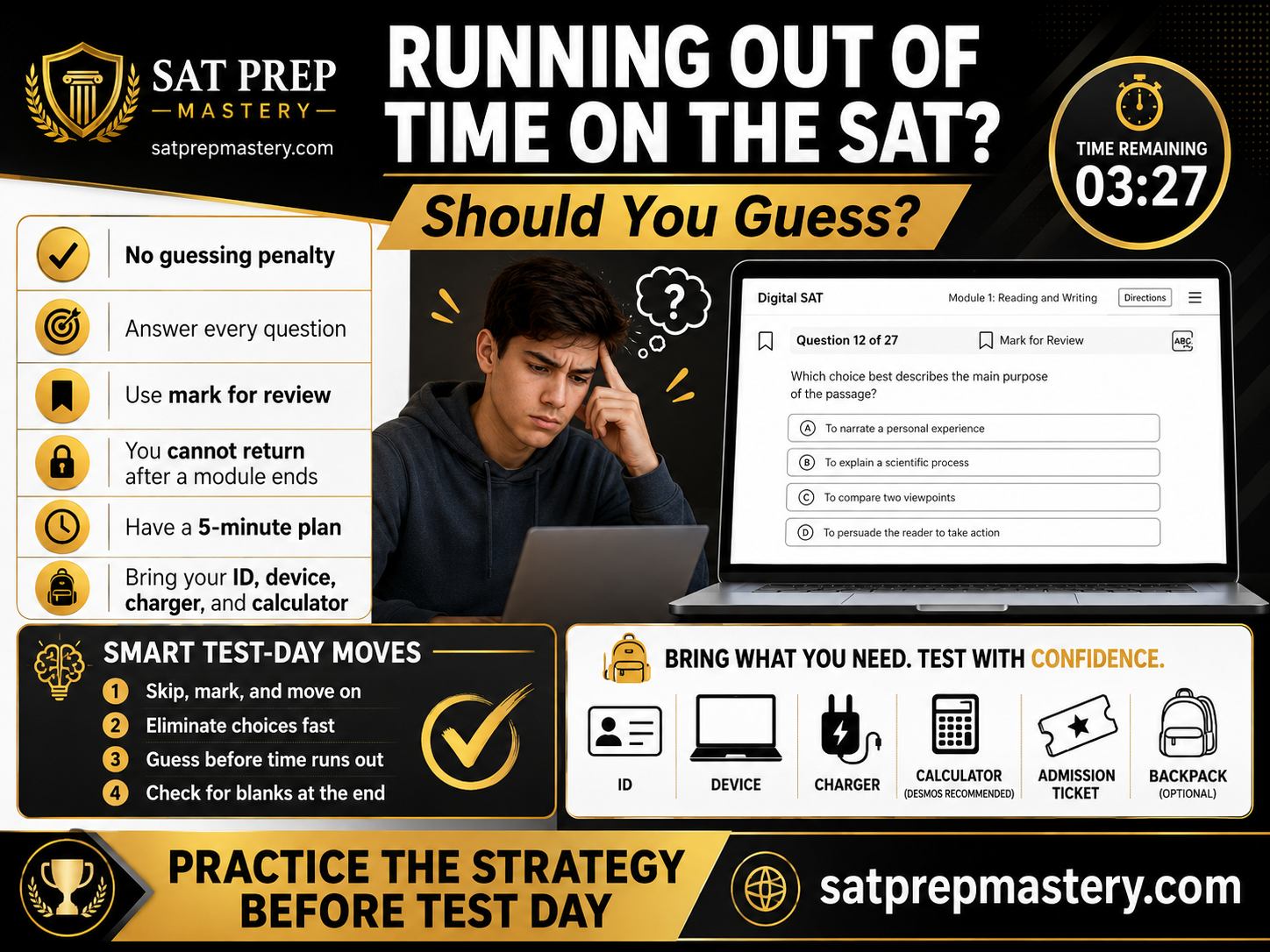
This guide separates current College Board test-day rules from evidence-informed preparation strategies. Test mechanics are drawn from College Board's SAT Testing Rules (revised May 19, 2026), the official What to Bring pages, and Bluebook documentation. Students should confirm requirements for their specific SAT administration, since rules can change up to one week before test day. This guide has not been reviewed by a named external expert, and no strategy here guarantees a score increase.
What Happens If You Run Out of Time on the SAT? Should You Guess?
Quick answer: The Digital SAT has no separate penalty for wrong answers, so answering is almost always better than leaving a question blank. A blank earns nothing; a guess has a chance. Eliminating even one choice improves that chance, so cross out what you can before selecting. Enter a provisional answer before moving on, and use mark for review to flag anything you want to revisit. You can move freely among questions within the current module, but once a module ends you cannot return to it. Build and rehearse an end-of-module routine before test day so nothing is improvised.
Digital SAT rules, Bluebook features, and test-day requirements can change. Verify current information through College Board before test day.
Last verified: July 17, 2026
The worry is specific and it usually arrives at night. "What if my kid hits the last few questions with a minute left?" "Do wrong answers count against the score?" "Should they just bubble the same letter for everything?" "The second part felt harder, does that mean it went badly or well?" "What happens when the Bluebook timer hits zero?" "What if the laptop freezes?" "And what exactly are we supposed to pack?"
Here is the quiet cost of all that uncertainty: it eats attention the student needs for actual questions. A test taker running a background loop of "am I allowed to guess?" is not fully solving the problem in front of them.
So let's remove the loop. Every question above has a clear, current answer, and a student who knows them walks in calmer.
The core idea is simple:
A student should not be deciding their emergency timing strategy for the first time during the official SAT.
The fix is a preplanned routine for skipping, marking, guessing, reviewing, and finishing each module, practiced until it runs on autopilot. That is exactly what structured test-day preparation is for: rehearsing timing decisions, finding the skills that eat the clock, and getting immediate help on the questions that slow a student down, all before the real test.
What Happens When Time Runs Out on a Digital SAT Module?
Each module is timed separately, and the timing is strict. Per College Board's official testing rules, the SAT has two sections, Reading and Writing then Math, and <cite index="121-1">each section has two modules, and once you leave a module you cannot return to it.</cite> While time remains in a module, you can move backward and forward among its questions, mark questions for review, and change answers. When the timer expires, that module closes and its questions are gone for good.
Anything you did not answer stays unanswered. Anything you selected is recorded. That is the whole reason the strategies below exist: the value of any question drops to zero the instant its module ends, so the goal near the end is always to have something entered.
One reassuring detail from the rules: an internet connection is required to start the test and to submit answers at the end, and <cite index="121-1">if your device is not connected when the test ends and your answers are not submitted, you have until 11:59 p.m. local time the next day to reconnect and submit.</cite> The Bluebook timer shows the time remaining in each part, and it can be hidden until five minutes are left, at which point an alert appears.
Running out of time on the SAT in one sentence
"When a module ends, the student loses access to its questions, so every end-of-module strategy should prioritize recording an answer before time expires."
Should You Guess on the SAT?
Yes, when you have to. The Digital SAT applies no separate penalty for incorrect answers, so a wrong guess costs nothing beyond the point you never had, while a blank guarantees zero. That single rule drives almost every decision on this page.
But "guess" covers a range of choices, and they are not equally good:
Leaving a question blank. The weakest option. No chance of credit.
A completely random guess. Better than blank, but the odds are only what chance provides.
Eliminating one answer, then guessing. Better odds, because you have removed a known wrong.
Eliminating two answers, then guessing. Better still. Now it is close to a coin flip on a real contender.
Entering a provisional answer and returning later. The smart move when you have a path but need time. You lock in a chance, then come back if the clock allows.
A reasoned estimate on a student-produced Math response. Even a partial solution or a sensible estimate can land on credit, so an empty grid-in is rarely the right call.
What students should not do: leave several questions blank while polishing one hard one; sink several minutes into a single problem; assume a letter is "due"; trust answer-pattern myths; change a correct-feeling answer just because the same letter appeared a few times; or guess early when there is still time to actually reason it out. Guess because time forces it, not because a question felt uncomfortable.
Random Guessing vs. Strategic Guessing
SAT Prep Mastery Time-Pressure Decision Table
Situation | Weak Reaction | Better Strategy | Why It Is Better |
|---|---|---|---|
No idea after an initial read | Stare at it for several minutes | Mark it, enter a provisional answer, move on | Protects time for answerable questions |
One answer can be eliminated | Guess without reviewing choices | Eliminate the clearly wrong choice first | Improves the quality of the guess |
Two answers remain | Change choices repeatedly | Compare the final two against the exact question | Keeps the decision evidence-based |
Fewer than five minutes remain | Continue in normal order | Check unanswered and marked questions first | Prevents avoidable blanks |
Fewer than one minute remains | Keep solving one hard problem | Enter an answer for every remaining question | Preserves the possibility of credit |
Difficult Math question | Do long calculations without a plan | Consider estimation, answer choices, or calculator tools | May produce a faster path |
Student-produced Math response | Leave it empty immediately | Estimate or solve partially when possible | A reasoned response beats no response |
Question answered provisionally | Forget to return | Use mark for review and revisit if time permits | Creates an organized review process |
Several answers share a letter | Change one because the pattern looks off | Keep answers the questions support | Letter patterns are not evidence |
Module is almost over | Review every completed question in order | Prioritize blanks, flags, and uncertainty | Spends time by potential value |
Strategic guessing is a timing-management tool, not a replacement for knowing the material. It rescues points at the margin. It does not manufacture a score.
The SAT Prep Mastery Five-Minute Emergency Plan
When roughly five minutes remain in a module, run this:
Open the question overview or review screen to see the whole module at a glance.
Identify every unanswered question.
Enter a provisional answer for every unanswered multiple-choice question.
Check that each student-produced Math response has a valid entry.
Return to questions where you can eliminate one or two choices and upgrade the guess.
Do not start an extremely long method without a clear path to the answer.
Use the final moments to confirm nothing was accidentally left blank.
The Bluebook alert at the five-minute mark is your cue to switch from solving to securing. Every one of these actions uses tools currently available in Bluebook: the question navigator, answer entry, answer elimination, and mark for review.
The One-Minute Emergency Plan
When roughly one minute remains, shift into triage:
Stop trying to finish any long solution.
Scan for unanswered questions.
Enter the best available answer for each.
Use rapid elimination where you can.
Confirm your answers actually registered.
Do not burn the final seconds second-guessing questions you already completed.
The final-minute rule
"An imperfect recorded answer still has a chance to earn credit; an unanswered question does not."
Because the SAT has no guessing penalty, this rule is always true. In the last minute, "answered" beats "perfect" every time.
How the Adaptive Digital SAT Changes Timing Strategy
Both sections are adaptive across two modules. Reading and Writing has two modules; Math has two modules. The first module of each section contains a broad mix of easy, medium, and hard questions, and performance on that first module helps determine whether the second module trends harder or easier.
A few things follow from that, and they matter for pacing:
A hard second module is not a verdict. Students should not try to read their score from how difficult Module 2 feels, and a tough question is not a signal to panic.
Trying to "protect" Module 1 by grinding endlessly on one question backfires. Time spent over-defending one item creates avoidable blanks elsewhere.
The right move is unchanged: make the best possible decision on every question, then move.
Once Module 1 ends, it is closed. There is no going back to fix it.
The scoring model is more involved than simply tallying correct answers, and no one outside College Board can predict how a single question will move a score. So the practical stance is to stop trying to game the algorithm and just answer well, question by question.
Does Guessing in Module 1 Affect the Adaptive Route?
Cautiously and honestly: Module 1 performance contributes to routing, and both correct and incorrect responses factor into the scoring and routing process. Beyond that, College Board does not give students a simple public formula for predicting how one answer changes the path.
What this means in practice is calmer than it sounds. One uncertain answer is not a crisis, and students should not race through an entire module out of fear of missing some invisible threshold. Reason carefully while time allows, and reserve strategic guessing for after a genuine attempt or when the clock demands it. Do not promise yourself that one guessed answer will or will not change the route, because that is not knowable. Just make each answer as good as the time permits.
How to Pace the Reading and Writing Section
Reading and Writing gives 64 minutes for 54 questions across two 32-minute modules, roughly 71 seconds per question on average. Treat that as a reference point, not a rigid command; some questions deserve more, some less.
Practical habits that save time: read what the question is actually asking before over-analyzing the passage, since each short passage has a single question attached. Recognize the question type quickly. Apply grammar rules efficiently rather than re-deriving them. Resist rereading the same lines hoping for new information. Eliminate wrong choices actively. Mark unusually hard questions and keep moving. And practice the transitions between question types, because the section constantly switches topics.
Move on when...
You have reread the same lines without gaining anything new.
Two honest attempts have not produced a clearer method.
The question is eating time several later questions will need.
You can narrow it to two choices but cannot decide immediately (mark it, guess, return if time allows).
How to Pace the Math Section
Math gives 70 minutes for 44 questions across two 35-minute modules, about 95 seconds per question on average. The calculator is available on the entire section, but availability is not a reason to reach for it every time.
Efficient habits: identify the skill being tested before you start calculating. Avoid unnecessary manual algebra when a faster route exists. Use the built-in Desmos calculator, or an approved personal calculator, strategically, and remember you can toggle Desmos between scientific and graphing modes. Check units and confirm which quantity the question wants. Estimate before committing to a long computation. Test the answer choices when that is quicker than solving forward. Mark long problems and return to them. Do not let the calculator slow you on problems that mental reasoning handles faster. And leave a little time to verify student-produced (grid-in) answers, which have no choices to sanity-check against.
Practice both calculator use and no-calculator reasoning even though calculator access is allowed, because the fastest path is sometimes the one that never opens a tool.
What Should Students Bring to the SAT?
Required for SAT Weekend
A fully charged, approved testing device (you cannot test on a phone) with Bluebook already installed.
Completed exam setup, done 1 to 5 days before test day, which generates your admission ticket.
Your admission ticket, electronic or printed (printed is preferred).
An acceptable photo ID. It must be a physical, original document; digital IDs are not accepted.
A pen or pencil for scratch work (it does not have to be a No. 2).
Your College Board username and password.
Helpful but optional
An approved personal calculator (there is a built-in Desmos, so this is a preference).
A power cord and/or portable charger. Outlet access is not guaranteed, and the device must stay on for roughly three hours.
A backup testing device.
An external mouse and mouse pad. An external keyboard is allowed only with tablets, not laptops.
A non-audible watch (no beeps, alarms, or timers).
A drink or snacks for the break.
A bag or backpack.
Epinephrine auto-injectors if needed, which may be carried in a clear bag and kept under the desk.
SAT School Day differences
For SAT School Day, the school manages much of the logistics. Scratch paper is provided, so students should not bring their own. A photo ID is generally required only for students testing away from their regular school or who are homeschooled. Some materials and instructions come from the school, so follow what the school tells you rather than assuming the Weekend checklist applies unchanged.
Students with accommodations
Approved accommodations can change timing, break structure, device setup, testing format, or permitted assistive technology. Accommodations must be approved by College Board's Services for Students with Disabilities before test day, and the request generally goes through a school counselor or SSD coordinator. Confirm approval and the exact test-day details early through official College Board channels rather than assuming an accommodation will be available.
What Should Students Not Bring or Use?
College Board's testing rules prohibit a long list of items during the test and during breaks. Among them: mobile phones; smartwatches; smart glasses or any internet- or AI-enabled eyewear; fitness trackers and other wearables; cameras, recording, or listening devices; any other communication device; stylus and smart pens; books, notes, dictionaries, highlighters; papers of any kind (scratch paper is provided); watches that beep or have alarms or timers; calculators on the prohibited list; and headphones or earbuds of any kind, wired or wireless, powered on or off.
The rules also bar accessing any phone or internet-connected device during the test or breaks, and specifically prohibit using AI tools such as ChatGPT or Photomath during testing. Prohibited devices generally must be turned off and stored according to the test center's process; failing to store a phone is itself a violation. College Board states that violations can lead to dismissal and score cancellation, so the safe move is simple: power devices off and put them away as instructed.
Some of these items may be permitted, or even required, for students with specific approved accommodations.
What If the Testing Device or Internet Connection Fails?
Stay calm, and tell the proctor immediately. That is the single most important move, because the staff and Bluebook have procedures, and quietly troubleshooting on your own can look like a rules violation.
What the official rules and guidance establish:
An internet connection is needed to start and to submit, and testing staff give instructions if there is an internet outage during the administration.
Answers are protected at the end even without a live connection. If your answers do not submit because the device is offline when the test ends, you have until 11:59 p.m. local time the next day to reconnect and submit.
Do not close the lid or cover the screen until you see the confirmation screen, since that can prevent answers from submitting.
A replacement device is possible but not guaranteed. Test centers may, but are not required to, offer a replacement if your device stops working, and you can accept or decline it.
Do not reach for a phone or any prohibited device to fix a problem. Notify staff and follow their direction and Bluebook's prompts.
Prevention beats panic: complete Bluebook exam setup in the days before the test, arrive with the device fully charged, and bring a charger and, if possible, a backup device. Not every technical issue resolves the same way, so the goal is to reduce the odds and know who to tell.
How to Practice So Running Out of Time Becomes Less Likely
Timing improves through structured practice, not through taking full test after full test and hoping. Build it up in a progression:
Learn the skill first, without heavy time pressure.
Measure how long your correct solutions actually take.
Identify which question types are slow for you.
Learn more efficient methods for those types.
Do short timed sets.
Practice mark-and-return decisions deliberately.
Rehearse the five-minute emergency routine.
Complete full timed modules.
Take full-length Bluebook practice tests.
Review where time was lost, not just what was wrong.
Track more than your score. Watch questions left blank, slow correct answers, time sunk into hard questions, unnecessary rereading, calculator setup time, questions revisited, accuracy after rushing, and whether you finish modules. Those numbers tell you where the clock actually breaks, which is usually a small number of repeatable habits.
Unstructured Timing Practice vs. a SAT Prep Mastery Structured Plan
Preparation Factor | Unstructured Timing Practice | SAT Prep Mastery Structured Plan |
|---|---|---|
Pacing goal | "Try to go faster" | Identifies where and why time is lost |
Question selection | Random timed questions | Targeted practice for slow skills |
Timing | Every question is rushed | Timing is added after understanding |
Guessing strategy | Decided during the test | Rehearsed before test day |
Mark for review | Used inconsistently | Built into a repeatable routine |
Error review | Only wrong answers | Wrong, guessed, and slow correct answers |
Calculator use | Improvised | Practiced for the right question types |
Full-length tests | Repeated without a clear purpose | Scheduled after targeted improvement |
AI assistance | Student may stay stuck | Immediate explanations and alternate methods |
Progress tracking | Total score only | Accuracy, timing, and repeated patterns |
Weekly schedule | Whatever free time appears | Organized around goals and the test date |
Test-day confidence | Depends on hope | Built through practiced routines |
The future of SAT preparation is not telling every student to work faster. It is identifying which skills consume time, teaching more efficient methods, and practicing the correct decision before test day.
A personalized SAT structured plan does exactly that: it finds the slow skills, sequences the work, and folds pacing and mark-and-return decisions into a routine the student has actually rehearsed by test day.
How an AI SAT Tutor Can Improve Timing
The most common way students lose time is getting stuck and staying stuck. An AI-powered online SAT tutor targets that directly: it explains why a method was slow, demonstrates a faster approach, clarifies a confusing question on the spot, compares manual and calculator-based methods, generates similar practice, analyzes wrong and guessed answers, helps a student recognize question types, and reinforces pacing decisions outside scheduled tutoring hours. Less time lost stuck means more time for the questions a student can actually earn.
Use it well. Attempt the question first. Ask for an explanation, not just an answer. Reproduce the method on your own afterward to confirm it stuck. Verify any test-day policy through College Board directly, since rules change and an AI can be out of date. And for specialized learning needs, serious anxiety, or plain accountability, a skilled human may still be the right addition.
How SAT Prep Mastery Prepares Students for Test-Day Decisions
SAT Prep Mastery connects the pieces that turn timing from a test-day gamble into a rehearsed skill: adaptive practice, question-level explanations, harder-than-real practice, timing analysis, mistake review, personalized planning, full-length preparation, progress tracking, and AI tutor support. The point is not to cram more questions but to practice the right decision, repeatedly, so it is automatic when the timer is running.
Plans start at $159 per year with a 7-day free trial and no credit card required. No platform can guarantee a score increase or predict the exact adaptive route, and this one does not claim to. What a good plan can do is make sure the student has decided, in advance, what to do when five minutes remain.
What Parents Should Say When Their Child Is Worried About Time
Helpful language:
"You don't need to solve every question perfectly."
"Your plan tells you when to move on."
"A hard question isn't a sign the test is going badly."
"Use the strategy you practiced."
"Check for unanswered questions before the module ends."
"One question shouldn't control the rest of the module."
Language to avoid:
"You have to answer everything correctly."
"Don't guess under any circumstances."
"The harder module means you definitely earned a high score."
"If you run out of time, the whole test is ruined."
"Just work faster."
The difference is that the first list points to a rehearsed plan, and the second raises the stakes on a test where calm is itself an advantage.
Common Digital SAT Timing Mistakes
Spending too long on one question. → Set an internal limit, then mark and move.
Leaving provisional answers blank. → Always enter something before you move on.
Forgetting to use mark for review. → Flag anything you want to revisit so you can find it fast.
Trying to predict the adaptive route. → It is not knowable. Just answer well.
Rereading without a purpose. → If a reread has no specific goal, decide and move.
Using the calculator for every step. → Reach for it only when it is genuinely faster.
Refusing to guess. → There is no penalty. A blank is strictly worse.
Guessing too early. → If there is time to reason, reason first.
Changing answers over letter patterns. → Keep answers the questions support.
Reviewing easy completed questions before blanks. → Blanks and flags come first.
Taking full tests without reviewing timing. → Review where time was lost, not just what was wrong.
Practicing only untimed. → Add timing after the skill is solid.
Practicing only under strict timing. → Learn first, then add the clock.
Ignoring slow correct answers. → A slow correct answer is a future blank. Speed it up.
Learning the rules at the last minute. → Know the mechanics well before test day.
Test-Day Decision Framework
If the student knows how to solve it
Solve it efficiently and move on.
If the student has a clear path but needs more time
Enter a provisional answer, mark it, and return if time permits.
If the student can eliminate choices
Eliminate, select the strongest remaining answer, and move on.
If the student has no workable path
Enter the best available answer, mark it if useful, and protect time for other questions.
If the module is almost over
Prioritize unanswered questions before rechecking completed work.
SAT time-pressure decision rule
"Answer what you can, mark what deserves another look, protect time for the rest of the module, and never let one question create several avoidable blanks."
Final Answer: What Happens If You Run Out of Time on the SAT?
When a module's timer expires, that module closes and you cannot return to it, so anything unanswered stays unanswered. That is the whole reason to manage the clock deliberately rather than hope.
The current scoring rule makes the strategy straightforward: the Digital SAT has no separate penalty for wrong answers, so answering is almost always better than leaving a question blank. A blank earns nothing; a guess can earn credit, and eliminating even one choice makes that guess meaningfully stronger than a blind one.
With about five minutes left, secure an answer for every remaining question, then upgrade the ones where you can eliminate choices. With about one minute left, stop solving and make sure nothing is blank. The adaptive format should not change any of this; a hard second module is not a signal to panic, and no one can predict how a single answer shifts the score, so the best plan is to answer each question as well as time allows.
None of this should be improvised on test day. Rehearse the pacing decisions, the mark-and-return routine, and the emergency plans in advance. A structured plan and an AI tutor help a student build those habits before it counts, and SAT Prep Mastery supports that preparation without promising any particular outcome.
Frequently Asked Questions
Is there a penalty for guessing on the SAT?
No. The Digital SAT does not subtract points for wrong answers. A wrong guess costs nothing beyond the point you never had, so answering is better than leaving a question blank.
Should you guess or leave a question blank on the SAT?
Guess. Because there is no penalty, a blank is strictly worse than a guess, which has at least some chance of credit. Eliminate any choices you can first to improve the odds.
What happens when the Digital SAT timer runs out?
The module closes and you lose access to its questions. Answers you selected are recorded; anything unanswered stays blank. The timer can be hidden until five minutes remain, when Bluebook shows an alert.
Can you go back to questions after a module ends?
No. Per College Board's rules, once you leave a module you cannot return to it. You can only review and change answers within the module you are currently taking.
Can you move between questions within a module?
Yes. While time remains in the current module, you can move freely backward and forward, change answers, and use mark for review to flag questions to revisit.
Does guessing affect the adaptive SAT module?
Module 1 performance contributes to which second module you see, and both correct and incorrect answers factor in. College Board does not publish a formula for how one answer changes the route, so one uncertain response is not worth panicking over.
Should I guess the same answer letter for every remaining question?
There is no evidence that any letter is "due" or advantaged. When time forces guessing, entering an answer for every remaining question matters more than which letter, and eliminating a choice first beats a blind pattern.
What should I do with five minutes left?
Open the question navigator, enter a provisional answer for every unanswered question, confirm your grid-in answers have entries, then return to questions where you can eliminate choices. Do not start a long method without a clear path.
What should I do with one minute left?
Stop solving long problems, make sure no question is blank, use quick elimination where you can, and confirm your answers registered. An imperfect recorded answer can earn credit; a blank cannot.
How do I use mark for review in Bluebook?
Use the bookmark icon to flag any question you want to revisit within the current module. The question navigator then shows your marked and unanswered questions so you can return to them before time runs out.
Does Bluebook have an answer-elimination tool?
Yes. On multiple-choice questions you can cross out answer options you think are wrong, which helps you focus on the remaining choices and make a stronger decision.
How much time is allowed for Reading and Writing?
64 minutes for 54 questions, split into two 32-minute modules, roughly 71 seconds per question on average. Use that as a reference rather than a hard limit for every item.
How much time is allowed for Math?
70 minutes for 44 questions, split into two 35-minute modules, about 95 seconds per question on average. Some questions warrant more time and some less.
Can I use a calculator on every SAT Math question?
Yes. A calculator is allowed on the entire Math section. Bluebook includes a built-in Desmos calculator, and you may also bring an approved personal calculator. Use it strategically rather than for every step.
What should I bring to the SAT?
For SAT Weekend: a charged approved device with Bluebook and exam setup done, your admission ticket, an acceptable physical photo ID, a pen or pencil, and your College Board login. A charger, approved calculator, and non-audible watch are useful optional items.
What happens if my laptop stops working?
Tell the proctor immediately and follow their instructions. A test center may offer a replacement device but is not required to. Do not try to fix it with a phone or other prohibited device.
What happens if the internet fails during the SAT?
Testing staff will give instructions. Notably, if your answers do not submit because the device is offline at the end, you have until 11:59 p.m. local time the next day to reconnect and submit them.
Should students practice guessing strategies?
Yes. Deciding your five-minute and one-minute routines in advance, and rehearsing elimination and mark-and-return, prevents freezing on test day. Improvised guessing under pressure tends to waste the little time that remains.
How can an AI SAT tutor help with pacing?
It shortens the time lost being stuck by explaining faster methods on the spot, comparing manual and calculator approaches, and analyzing slow or guessed answers so the same delay stops recurring. Use it to explain, not just to answer.
How does a structured SAT plan prevent timing problems?
It identifies which specific skills consume time, teaches more efficient methods, and builds pacing and emergency routines into practice, so timing decisions are rehearsed rather than invented during the real test.
Practice the Decision Before Test Day
The students who stay calm when five minutes are left are not braver than everyone else. They have simply done this before, on purpose, many times. SAT Prep Mastery helps students replace panic and improvised guessing with adaptive practice, personalized planning, timing review, full-length preparation, progress tracking, and on-demand AI support.
SAT® is a trademark registered and owned by College Board®, which is not affiliated with and does not endorse this product or site. Digital SAT rules, Bluebook features, and test-day requirements can change. Verify current information through College Board before test day. Last verified: July 17, 2026.