The Future of AI Tutoring: Can an AI Tutor Really Replace a Traditional SAT Tutor?
Quick answer: An AI tutor is a software-based learning assistant that uses artificial intelligence to explain concepts, generate practice questions, analyze mistakes, and adapt to how each student learns. AI tutors can't fully replace great human mentors, but for structured, skills-based exams like the SAT, a specialized AI tutor can deliver most of what students actually pay tutors for — personalized explanations, unlimited practice, and instant feedback — at a fraction of the cost and available 24/7.
Students on Reddit and admissions forums are asking whether AI tutoring is a genuine breakthrough or an overhyped shortcut. Parents wonder if it's safe to trust. Tutors wonder if they're being replaced. This article answers those questions honestly — trade-offs included — and explains where a purpose-built tool like the AI SAT tutor from SAT Prep Mastery fits in.
Are there any good AI tutors that seem to be gaining popularity?
Yes — and the category is growing fast. But there's a critical distinction most students miss: a general-purpose AI chatbot is not the same thing as an AI tutor. Understanding that difference is the single most important factor in whether AI actually helps your SAT score.
Why AI tutors exploded recently
Three things happened at roughly the same time:
AI got genuinely good at explaining things — breaking down a grammar rule or a math problem step by step, rephrasing it multiple ways, and adjusting to a student's level.
The SAT went fully digital and adaptive, making static prep books a worse fit than ever. Adaptive tests reward adaptive preparation.
Traditional tutoring priced out most families. Private SAT tutors commonly charge $50–$200+ per hour. AI tutoring made personalized help affordable for the first time.
The result: "study with AI" went from niche experiment to mainstream habit in about two years.
What makes a good AI tutor?
Not all AI tutoring is created equal. A genuinely good AI tutor has a few non-negotiable traits:
Subject-specific accuracy. It's trained and constrained around a defined body of content — like the actual SAT domains — rather than the entire internet.
Pedagogy, not just answers. It guides students toward the answer with hints and Socratic questioning instead of just handing over solutions.
Adaptive difficulty. It notices what you're getting wrong and serves harder or easier material accordingly.
Mistake analysis. It tracks why you missed a question (careless error vs. concept gap vs. timing) and turns that into a plan.
Structure. It gives you a study plan and holds you to it, rather than waiting passively for questions.
The problem with generic AI chatbots
Here's the uncomfortable truth about using a general chatbot as your SAT tutor:
Callout: The generic chatbot trap A general AI assistant will answer any SAT question you paste in — but it doesn't know the digital SAT's format in depth, doesn't track your progress between sessions, and occasionally explains something incorrectly with total confidence.
Generic chatbots are also reactive: they wait for you to ask the right question. Struggling students often don't know what they don't know — and closing that gap is exactly a tutor's job.
Why specialized AI tutors outperform generic AI
A specialized AI SAT tutor beats a generic chatbot for the same reason a cardiologist beats a general search engine when you have a heart condition: focus.
Concrete example: a student asks about a transition-word question. A generic chatbot explains transition words in general English. A specialized SAT AI tutor recognizes it as a "Transitions" question from the digital SAT's Expression of Ideas domain, teaches the elimination strategy for that question type, generates five more official-style questions at increasing difficulty, and logs the result for your study plan. Same AI capability — completely different outcome for your score.
Why SAT Prep Mastery's AI tutor is built specifically for SAT success
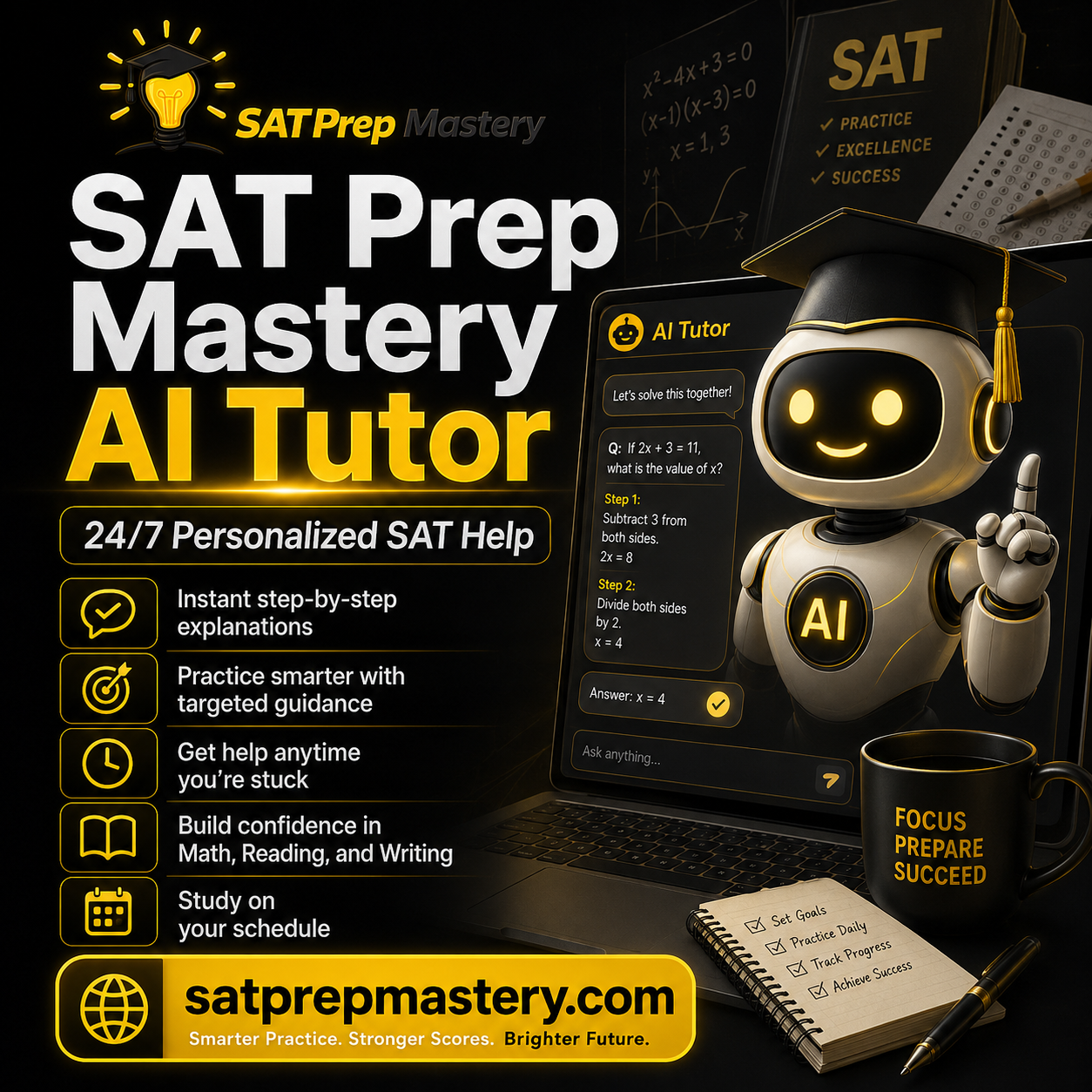
This is exactly the philosophy behind SAT Prep Mastery. Its AI online tutor isn't a general chatbot with an SAT sticker on it — it's designed around the digital SAT itself:
Explanations mapped to the actual SAT question domains in Reading & Writing and Math
Practice questions modeled on the digital SAT's format and difficulty tiers
Progress tracking that identifies weak skills and adjusts your plan automatically
Availability at 11 p.m. on a Tuesday, when human tutors are asleep and your test is Saturday
The goal isn't to be the smartest AI in the world. It's to be the most useful tutor for one specific, high-stakes test.
Is the "AI Personal Tutor" dream a trap? Need a gut check.
Fair question — and it deserves an honest answer, not marketing spin. The "personal AI tutor for every student" vision is real, but it comes with genuine failure modes. Here's the gut check.
When AI tutoring works
AI tutoring works remarkably well when:
The subject is structured and measurable. The SAT is arguably the ideal use case: fixed content domains, objective right answers, and a score that quantifies progress. AI thrives here.
The student shows up consistently. AI removes the barriers of cost and scheduling, so the students who fail with AI usually fail on consistency, not quality of instruction.
Feedback loops are fast. Answer a question, get instant analysis, correct the misunderstanding, try again. That tight loop is where learning actually happens — and AI runs it faster than any human can.
Practice volume matters. Score improvement on the SAT correlates strongly with the number of quality practice questions completed and reviewed. AI generates unlimited targeted practice; a human tutor assigns a worksheet.
When AI tutoring does NOT work
Equally important — AI tutoring fails when:
The student wants answers, not understanding. If you use AI as an answer machine, you'll feel productive and learn nothing. The score report on test day will tell the truth.
Motivation is the core problem. AI can nudge, remind, and gamify — but if a student fundamentally doesn't want to prep, a human coach (or a parent) is still the better intervention.
The student never verifies or reflects. Passive reading of AI explanations is barely better than passive reading of a textbook.
Deep emotional support is needed. Test anxiety, confidence collapse after a bad practice test, family pressure around admissions — these are human problems that benefit from human connection.
The ingredients AI can't skip (and neither can you)
Decades of learning science are clear about what drives improvement, with or without AI:
Effort. The struggle is the mechanism. Any tool that removes all struggle also removes the learning.
Feedback. You need to know not just that you were wrong, but why. AI delivers this instantly, specifically, and without judgment on every question.
Practice. No explanation replaces doing 40 real linear-equations problems.
Spaced repetition. Reviewing at increasing intervals beats cramming — and a good AI tutor schedules it automatically, resurfacing skills right before you'd forget them.
Desirable difficulty. You improve fastest slightly above your current level. Adaptive AI lives precisely in that zone.
AI should guide thinking, not replace it
The healthiest mental model: AI is a coach, not a vending machine.
A vending-machine relationship with AI looks like: paste question → receive answer → move on. Fast, satisfying, and useless.
A coaching relationship looks like: attempt the question yourself → get a hint when stuck → compare your reasoning to the explanation → do three similar questions → review the pattern a week later. Slower per question, dramatically faster per point of score improvement.
This is how the AI online tutor at SAT Prep Mastery is designed to behave — as an intelligent coach that prompts you to think first, explains after you've engaged, and builds your practice plan around your actual weaknesses rather than around whatever you feel like asking. The dream isn't a trap. Using the dream lazily is.
What are your thoughts about AI and the tutoring industry?
The tutoring industry is going through its biggest structural change since online video, and it's worth understanding where things are actually heading — for students choosing tools today and for tutors planning careers.
How tutoring has changed
Tutoring has moved through three eras:
Era 1: In-person and local — whoever lived nearby, at whatever price and hours they offered.
Era 2: Online video tutoring — geography disappeared, but a human hour still cost a human hour.
Era 3: AI-first tutoring — the marginal cost of another explanation, practice question, or feedback session is nearly zero, which changes everything about pricing, access, and scale.
How students learn today
Today's students grew up with instant answers. They don't schedule their curiosity for Thursday at 4 p.m. — they want quadratic functions explained at the moment of confusion, often at 10:47 p.m. the night before a quiz. They also learn in shorter, frequent sessions: fifteen focused minutes of adaptive practice five days a week fits modern attention better than one 90-minute weekly session — and distributed practice is what learning science recommends anyway. For structured subjects, digital learning is increasingly the preferred mode, not a fallback.
Why AI tutoring is becoming mainstream
Three forces are pushing AI tutoring from novelty to default:
Economics. Personalized 1-on-1 instruction has always produced the best outcomes — the famous problem in education research is that 1-on-1 tutoring works brilliantly but is too expensive to give everyone. AI is the first serious attempt to solve that cost problem.
Data. An AI tutor sees every question you've ever answered. No human tutor retains that level of detail about a student's error patterns, pacing, and skill gaps.
Normalization. Students already use AI daily. Using it for SAT prep isn't an adjustment; not using it is starting to feel like the odd choice.
Human tutors vs AI tutors: what each does best
In short: humans win on motivation, accountability, and emotional support. AI wins on availability, unlimited practice, analytics, and cost. (See the full side-by-side comparison table later in this article.)
Will AI replace tutors?
Mostly no — but it will redefine them. The information transfer parts of tutoring — explaining concepts, walking through solutions, generating practice, tracking errors — are being absorbed by AI, which does them faster, cheaper, and more consistently. The human parts — motivation, accountability, strategy, emotional resilience — become more valuable, not less, once the routine work is automated.
What human tutors will do in the future
The likely equilibrium: future tutors become coaches, while AI handles explanations, practice, and analytics.
A tutor in 2030 won't spend sessions explaining subject-verb agreement for the hundredth time. They'll review the analytics the student's AI tutor generated, diagnose strategic issues like pacing, set goals, and keep the student emotionally on track — while the AI does the instructional labor underneath. The best model for most students today mirrors that future: an AI tutor for the daily work, plus human support for motivation. Platforms like SAT Prep Mastery are built to be the AI half of that partnership.
The reality of working as an AI Tutor
Two very different things get mixed together online under this phrase:
Working FOR an AI company as a human "AI tutor" — real jobs where educators help train, evaluate, and improve AI models.
Using an AI tutor as a student — studying with an AI-powered tutoring product.
Job boards mean the first; students asking "should I get an AI tutor" mean the second. Both are real — and the first explains why the second works.
How AI tutors are actually created
A quality educational AI product is not one engineer prompting a chatbot. Behind a serious AI tutor is a multidisciplinary team:
Education experts and teachers who define what correct, grade-appropriate explanations look like and review the AI's teaching for accuracy.
Psychologists and learning scientists who build in spaced repetition, retrieval practice, and desirable difficulty — so the product teaches the way brains actually learn.
Curriculum specialists who map every question and explanation to the actual test blueprint — the College Board's defined domains for Reading & Writing and Math.
Software engineers who constrain the model, build the adaptive logic, and continuously test outputs for errors.
Why specialized educational AI differs from ChatGPT
This is the payoff of all that human expertise. A general-purpose chatbot is optimized to be helpful about everything, which makes it deeply focused on nothing. A specialized SAT tutor is different in kind, not just in branding:
Its content is scoped to the SAT, which dramatically reduces the space for errors and hallucinations.
Its behavior is designed by educators to teach rather than to answer.
Its practice questions follow the real test's format, not a generic approximation.
It has memory of your performance, turning every session into input for the next one.
When you use the AI tutor at SAT Prep Mastery, you're not talking to a raw model — you're using a system where educational expertise has already been baked into how the AI explains, questions, and plans.
How dangerous is it to use AI as a tutor?
"Dangerous" is a strong word, but the concern behind the question is legitimate. AI tutoring has real risks — and every one of them is manageable once you name it. Here's the honest list.
Risk 1: Hallucinations
AI models can occasionally state something false with confidence. In a specialized tutor this is dramatically reduced — content is scoped, reviewed, and constrained to a defined curriculum — but no AI system is perfect.
The fix: Treat surprising claims as things to verify against official practice materials. Healthy skepticism about sources is, conveniently, a skill the SAT Reading section rewards anyway.
Risk 2: Blind trust
Blind trust in any single source — AI, prep book, or human tutor — is bad test prep.
The fix: Ask "why" until the explanation actually makes sense to you. A good AI tutor welcomes infinite follow-ups — one of its biggest advantages over a human on the clock.
Risk 3: Copying answers
The most common failure mode: paste the question, copy the answer, feel productive, learn nothing. On SAT prep this is pure self-sabotage — the test-day version of you takes the exam alone.
The fix: Attempt every question before asking for help, use hints before full solutions, and follow each explanation with similar problems done unassisted.
Risk 4: Dependency
If you can only solve problems with an AI window open, you've outsourced, not learned.
The fix: Regular no-AI sessions and full-length timed practice tests, which expose any gap between "understanding with help" and "performing alone.
Best practices in one box
Callout: The safe AI studying loop
Attempt first. Struggle for a few minutes before asking.
Verify. Make sure explanations square with official materials.
Practice. Follow every explanation with 3–5 similar questions, unassisted.
Make mistakes on purpose. Seek out hard questions. Errors found in practice are points earned on test day.
Test yourself cold. Weekly timed sections with no AI, no notes.
Why AI plus active learning is genuinely powerful
Every risk above is a usage problem, not a technology problem. Combined with active learning — attempting first, questioning explanations, practicing after — AI becomes arguably the most powerful study tool ever available to a high school student: an infinitely patient expert who never judges you, never runs out of questions, and remembers every mistake you've made so you don't repeat it. The tool is only as dangerous as the habits around it.
Benefits of Using an AI SAT Tutor
The core benefits, in plain terms:
24/7 availability — help at the exact moment of confusion, not next Thursday
Dramatically lower cost than $50–$200/hour private tutoring
Personalized pacing — adaptive difficulty tuned to your current level
Unlimited practice questions in the digital SAT's format
Instant, specific feedback on every answer
Automatic mistake tracking that turns error patterns into study priorities
Structured study plans that adjust as your skills change
Zero judgment — ask the basic question five times if you need to
Perfect consistency from day 1 to day 90
No scheduling or travel — study anywhere, in sessions of any length
Who Should Use an AI Tutor?
An AI online tutor isn't just for one type of student. It fits especially well for:
Self-motivated students who want expert guidance without the price tag
Busy student-athletes whose schedules make fixed weekly sessions nearly impossible
AP and honors students who need SAT prep to fit into the cracks of a heavy week
Homeschool students who want structured prep with built-in progress tracking
Students aiming for Ivy League and top-tier schools who need high-volume practice on the hardest question tiers
Students who need affordable tutoring — families for whom $2,000 prep packages were never an option
Parents who want flexibility and visibility into their student's actual progress
If several of those describe you, an AI SAT tutor is likely the highest-leverage prep decision you can make.
Can an AI Tutor Improve SAT Scores?
Yes — when it's used actively. Score improvement on the SAT comes from a handful of known drivers, and a well-built AI tutor targets every one of them:
Personalized feedback. Every wrong answer gets an immediate explanation of the correct reasoning and the flaw in yours.
Targeted practice. Your hours go to the specific skills costing you points, not generic question sets.
Mistake analysis. Careless errors, concept gaps, and timing problems need different fixes — AI tells you which one you actually need.
Adaptive learning. Questions stay in your growth zone: hard enough to stretch you, never so hard you shut down.
24/7 availability. More total study happens when help is available whenever motivation strikes.
Structured plans. AI builds a plan from your diagnostics and updates it from ongoing performance.
No honest company promises a specific point gain — improvement depends on your starting point, timeline, and effort. But the mechanism is straightforward: students who complete more targeted practice with better feedback improve more, and that is precisely what AI tutoring optimizes.
The Future of AI Tutoring
The realistic trajectory over the next few years:
AI tutors become the default first layer of academic help, the way search engines became the default first layer of research.
Personalization deepens — plans built on how you learn, not just what you miss.
Human educators move up the stack into coaching and motivation, with AI handling instruction and analytics underneath.
Access widens — personalized tutoring reaches the millions of families it was always priced away from.
SAT Prep Mastery is built on that thesis: that the future of SAT preparation is a specialized, always-available AI tutor doing the daily instructional work, designed by people who understand both the test and how students learn. Not a replacement for thinking — an amplifier for it.
AI SAT Tutor vs Human Tutor: Side-by-Side Comparison
Compare | Human Tutor | SAT Prep Mastery AI Tutor |
|---|---|---|
Availability | Limited hours, often booked | 24/7, including test week |
Scheduling | Fixed appointments, coordination required | Study any time, any session length |
Cost | Typically $50–$200+ per hour | Low flat cost for unlimited use |
Personalization | Good, limited by session memory | Continuous, data-driven, every question tracked |
Practice Questions | Assigned from workbooks | Unlimited, digital-SAT format, on demand |
Adaptive Learning | Manual adjustment | Automatic, question by question |
Performance Tracking | Informal notes | Full analytics on every skill |
Instant Feedback | Only during sessions | On every answer, immediately |
Study Plans | Depends on tutor | Auto-generated and continuously updated |
Essay Support | Varies by tutor | On-demand writing feedback |
Consistency | Varies with tutor's day | Identical quality every session |
Travel Required | Sometimes | Never |
Scalability | One student per hour | Every student, simultaneously |
AI Tutor vs No Tutor: What Self-Study Alone Misses
Compare | No Tutor (Self-Study) | SAT Prep Mastery AI Tutor |
|---|---|---|
Motivation | Willpower alone | Plans, progress streaks, visible improvement |
Mistake Analysis | You guess why you missed it | Every error classified and explained |
Study Plan | DIY, often abandoned | Structured plan built from your diagnostics |
Explanations | Static answer keys | Interactive, ask follow-ups until it clicks |
Practice | Finite book questions | Unlimited targeted questions |
Availability | Materials only | Expert-level help 24/7 |
Progress Tracking | Rarely done well | Automatic, skill-by-skill |
Confidence | Uncertainty on test day | Verified readiness, backed by data |
Consistency | Streaky, cram-heavy | Steady, spaced, science-aligned |
Score Improvement Potential | Modest for most students | Significantly higher with active use |
Frequently Asked Questions About AI Tutoring
What is an AI tutor?
An AI tutor is a software-based learning tool that uses artificial intelligence to explain concepts, generate practice questions, give instant feedback, and adapt to each student's strengths and weaknesses — functioning like a personal tutor that's available around the clock.
Can AI replace SAT tutors?
AI can replace most of the instructional work — explanations, practice, feedback, analytics — but not the human elements of motivation and emotional support. For many students, an AI tutor plus supportive parents or teachers covers everything a private tutor did.
Is AI tutoring cheaper than human tutoring?
Dramatically. Private SAT tutors commonly charge $50–$200+ per hour, while AI tutoring typically costs a small flat amount for unlimited use — often less per month than a single hour with a human tutor.
Can an AI tutor explain math?
Yes. Explaining SAT math step by step is one of AI tutoring's strongest use cases. A good AI tutor can re-explain the same problem multiple ways, at multiple levels, until the concept clicks.
Can an AI tutor improve SAT scores?
Yes, when used actively. AI tutors improve the known drivers of score gains — targeted practice volume, feedback speed, mistake analysis, and consistency. Students who attempt questions first and practice after explanations see the biggest improvements.
Can AI help with SAT essays and writing?
Yes. AI tutors can give immediate feedback on grammar, clarity, structure, and the specific writing conventions the digital SAT tests in its Reading & Writing section.
Should parents trust AI tutoring?
Parents should vet AI tutoring like any prep program: is it built around the actual test, does it show progress, does it teach rather than just answer? Purpose-built platforms like SAT Prep Mastery are designed with those safeguards; unrestricted general chatbots are where caution is warranted.
Can AI create study plans?
Yes — and update them continuously. An AI tutor builds a plan from your diagnostic results, then adjusts it every week based on what you're actually mastering, which no static prep book can do.
Can an AI tutor help advanced students?
Yes. Adaptive systems keep serving harder material as you improve — exactly what students chasing 1500+ need: high-difficulty questions in their weakest remaining skills.
Can an AI tutor help beginners?
Yes — beginners often benefit most. An AI tutor never judges basic questions, explains foundations as many times as needed, and builds difficulty gradually from wherever you start.
Is AI tutoring available 24/7?
Yes. Around-the-clock availability is one of AI tutoring's defining advantages — help exists at the moment of confusion, whether that's Sunday morning or midnight before the test.
How does SAT Prep Mastery's AI tutor work?
You practice questions aligned to the digital SAT's real domains while the AI online tutor explains anything you miss, tracks your error patterns, adapts difficulty to your level, and maintains an evolving study plan — available whenever you're ready to study.
Is it cheating to study with an AI tutor?
No. Using AI to learn concepts, practice, and review mistakes is studying — the same as using a tutor or a prep book. Copying AI answers onto graded homework is cheating. The line is whether you can perform without help afterward.
How is an AI SAT tutor different from ChatGPT?
A specialized AI SAT tutor is scoped to the actual test: real question formats, domain-mapped explanations, adaptive difficulty, and persistent tracking of your performance. A general chatbot has none of that context and no memory of your progress.
How many hours a week should I study with an AI tutor?
For most students, 3–5 hours per week of active practice over 2–3 months produces meaningful improvement. Shorter, frequent sessions beat marathon cramming — and an AI tutor makes frequent short sessions easy.
When should I start SAT prep with an AI tutor?
Ideally 3–6 months before your test date. That timeline allows a full diagnostic, targeted skill-building, spaced review, and several timed practice tests without cramming.
The Bottom Line: AI Tutoring Is Where SAT Prep Is Heading
The debate about whether AI tutoring is "real" is quietly ending the way the online-learning debate ended: the tools got good, students got results, and access won.
The honest summary: AI tutors won't do the work for you, can't replace human encouragement, and reward good study habits — like every effective form of tutoring ever has. What they change is everything else: personalized instruction that used to cost thousands of dollars is now available to any student, at any hour, with better analytics than any human tutor could keep in their head.
That's not a gimmick. That's the next generation of personalized learning — and for a structured, high-stakes, skills-based test like the SAT, it's arguably the single best application of AI in education today.
If you're preparing for the SAT and wondering whether an AI tutor is worth trying, the answer is simple: see it for yourself. Explore SAT Prep Mastery to see how the platform approaches modern digital SAT prep, and try the AI online SAT tutor to experience what studying with an intelligent coach — not an answer machine — actually feels like.
Your future score is built one practice question at a time. Start today.