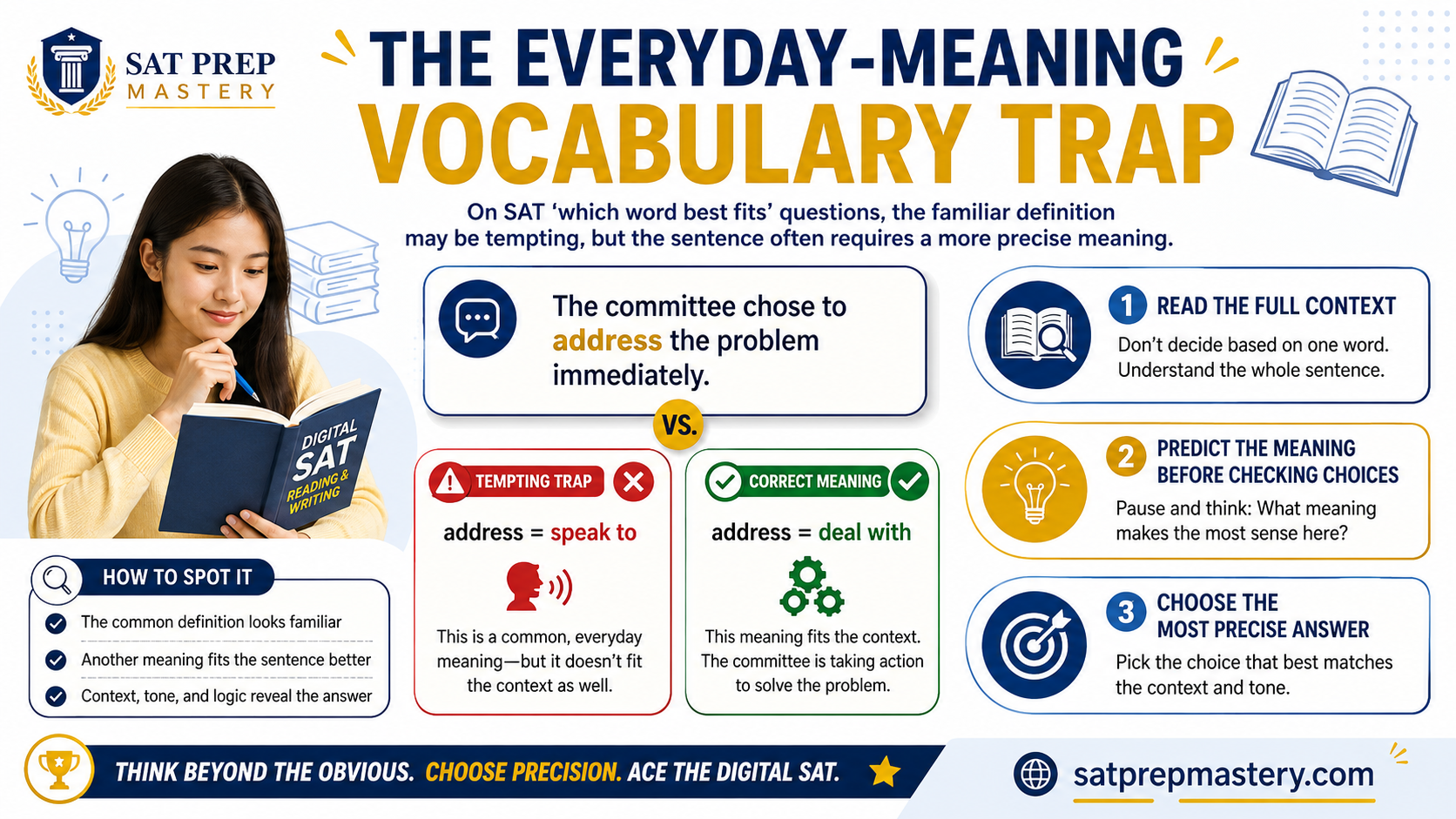
SAT Trap. Everyday-Meaning Vocabulary Trap on the SAT: How to Spot and Avoid It
On Digital SAT Words in Context questions, the correct answer is not necessarily the word's most familiar definition. The test asks you to choose the meaning that fits the sentence's logic, tone, and purpose — which is often a word's secondary or more precise sense. The safest method is to predict the needed meaning in your own words before you study the answer choices, then substitute each option back into the sentence and eliminate anything that is only loosely related. Precision wins; familiarity misleads.
Last verified: July 21, 2026
What Is the Everyday-Meaning Vocabulary Trap?
The everyday-meaning vocabulary trap happens when a word's most common, dictionary-first definition appears as an answer choice — and it is wrong. The passage requires a different, more exact sense of that word, and the familiar meaning is placed there specifically because students recognize it instantly and stop thinking.
Here is the trap in miniature:
Conservationists released sterile males in order to check the beetle population's growth.
If you know check as "to inspect" or "to look at," that meaning fits nothing here. In this sentence, check means to restrain or slow down. Students who recognize the everyday definition and reach for choices like inspect or examine lose the point — not because their vocabulary is weak, but because they answered from memory instead of from the sentence.
The SAT is not asking which definition you recognize first. It is asking which meaning works precisely in this passage.
This distinction sits at the heart of the SAT vocabulary in context trap, and it is the single most common reason strong readers miss questions in the opening stretch of each Reading and Writing module.
Where These Questions Appear on the Digital SAT
College Board organizes the Reading and Writing section into four content domains: Craft and Structure, Information and Ideas, Standard English Conventions, and Expression of Ideas. Words in Context questions live inside Craft and Structure, which College Board describes as measuring the skills needed to understand and use high-utility academic words and phrases in context.
A few structural facts worth knowing before you prep:
Each passage runs roughly 25 to 150 words and is followed by one multiple-choice question.
Passages draw on literature, history/social studies, the humanities, and science — so the vocabulary is academic, not obscure.
Questions testing similar skills are grouped together and arranged from easiest to hardest, which means vocabulary questions cluster near the start of a module and get progressively trickier.
The Reading and Writing section runs 64 minutes across two modules of 27 questions each, giving you a little over a minute per question on average.
That last point matters more than students expect. Because Digital SAT vocabulary questions are grouped and escalate in difficulty, the trap questions tend to land right where your pacing is still settling.
Why Strong Students Fall for This Trap
This trap is unusual because it punishes confidence. Students with large vocabularies fall for it more often than students who read carefully but know fewer words. Here is why.
Familiarity bias
Your brain retrieves the most-used definition of a word in a fraction of a second. That speed feels like knowledge. When a choice matches the definition you already hold, it produces a small click of recognition — and students mistake that click for correctness. The SAT builds distractors around exactly this reflex.
Reading too quickly
Words in Context questions look short, so students treat them as quick points and read only the sentence containing the blank. But the clue that determines the answer frequently sits in the sentence before or after. Skipping that sentence removes the very evidence that separates two plausible choices.
Choosing by sound
Some choices simply feel more "SAT-like" — longer, more academic, more impressive. Students select them because they sound like the kind of word a hard test would use. Sophistication is not a criterion. Fit is.
Ignoring surrounding sentences
A single sentence rarely carries enough information to pin down a precise meaning. Tone, contrast, and cause-and-effect signals usually appear in neighboring sentences. Reading the blank in isolation is like judging a puzzle piece without looking at the picture.
Knowing one definition but not secondary meanings
Words like qualify, sustain, command, register, reserve, check, address, and fine each carry multiple established meanings. Most students confidently know one. The SAT routinely tests the others — not to trick you, but because that is how these words genuinely function in academic writing.
Failing to predict before viewing choices
This is the root cause of all the others. Once you read four choices, they contaminate your thinking; each one starts to seem arguable. Predicting first gives you an independent standard to measure them against.
The Five-Step Method for Solving Vocabulary-in-Context Questions
Use this sequence every time. It converts a guessing situation into a matching situation.
1. Read the entire sentence and nearby context. Read the sentence with the blank plus at least one sentence on either side. You are hunting for the relationship the passage is building, not just the grammar of one line.
2. Identify the sentence's logic and tone. Ask what the sentence is doing. Is it contrasting two ideas? Explaining a result? Qualifying an earlier claim? Praising, criticizing, or staying neutral? Name the job before you name the word.
3. Predict a simple meaning in your own words. Cover the choices. Fill the blank with plain English — even clumsy plain English. "Slow down." "Push back on a little." "Have real skill in." Your prediction does not need to be elegant; it needs to be directionally exact.
4. Substitute each answer choice. Read the full sentence out loud in your head with each option inserted. Not the choice alone — the whole sentence. Many wrong answers only reveal themselves as wrong when they are sitting inside the sentence.
5. Select the most precise choice, not merely a possible one. On hard questions, two choices will both "work." One will work approximately; one will work exactly. The SAT always rewards the exact one.
Context first. Prediction second. Choices last.
Tape that somewhere. It is the whole strategy compressed into six words.
Clues That Reveal the Correct Meaning
Every Words in Context question contains a clue that makes the answer decidable. Learning to spot the clue type is what turns these from a vocabulary contest into a logic exercise.
Contrast words
Words like but, however, although, yet, despite, while, rather than, and nevertheless signal that the blank must oppose something nearby. If the previous clause is positive, the blank leans negative — and vice versa. Contrast words are the fastest clue on the test because they cut the choices in half instantly.
Cause-and-effect clues
Because, therefore, thus, since, as a result, consequently, and so tell you the blank either produces or results from the neighboring idea. Once you know the direction of causation, you can often predict the answer without knowing the tested word at all.
Tone
Academic passages carry attitude: admiring, skeptical, cautious, enthusiastic, neutral. A choice with the wrong emotional temperature is wrong even if its literal meaning is close. If a researcher is described as measured and careful, a word like decries is out regardless of how well it fits logically.
Examples and definitions
Passages frequently define the blank for you. Look for colons, dashes, appositives, and phrases like that is, in other words, such as, or specifically. When a sentence continues past the blank to explain itself, the explanation is your answer key.
Positive and negative connotations
Before choosing among finalists, tag each one with a plus, minus, or zero. Then tag what the sentence needs. Mismatches disappear. This is the single fastest elimination move under time pressure.
The grammatical role of the word
Ask what the word must do in the sentence. Is it acting on an object? Describing a noun? Modifying a verb? A word can have the right general meaning and still be impossible in the slot. You can sustain a food web, but a food web cannot endure something on behalf of others — the grammar rules it out before the meaning does.
Common Wrong-Answer Patterns
The Digital SAT builds distractors from a small, repeatable set of templates. Once you can name them, you can spot them.
The everyday definition. The word's most common meaning, offered as a choice, correct in a dictionary and wrong in this sentence.
A word related to the topic but wrong in context. The passage is about seismology, so a choice mentions transmitting signals. Topic association is not evidence.
A choice with the right tone but wrong meaning. It feels like it belongs — same temperature, same register — but it does not say what the sentence needs said.
A choice that is too broad. Technically compatible, but vague. If a choice would fit in fifty different sentences, it is probably not the answer to this one.
A choice that is too strong. Refutes when the passage says complicates. Halts when the passage says slows. Overstatement is the most common trap in history and science passages.
A technically possible but less precise choice. The hardest distractor type. It is defensible. It is just not the best. Precision is the tiebreaker.
A familiar word selected without substitution. Chosen on recognition alone, never actually tested inside the sentence.
Practice Questions
All examples below are original practice questions written for this article. They are not reproduced from College Board materials.
Example 1 — Science
Deep-sea hydrothermal vent communities receive no sunlight, yet they support dense populations of tube worms, crabs, and shrimp. Chemosynthetic bacteria, which convert dissolved minerals into chemical energy, ______ the entire food web.
Which choice completes the text with the most logical and precise word?
A) sustain B) endure C) tolerate D) withstand
Correct answer: A
Step by step: The bacteria act on the food web — they are the reason it exists without sunlight. Predict: "keep going" or "provide the energy for." Sustain carries exactly this sense of maintaining and supporting something over time.
Why the others tempt: All three distractors cluster around the everyday meaning of sustain as "to endure" (as in a sustained effort). Endure, tolerate, and withstand all mean putting up with hardship — they describe surviving something, not supplying something. A food web is not being tolerated here; it is being fed.
The exact clue: The grammatical role. The bacteria perform the action on "the entire food web" as a direct object. You cannot endure a food web.
Example 2 — History
For decades, textbooks credited the printing press with directly causing the Protestant Reformation. Recent scholarship does not overturn this account so much as ______ it, noting that rising literacy rates and pre-existing networks of religious dissent were equally necessary conditions.
Which choice completes the text with the most logical and precise word?
A) refutes B) qualifies C) certifies D) endorses
Correct answer: B
Step by step: The phrase "does not overturn... so much as" sets up a contrast: not rejection, but something gentler. Predict: "limits it a little" or "adds conditions to it." Qualify means precisely that — to modify a claim by adding limits.
Why the others tempt: Qualify's everyday meaning is "to be eligible" or "to meet requirements," which is why students hesitate to pick it here. Refutes is too strong and is directly contradicted by "does not overturn." Certifies plays on the eligibility sense of qualify. Endorses reverses the logic entirely.
The exact clue: The contrast construction "not X so much as Y." Whatever fills the blank must be weaker than overturning but stronger than agreeing.
Example 3 — Art
Though she received no formal academy training, Artemisia Gentileschi came to ______ a technical vocabulary of light and gesture that rivaled that of her workshop-educated contemporaries.
Which choice completes the text with the most logical and precise word?
A) command B) order C) dominate D) instruct
Correct answer: A
Step by step: The sentence contrasts her lack of formal training with the mastery she nonetheless achieved. Predict: "have full mastery of." Command carries this sense — to possess authoritative skill in something.
Why the others tempt: The everyday meaning of command is "to give orders," which generates order and instruct as distractors. Dominate sounds forceful and art-adjacent but takes the wrong kind of object — you dominate rivals, not a vocabulary.
The exact clue: The object is "a technical vocabulary." A person can master a vocabulary; a person cannot order or instruct one.
Example 4 — Environmental Studies
Because the invasive beetle had no natural predators on the island, biologists released thousands of sterilized males to ______ the population's growth without eradicating the species outright.
Which choice completes the text with the most logical and precise word?
A) check B) halt C) inspect D) examine
Correct answer: A
Step by step: The phrase "without eradicating the species outright" tells you the goal is partial restraint, not elimination. Predict: "slow down" or "hold back." Check means to restrain or curb.
Why the others tempt: Inspect and examine both mirror the everyday meaning of check and would be reasonable dictionary synonyms in another sentence. Halt has the right category of meaning but is too strong — it contradicts the explicit statement that the species is not being eliminated.
The exact clue: The qualifier "without eradicating the species outright" rules out any total-stop word.
Example 5 — Social Science
In field interviews, participants consistently displayed a marked ______, answering questions briefly and rarely volunteering personal detail — a pattern the researchers cautioned should not be misread as unfriendliness.
Which choice completes the text with the most logical and precise word?
A) reserve B) reservation C) confusion D) coldness
Correct answer: A
Step by step: The sentence describes a habitual manner: brief, private, restrained. Predict: "held-back quality." Reservenames exactly this trait of self-restraint in manner.
Why the others tempt: Reserve's everyday meanings — to book a table, to set something aside — make students distrust it as a noun describing personality. Reservation plays on both the booking sense and the "doubts" sense. Coldness has the right general temperature but is explicitly ruled out. Confusion misreads brevity as not understanding.
The exact clue: The closing clause, "should not be misread as unfriendliness," eliminates every negatively charged choice.
Example 6 — Technology
Modern broadband seismometers are engineered to ______ ground motions thousands of times fainter than any a person could feel, converting those minute displacements into digital signals.
Which choice completes the text with the most logical and precise word?
A) register B) enroll C) broadcast D) certify
Correct answer: A
Step by step: The instrument receives motion and turns it into data. Predict: "detect" or "pick up." Register means to detect and indicate a reading.
Why the others tempt: The familiar meaning of register is "to sign up," producing enroll and certify as distractors. Broadcast is technology-adjacent — it sounds like something an instrument does — but it describes sending information outward, the opposite direction of what the sentence describes.
The exact clue: "Converting those minute displacements into digital signals" defines the action as receiving and recording, not transmitting.
Example 7 — Literature
Morrison's later novels ______ questions of inherited memory and communal silence that her earliest fiction had approached only glancingly.
Which choice completes the text with the most logical and precise word?
A) address B) greet C) label D) direct
Correct answer: A
Step by step: The contrast is between glancing engagement and sustained engagement. Predict: "take on directly" or "deal with." Address means to engage with a subject deliberately.
Why the others tempt: The everyday senses of address — speaking to someone, writing an address on an envelope — generate greet, label, and direct. Each is a legitimate meaning of address in some context and none works with "questions" as the object.
The exact clue: The contrast with "only glancingly" requires a word meaning deeper, more direct engagement.
Example 8 — Economics
The difference between the two subsidy programs is a ______ one: both transfer identical sums to producers, but one disburses funds before the harvest and the other afterward.
Which choice completes the text with the most logical and precise word?
A) fine B) pleasant C) vast D) acceptable
Correct answer: A
Step by step: The colon defines the difference for you — identical amounts, different timing. That is a small, technical distinction. Predict: "subtle" or "slight." Fine means precisely that: delicately small, as in a fine distinction.
Why the others tempt: Fine's everyday meaning is "good" or "okay," which produces pleasant and acceptable. Neither describes a difference. Vast is directly contradicted by the explanation after the colon.
The exact clue: The colon. Everything after it defines the blank, and what it defines is a narrow technical gap.
Trap Comparison Table
Trap Situation | Tempting Student Reaction | Better Strategy | Context Clue to Check |
|---|---|---|---|
Familiar definition appears | Choose it immediately | Predict before selecting | Sentence purpose |
Two words seem possible | Pick the more familiar one | Compare precision | Tone and logic |
Word sounds academic | Assume it is correct | Substitute it directly | Grammar and meaning |
Passage topic matches a choice | Choose by association | Test the sentence itself | Nearby evidence |
Time is running out | Guess from memory | Eliminate imprecise meanings | Contrast or cause words |
A Fast 30-Second Decision Routine
When the clock is tight, compress the method into five moves:
Read before and after the blank. One sentence on each side, minimum.
Name the relationship. Contrast, cause, example, or definition — say it to yourself in one word.
Predict a plain-English meaning. Ugly is fine. Vague is not.
Eliminate choices with the wrong tone. Plus, minus, or neutral. Cut the mismatches.
Choose the most precise remaining answer. When two survive, pick the narrower one.
Practiced twenty or thirty times, this routine takes well under a minute and holds up even when you do not know one of the words in the choices.
How SAT Prep Mastery Helps Students Spot Traps
Recognizing a trap once is easy. Recognizing it reliably, at minute forty of a timed module, is a trained skill — and training it requires questions that are built around traps, plus feedback that explains the pull of every wrong answer.
That is the design principle behind SAT Prep Mastery. Instead of general reading drills, students work through targeted Reading and Writing practice weighted toward the exact patterns above: everyday-meaning distractors, too-strong choices, and topic-association bait. Difficulty scales into genuinely hard trap-based questions rather than plateauing at the comfortable middle.
Every question returns an immediate explanation, and the AI tutor allows follow-up questions in plain language — why was C tempting? or show me another one with a contrast clue — so a missed question becomes a short lesson rather than a red mark. Mistake analysis groups errors by pattern, which is how students discover that they are not "bad at vocabulary" but specifically vulnerable to too-strong answer choices. Adaptive recommendations then route practice toward that weakness, and progress tracking shows whether the pattern is actually closing.
Families who want structure can build a personalized SAT structured plan mapped to a target score and test date, or work with an online SAT tutor for the accountability piece that self-study often lacks.
The underlying philosophy is simple: students improve when they learn why an answer was tempting, not merely which letter was correct. A student who can articulate the pull of a distractor has learned something transferable. A student who only knows the answer key has learned one question.
Final Checklist
Run this after every Words in Context question you miss:
[ ] Did I read the full context, including the sentences around the blank?
[ ] Did I identify the tone and the logical relationship?
[ ] Did I predict the meaning first, before reading the choices?
[ ] Did I substitute every serious choice back into the sentence?
[ ] Am I choosing the most precise answer, not just a workable one?
[ ] Am I being distracted by the everyday meaning of the word?
If you miss a question and every box is checked, the issue is vocabulary knowledge. If any box is unchecked, the issue is method — and method is much faster to fix.
Frequently Asked Questions
What are Words in Context questions on the SAT? They are questions within the Craft and Structure domain of the Digital SAT Reading and Writing section that ask which word or phrase most logically and precisely completes a short passage, or what an underlined word means as used in the text. Each passage is short and paired with a single question. They typically appear at the start of each module.
Does the Digital SAT test obscure vocabulary? No. College Board describes this domain as testing high-utility academic words and phrases — the kind that recur across college-level reading. The difficulty comes from precision of usage, not rarity. You are far more likely to see a common word used in an uncommon sense than a word you have never encountered.
Should students memorize long vocabulary lists? Long lists of obscure words are a poor use of time. A better investment is studying multiple meanings of common academic words and reading nonfiction closely enough to see how those words behave in real sentences. Depth beats breadth for this question type.
How do I know when a word has a secondary meaning? Watch for the mismatch signal: you plug in the familiar definition and the sentence gets slightly awkward or the logic wobbles. That friction is the tell. Words that function as both noun and verb — check, address, reserve, register, command — are especially likely to be tested in a secondary sense.
What should I do when two choices seem correct? Return to the sentence's exact task and compare precision rather than plausibility. Ask which choice would be wrong if the sentence changed slightly — the more specific answer is usually correct. Check tone and strength as tiebreakers; overstated choices are the most common near-miss.
Should I read the whole passage? Yes, but the passages are short, so this costs little. Reading only the sentence with the blank is the most common cause of avoidable misses, because the deciding clue often sits in the neighboring sentence.
How can I solve these questions faster? Speed comes from prediction, not from skimming. Predicting a meaning before reading the choices means you evaluate four options against a fixed standard instead of debating them against each other. Students who predict consistently tend to finish these questions faster and more accurately.
Why is the familiar definition often wrong? Because it is placed there deliberately. Test writers build distractors from the meanings students retrieve fastest, since instant recognition suppresses careful reading. The familiar definition is not always wrong — but it is never right because it is familiar.
Can context clues always reveal the answer? In a well-constructed question, yes — there is always enough evidence in the passage to eliminate three choices. If you cannot find the clue, you have usually not read far enough around the blank, or you have not named the logical relationship the sentence is building.
How can an AI SAT tutor help with vocabulary traps? An AI tutor can explain not just the correct answer but the specific reason each wrong choice was appealing, then generate additional questions targeting the same trap pattern until the habit sticks. That immediate, pattern-level feedback is difficult to get from an answer key alone.
Keep Going: Digital SAT Reading and Writing Strategy
This article is part of a larger Reading and Writing strategy series. Work through the related guides in order:
Words in Context: The Complete Guide
SAT Transition-Word Traps
Main-Purpose Question Traps
Evidence-Question Traps
Grammar and Punctuation Traps
Digital SAT Reading and Writing Timing
The SAT Mistake-Analysis Guide
AI SAT Tutor
Personalized SAT Study Plan
Best Adaptive SAT Practice Platform
Learn to Recognize the Trap Before Test Day
The students who beat this trap are not the ones with the biggest vocabularies. They are the ones who built a habit of predicting before choosing — and who practiced on questions designed to punish shortcuts.
References
College Board, The Reading and Writing Section — SAT Suite: https://satsuite.collegeboard.org/sat/whats-on-the-test/reading-writing
College Board, How the SAT Is Structured: https://satsuite.collegeboard.org/sat/whats-on-the-test/structure
College Board, Digital SAT Suite of Assessments Specifications Overview: https://satsuite.collegeboard.org/media/pdf/digital-sat-test-spec-overview.pdf
College Board, Student Question Bank: Reading and Writing Questions: https://satsuite.collegeboard.org/practice/student-question-bank/reading-writing
College Board, Bluebook application — official full-length adaptive practice tests with answer rationales
All practice questions in this article are original and were written specifically for SAT Prep Mastery. No College Board test items are reproduced.