SAT Transition Word Trap: Why "Sounds Right" Is Often Wrong
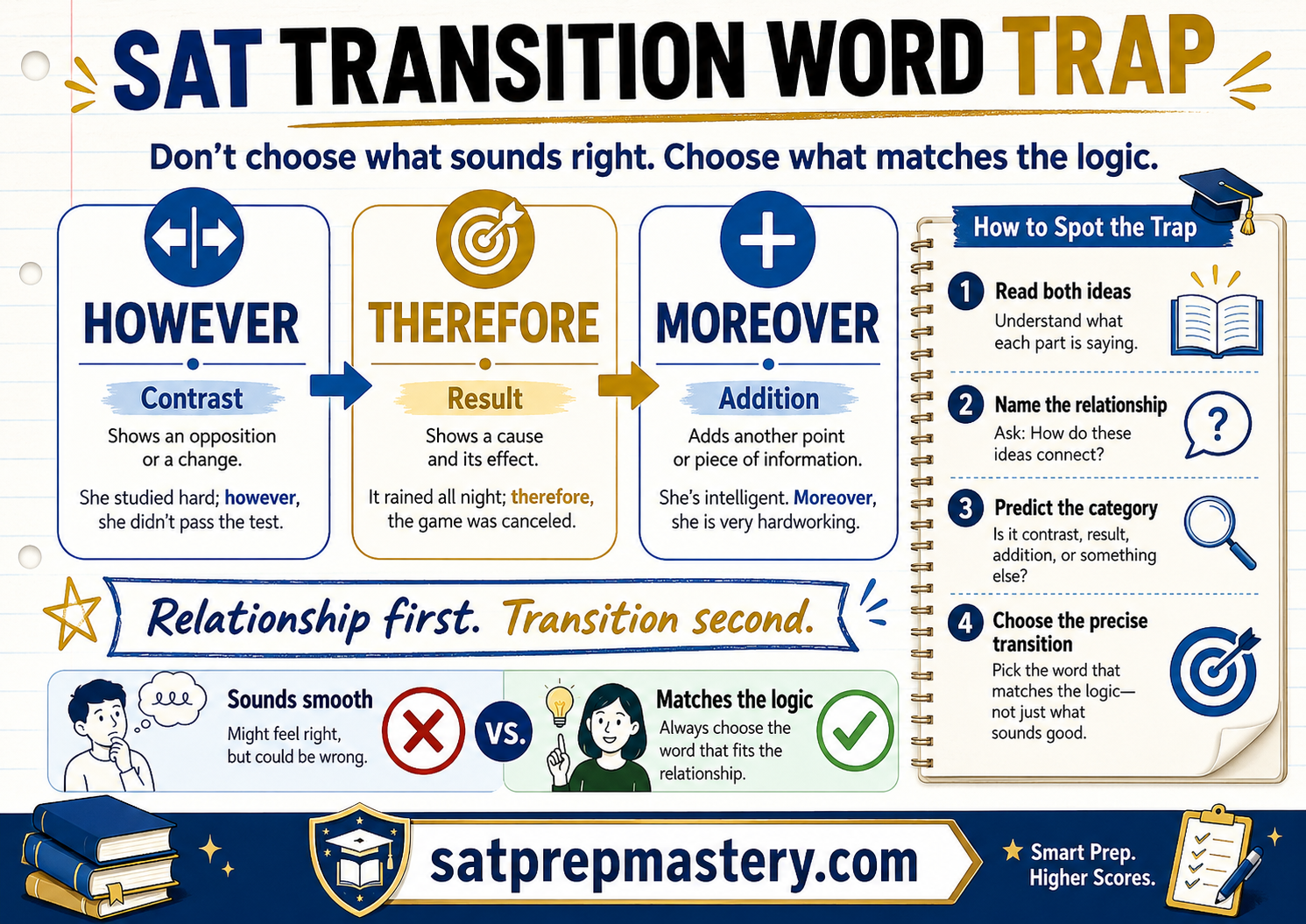
Students should not choose a transition because it sounds smooth. The correct method is to identify the exact logical relationship between the two ideas first, describe that relationship in plain English, and only then choose the transition that matches it. "However" signals contrast, "therefore" signals a result, and "moreover" adds supporting information in the same direction — and none of them are interchangeable just because they sound similarly formal.
Relationship first. Transition second.
Last verified: July 21, 2026
What Is the "Sounds Right" Transition Trap?
The "sounds right" trap happens when a transition reads smoothly in the sentence — grammatically clean, formal in tone, comfortable to the ear — but describes the wrong logical relationship between the two ideas it connects.
Here's a compact example:
The city's new bus routes cut average commute times by nearly a third. However, ridership increased sharply in the first year.
"However" sounds natural here — it's a common, formal-sounding transition, and nothing about the grammar is wrong. But nothing in the second sentence contradicts or limits the first. Faster commutes and higher ridership move in the samedirection; one plausibly explains the other. The accurate transition is something like "as a result" or "consequently," not "however." A student reading by ear will often miss this, because "however" simply sounds like the kind of word that belongs in a serious sentence.
The SAT is not testing which transition sounds most polished. It is testing which transition accurately describes the relationship between the ideas.
This is the core of the SAT transition word trap, and it is one of the most consistent point-losers in the Expression of Ideas domain — precisely because these questions look easy at a glance.
Where Transition Questions Appear on the Digital SAT
Transitions are one of two skills tested inside the Expression of Ideas content domain of the Digital SAT Reading and Writing section (the other is Rhetorical Synthesis). College Board describes Expression of Ideas questions as measuring the ability to revise texts to improve written expression and meet specific rhetorical goals.
A few structural facts worth knowing as you prep:
Transition questions present a short passage — usually just two or three sentences — with a blank where a connecting word or phrase belongs.
You are asked to choose the word or phrase that most logically connects the surrounding sentences, not the one that merely sounds fluent.
Questions testing similar skills are grouped together and arranged from easiest to hardest, so transition questions cluster together within a module.
Because the surrounding passage is brief, every word in it is doing work — there usually isn't a throwaway sentence to skip.
That brevity is exactly why the trap is effective. With only two or three sentences to read, students often read them too quickly, absorb the general topic, and reach for whichever transition feels stylistically appropriate rather than logically exact.
Why Students Fall for This Trap
This trap catches capable students specifically because it rewards a habit that works well in casual writing and fails on the SAT.
Reading by sound instead of logic
Years of writing practice train students to insert transitions that "flow." That instinct is useful for essays and useless here, because SAT distractors are built to flow just as smoothly as the correct answer.
Memorizing transitions without categories
Many students learn transition words as a flat list — however, therefore, moreover, meanwhile — without organizing them by what they actually do. Without categories, there's no framework to check a choice against; there's only a vague sense of "this fits."
Looking at the answer choices too early
Reading the choices before fully processing the two ideas lets the choices frame your thinking. Once you've seen "however" and "therefore" side by side, it's tempting to pick whichever one your gut prefers instead of independently deciding what relationship the sentence needs.
Failing to read the sentence before and after the blank
Some students read only up to the blank and guess from there. The relationship can't be determined from one side; you need both ideas fully in view.
Confusing contrast with concession
Contrast and concession are close cousins, and many students treat them as one category. They're related but not identical — more on this below.
Confusing cause with sequence
"This happened, then that happened" is not the same claim as "this caused that." Treating sequence as automatic causation is one of the most common transition errors on the test.
Choosing a formal-sounding word
"Nevertheless," "furthermore," and "consequently" all sound appropriately academic. Sounding academic is not a selection criterion — matching the logic is.
Treating similar transitions as interchangeable
Not every contrast word means the same thing, and not every addition word means the same thing. "However" and "nevertheless" both signal contrast, but they aren't always swappable — a careful reader needs to know when the difference matters.
The Five-Step Method for Solving SAT Transition Questions
1. Read the sentence before and after the blank. Get both full ideas into view before you think about answer choices at all.
2. Summarize each idea in simple language. Reduce each sentence to its core claim, in your own plain words. Strip out details that don't affect the logical relationship.
3. Name the relationship between the ideas. Say it as one word or short phrase: contrast, result, addition, example, concession, sequence, comparison, clarification.
4. Predict a transition category. Before reading the choices, know what kind of word you're looking for — not the exact word, just its job.
5. Choose the option that matches the relationship precisely. When more than one choice comes from the right category, pick the one that fits most exactly, not merely acceptably.
Do not ask, "Which word sounds best?" Ask, "What is the second idea doing in relation to the first?"
The Main SAT Transition Categories
Logical Relationship | What the Second Idea Does | Common Transitions | Plain-English Test |
|---|---|---|---|
Addition / Continuation | Adds another point in the same direction | moreover, additionally, furthermore, also | "And here's another thing that supports this." |
Contrast | Opposes or differs from the first idea | however, in contrast, conversely, on the other hand | "But that's not what happened / not true here." |
Concession | Acknowledges a fact, then holds the original point anyway | although, even so, nevertheless, despite this | "That's true, but it doesn't change the conclusion." |
Cause and Effect | Is caused by or explains the first idea | because, since, due to | "This happened for that reason." |
Result / Conclusion | Follows logically as an outcome | therefore, consequently, as a result, thus | "So, in the end, this is what followed." |
Example / Illustration | Gives a specific instance of the first idea | for example, for instance, specifically | "Here's a concrete case of that." |
Clarification / Restatement | Says the same idea more precisely | in other words, that is, put simply | "To say that another way..." |
Emphasis | Underlines the importance of the first idea | indeed, in fact, certainly | "And this really matters." |
Sequence / Time | Marks order or timing, not logic | meanwhile, subsequently, afterward | "This happened next, not necessarily because of it." |
Comparison | Shows similarity between two things | similarly, likewise, in the same way | "This other thing works the same way." |
Transitions within the same broad category still differ in precision and tone. "However" and "nevertheless" are both contrast words, but "nevertheless" specifically carries a sense of despite an obstacle — closer to concession — while "however" is a more general pivot. Treating every word in a category as fully interchangeable will still cost you points on harder questions.
However vs. Therefore vs. Moreover
These three are the test's most frequently used transitions, and distinguishing them cleanly resolves a large share of transition questions.
However
"However" introduces contrast or an unexpected difference. The second idea pushes back against, limits, or diverges from the first.
Example: The lecture hall was nearly empty at nine in the morning. However, by noon every seat was filled.
Therefore
"Therefore" introduces a result or conclusion that follows from the first idea. The second idea is caused by or logically supported by the first.
Example: The bridge inspection found significant rust on the support cables. Therefore, the city closed the bridge to traffic.
Moreover
"Moreover" adds another supporting point in the same direction as the first idea. The second idea reinforces rather than opposes or concludes.
Example: The new vaccine reduced hospitalization rates significantly. Moreover, it produced no serious side effects in trials.
Ask This Question | If Yes, Consider |
|---|---|
Does the next idea oppose or limit the first? | However or another contrast transition |
Does the next idea result from the first? | Therefore or another result transition |
Does the next idea add another supporting point? | Moreover or another addition transition |
Contrast vs. Concession
Contrast and concession are related — both involve some form of tension between ideas — but they aren't identical, and mixing them up costs points on harder questions.
Contrast (however, in contrast, conversely) simply states that two ideas differ or point in opposite directions. There's no admission involved; the second idea just isn't aligned with the first.
Concession (although, nevertheless, even so, despite this) does something more specific: it acknowledges a fact or objection, and then asserts that the main point remains true anyway. Concession has a built-in structure of "yes, but still."
Contrast: Sales in the northern region declined. In contrast, sales in the southern region rose sharply. Concession:Although sales in the northern region declined, the company's overall profit increased.
Notice the difference: contrast places two facts side by side without one undermining the other's importance. Concession specifically frames the first idea as a potential objection that the second idea overcomes.
Cause, Result, and Sequence Are Not the Same
Because, therefore, and consequently all point to a causal link. Then, subsequently, and meanwhile only point to timing. Mixing these up — assuming that because one event follows another, the first must have caused the second — is one of the most common logical traps on the exam, not just a vocabulary issue.
Sequence, no causation: The museum renovated its west wing in 2019. Meanwhile, attendance at the east wing exhibits held steady. Causation: The museum renovated its west wing in 2019. As a result, overall attendance rose by twenty percent the following year.
In the first example, two things happened around the same time, but nothing in the passage claims one caused the other — "meanwhile" correctly signals simultaneity, not consequence. In the second, the passage explicitly frames a change in attendance as an outcome of the renovation, so a result word is required. If the passage doesn't state or clearly imply causation, don't supply it yourself by picking "therefore."
Common Wrong-Answer Patterns
The transition sounds formal. Words like "nevertheless" and "furthermore" carry academic weight that can substitute for actual logical fit in a rushed reading.
The word belongs to the wrong logical category. A contrast word offered where the sentence needs a result word, or vice versa.
The transition describes the topic but not the relationship. Both sentences are about the same subject, so an addition word feels safe — even when the second sentence actually contradicts the first.
The choice is grammatically correct but logically inaccurate. Every choice will read as a complete, proper sentence. Grammar never disqualifies a wrong answer here; only logic does.
Two transitions are similar, but one is more precise. "However" versus "nevertheless," or "therefore" versus "thus" — usually interchangeable, but not always, especially when concession is specifically in play.
The student assumes chronology means causation. Covered above — one of the highest-frequency errors on harder questions.
The student misses a contrast word inside the sentence. If a sentence already contains "but" or "yet" internally, that changes what relationship the blank needs to complete.
The student chooses "however" whenever the ideas differ slightly. Not every difference in emphasis is a true contrast; sometimes it's just a shift in focus, better served by a neutral transition or none of the tested categories at all.
The student chooses "therefore" without proving cause or conclusion. If the passage never actually connects the two ideas causally, supplying "therefore" invents a link the author didn't make.
Original SAT-Style Practice Questions
Original practice questions written for this article.
Question 1 — Science
Researchers tagged over two hundred migratory songbirds with lightweight GPS trackers. ______, the birds' flight paths varied far more than expected, with some individuals traveling nearly a thousand miles off the predicted route.
A) Moreover B) Surprisingly C) Therefore D) Similarly
Correct answer: B
Relationship: The second sentence presents an unexpected finding, not an addition, result, or comparison — the surprise itself is the point.
Trap alert: "Moreover" tempts students because both sentences are about the same study, but the second idea isn't adding supporting evidence — it's an unexpected outcome. "Therefore" wrongly implies the tagging caused the variation. "Similarly" has no comparison target.
Question 2 — History
Colonial tax records from the 1750s were long assumed to be lost. ______, a routine archive digitization project uncovered nearly complete ledgers in a previously uncatalogued collection.
A) However B) Consequently C) In other words D) Similarly
Correct answer: A
Relationship: Contrast — records were assumed lost, but they were in fact found.
Trap alert: "Consequently" wrongly implies the assumption caused the discovery. "In other words" would require the second sentence to restate the first, not contradict it. "Similarly" requires a parallel case, not a reversal.
Question 3 — Literature
Early reviewers dismissed the novel's fragmented structure as a flaw. ______, contemporary critics argue that the fragmentation itself mirrors the protagonist's disjointed memory.
A) In contrast B) For example C) Meanwhile D) Indeed
Correct answer: A
Relationship: Contrast between two critical eras — dismissal versus reinterpretation.
Trap alert: "Meanwhile" wrongly implies simultaneity between two eras separated by time. "For example" would require the second idea to illustrate the first, not oppose it. "Indeed" would require agreement with the first idea, not reversal.
Question 4 — Economics
The central bank raised interest rates for the third consecutive quarter. ______, consumer borrowing slowed and mortgage applications fell to a five-year low.
A) Nevertheless B) As a result C) For instance D) Meanwhile
Correct answer: B
Relationship: Cause and effect — the rate increase is presented as the reason for the slowdown.
Trap alert: "Nevertheless" wrongly frames the second idea as happening despite the first, when it's actually caused by it. "Meanwhile" strips out the causal link and reduces it to mere timing. "For instance" would require the second sentence to be a specific case of the first, not a consequence.
Question 5 — Art
The mural's restoration required removing several layers of overpainting added in the 1960s. ______, conservators had to develop a new solvent gentle enough not to damage the original pigment beneath.
A) Additionally B) However C) In other words D) For example
Correct answer: A
Relationship: Addition — a second related fact about the same restoration project, same direction.
Trap alert: "However" wrongly assumes conflict where there's simply a second challenge being described. "In other words" would require restating the first idea, not adding a new one. "For example" would need the second sentence to be a specific instance, not a separate development.
Question 6 — Psychology
Participants who journaled nightly reported no measurable change in sleep quality after four weeks. ______, participants who journaled and also reduced screen time before bed showed significant improvement.
A) Similarly B) In contrast C) Consequently D) Specifically
Correct answer: B
Relationship: Contrast between two groups with different outcomes.
Trap alert: "Similarly" wrongly suggests the two groups had the same result. "Consequently" wrongly implies the first group's lack of change caused the second group's improvement. "Specifically" would require the second sentence to narrow or detail the first, not present a different outcome.
Question 7 — Environmental Studies
Wetland restoration projects are often criticized as slow and expensive. ______, a decade-long study found that restored wetlands recovered ninety percent of their original biodiversity within just six years.
A) Indeed B) However C) Meanwhile D) Likewise
Correct answer: B
Relationship: Contrast — a criticism is presented, then countered by evidence.
Trap alert: "Indeed" wrongly implies agreement with the criticism rather than a pushback against it. "Meanwhile" reduces the relationship to simultaneity, losing the pushback entirely. "Likewise" would require a similar, not opposing, claim.
Question 8 — Technology
Early voice-recognition software struggled badly with regional accents. ______, current systems trained on far larger and more diverse audio datasets handle accented speech with over ninety-five percent accuracy.
A) Similarly B) In contrast C) For example D) Subsequently
Correct answer: B
Relationship: Contrast between an old limitation and a present-day improvement.
Trap alert: "Similarly" wrongly implies the two systems perform alike. "For example" would require the second sentence to illustrate the first, not reverse it. "Subsequently" captures timing but drops the fact that performance actually changed for the better — the passage needs the contrast marked, not just the sequence.
Example Trap Walkthrough
Passage: The startup's first product failed to gain traction after launch. Within a year, the founders had pivoted to an entirely different market and secured their largest contract to date.
Question: Which choice most logically completes the text? A) However B) Therefore C) For example D) Meanwhile
Step 1: State the first idea
The first product did not succeed.
Step 2: State the second idea
The company changed direction and later won a major contract.
Step 3: Name the relationship
This isn't a simple contrast (the sentence isn't saying "but the opposite happened right away") and it isn't a strict result (the passage doesn't say the failure directly caused the pivot to succeed — it describes a shift in strategy and a later outcome). It's closest to result following from a response to the first event — the company's course correction produced a positive outcome. "Therefore" fits because the sentence frames the pivot and success as flowing from the initial failure prompting a change in approach.
Step 4: Eliminate wrong categories
"For example" fails immediately — the second sentence isn't a specific instance of the first, it's a different event. "Meanwhile" fails because there's no simultaneity being described; the passage is sequential and causally linked, not two things happening at once. "However" is the trap: a student reading by ear might reach for it because the story appears to "turn around," but nothing in the second sentence contradicts or limits the first — it's a consequence of the company responding to it, not an opposing fact.
Step 5: Select the precise transition
Therefore — or a similar result transition — best captures a company's failure leading, through action taken in response, to eventual success. A student relying only on the story's dramatic turnaround would likely pick "however," mistaking a narrative reversal for a logical contradiction.
Transition Trap Comparison Table
Trap Situation | Tempting Student Reaction | Better Strategy | Logical Clue to Check |
|---|---|---|---|
Transition sounds smooth | Choose it immediately | Name the relationship first | Agreement or opposition |
Ideas mention the same topic | Choose "moreover" | Determine whether the ideas support or contrast | Direction of the second idea |
Second sentence follows the first | Choose "therefore" | Check whether the first idea actually causes the second | Cause and result |
Negative idea appears | Choose "however" | Check whether the second idea truly reverses the first | Contrast |
Two choices seem similar | Choose the more familiar one | Substitute both and compare precision | Exact function |
Time is running out | Read choices repeatedly | Paraphrase the relationship in one word | Contrast, result, addition, or example |
A Fast 20-Second Transition Routine
Read both ideas. Both sides of the blank, in full.
Say "same direction," "opposite direction," "result," or "example." One label, out loud in your head.
Eliminate transitions from all other categories. This alone usually leaves two choices.
Substitute the remaining choice. Read the full passage with it inserted.
Confirm that the logic, not only the sound, works. If it only sounds right, keep checking.
How SAT Prep Mastery Helps Students Recognize Transition Traps
Naming a logical relationship correctly under a timer is a trained reflex, not a one-time insight — which is why practice built specifically around trap patterns matters more than generic transition drills.
SAT Prep Mastery is built around that principle. Its targeted Reading and Writing practice is weighted toward the exact traps covered here: sound-alike distractors, sequence-versus-causation confusion, and contrast-versus-concession mixups. Difficulty scales into genuinely hard trap-based questions instead of leveling off at easy ones, and every question returns an immediate explanation.
The AI tutor allows natural follow-up — why is "however" wrong here? or give me another cause-and-effect question — so a missed question becomes a short, specific lesson. Mistake analysis groups errors by pattern rather than by right-or-wrong, which is how a student discovers they're not "bad at transitions" generally, but specifically prone to mistaking sequence for causation. Adaptive recommendations route further practice toward that exact gap, and progress tracking shows whether it's actually closing over time.
Families looking for structure can build a personalized SAT structured plan around a target score and timeline, or work with an online SAT tutor for the weekly accountability that keeps a self-study plan on track.
Practice that requires a student to name the logical relationship out loud — even mentally — before selecting an answer builds the habit that beats this trap for good. Students need to understand why a tempting transition is wrong, not merely memorize the correct answer letter.
Final Student Checklist
[ ] Did I read both sides of the blank?
[ ] Can I summarize both ideas in plain language?
[ ] Is the relationship addition, contrast, result, example, or sequence?
[ ] Did I predict the category before choosing?
[ ] Am I choosing by logic rather than sound?
[ ] Does the transition make the relationship precise?
[ ] Did I mistake chronology for causation?
[ ] Can I explain why the other choices are wrong?
Frequently Asked Questions
What are transition questions on the Digital SAT? They're part of the Expression of Ideas content domain in the Reading and Writing section. A short passage — typically two or three sentences — has a blank, and you choose the word or phrase that most logically connects the ideas around it.
How do I know whether to use however or therefore? Ask what the second idea does to the first. If it opposes, limits, or differs from it, that's contrast — "however." If it follows as a caused outcome or logical conclusion, that's result — "therefore." The two categories are opposites, so getting the direction right eliminates one immediately.
What is the difference between however and nevertheless? Both signal contrast, but "nevertheless" carries a stronger sense of concession — the first idea is acknowledged as a real obstacle or objection, and the second idea holds true despite it. "However" is the more general, all-purpose contrast word.
When should I use moreover? Use it when the second idea reinforces or supports the first in the same direction — an additional point, not a turn or a conclusion. If the second sentence could just as easily start with "and here's another reason," moreover likely fits.
Does therefore always show cause and effect? It shows a result or conclusion that follows logically from the first idea — which is a form of cause and effect, but the SAT expects the passage to actually support that link. Never supply "therefore" just because two sentences appear next to each other; the causal connection needs to be present in the text.
What should I do when two transitions seem correct? Compare precision, not plausibility. Reread both ideas and ask which transition captures the relationship exactly rather than approximately — often one choice is a close cousin (like "however" versus "nevertheless") that fits a slightly different shade of the same category.
Should I memorize SAT transition words? Memorizing a raw list has limited value. It's far more useful to memorize the categories — contrast, result, addition, concession, sequence, example — and know two or three common words for each, since the test rewards identifying the relationship over recognizing a word.
How can I answer transition questions faster? Predicting the category before looking closely at the choices is the biggest speed gain. Once you know you need a contrast word, you can scan four choices and eliminate non-contrast options almost instantly.
Why does the SAT include several grammatically correct choices? Because grammar was never the test. Every answer choice in a transition question typically forms a complete, correct sentence — the differentiator is always logical fit, which is exactly why reading by "sound" fails on harder questions.
Can an AI SAT tutor help with transition questions? Yes — an AI tutor can walk through why a specific wrong transition felt tempting, point out the exact clue in the passage that rules it out, and generate more questions targeting the same relationship type until the pattern is reliably recognized.
Keep Going: Digital SAT Reading and Writing Strategy
This article is part of a larger Reading and Writing strategy series. Related guides in this silo:
Everyday-Meaning Vocabulary Trap
Words in Context: The Complete Guide
Main-Purpose Question Traps
Evidence-Question Traps
Rhetorical Synthesis Questions
Grammar and Punctuation Traps
Digital SAT Reading and Writing Timing
The SAT Mistake-Analysis Guide
AI SAT Tutor
Personalized SAT Study Plan
Best Adaptive SAT Practice Platform
Learn the Logic Before Test Day
References
College Board, The Reading and Writing Section — SAT Suite: https://satsuite.collegeboard.org/sat/whats-on-the-test/reading-writing
College Board, How the SAT Is Structured: https://satsuite.collegeboard.org/sat/whats-on-the-test/structure
College Board, Digital SAT Suite of Assessments Specifications Overview: https://satsuite.collegeboard.org/media/pdf/digital-sat-test-spec-overview.pdf
College Board, Student Question Bank: Reading and Writing Questions: https://satsuite.collegeboard.org/practice/student-question-bank/reading-writing
College Board, Bluebook application — official full-length adaptive practice tests with answer rationales
All practice questions in this article are original and were written specifically for SAT Prep Mastery. No College Board test items are reproduced.