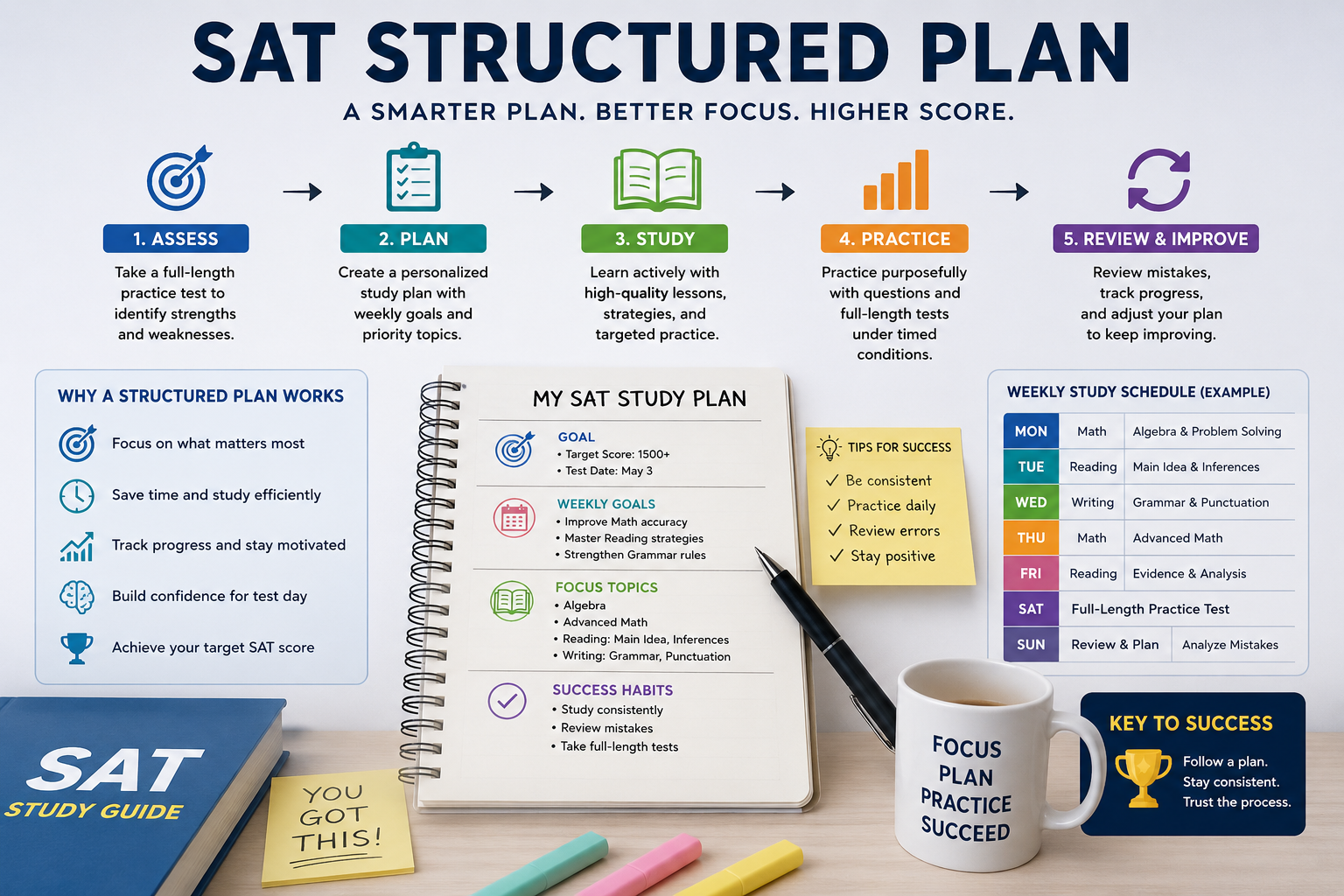
SAT Structured Plan: How to Build a Study Plan That Actually Raises Your Score
Students spend hundreds of hours preparing for the SAT. Yet most walk into test day with a score far below their potential — and it's almost never because they aren't smart enough.
They don't lack intelligence. They lack a structured plan.
Random studying — opening a prep book to whatever chapter looks interesting, grinding easy questions that feel good, cramming the week before — burns enormous amounts of time while barely moving your score. Without a plan, you spend most of your hours reviewing what you already know and avoiding the exact skills that are costing you points.
The best SAT preparation today looks completely different: personalized and adaptive. Your study plan is built around your diagnostic results, updates as your skills change, and directs every study session toward the questions with the highest score payoff. That's the philosophy behind the Structured Plan from SAT Prep Mastery — and this guide explains exactly how structured SAT preparation works, what top scorers actually do, and how to build a plan for your own timeline.
Those who scored 1500+ on the SAT, what did your study plan look like?
Read enough score reports from 1500+ scorers and a striking pattern emerges: almost none of them studied more hours than average students. They studied differently. Their plans share six traits:
Consistency over intensity. Nearly every top scorer describes 45–90 minutes most days for 2–4 months — not weekend marathons. Daily contact with the material keeps skills warm and makes spaced review possible.
Adaptive practice. They didn't work through books front to back. They practiced hardest where they were weakest, and moved on quickly from mastered skills.
Ruthless mistake review. The near-universal habit: every missed question got analyzed. Why did I miss this — concept gap, careless slip, or timing? Top scorers often spent as much time reviewing errors as doing new questions.
Regular full-length practice tests. Typically every 1–2 weeks, under real timing, followed by deep review. Practice tests weren't just measurement — they were the primary diagnostic that reshaped the next week's plan.
Weakness tracking. Whether in a spreadsheet or a notebook, they tracked misses by question type, so "study Reading" became "drill transition questions and command-of-evidence."
Quality over quantity. Fifty questions reviewed deeply beat two hundred questions rushed. Volume without reflection is the most common way students waste a hundred hours.
Notice what this list really is: a feedback loop. Practice → analyze → target weaknesses → re-test → repeat.
That loop is precisely what the SAT Prep Mastery Structured Plan automates. It tracks every question you answer, classifies your misses, and rebuilds your weekly roadmap around your actual weaknesses — the same system 1500+ scorers built manually, running for you in the background.
Any tips on how to make a structured plan?
Yes — and the good news is that an effective SAT prep schedule follows a repeatable formula. Here's how to build one from scratch.
Start with a diagnostic, then set a goal
Take one full-length digital SAT practice test before planning anything. Your plan should be built on data, not vibes. Then set two numbers: your goal score, and your test date. The gap between your diagnostic and your goal determines how aggressive the plan needs to be.
Plan monthly, then weekly
Monthly level: assign each month a theme. Month 1: rebuild weak fundamentals. Month 2: mixed practice and timing. Final month: full tests and polish.
Weekly level: every Sunday, look at last week's data and assign specific skills to specific days. A good week names the exact question types you'll drill — not just "do math."
Prioritize weak areas (but don't abandon strengths)
Roughly 60–70% of study time should go to your weakest skill domains, because that's where points are cheapest. The remaining time maintains strengths so they don't decay.
Balance Math and Reading & Writing
Touch both sections every week, even if unevenly. A common structure: alternate primary focus by day (Math-heavy Monday/Wednesday/Friday, Reading & Writing Tuesday/Thursday), with 15 minutes of the other section as a warm-up.
Schedule practice tests — and recovery
Put full-length tests on the calendar every 1–2 weeks, each followed by a dedicated review session the next day. And build in one true rest day per week. Recovery days aren't laziness; they prevent the burnout spiral that kills most self-made plans by week three.
Why AI-generated plans beat handwritten schedules
A handwritten SAT prep calendar has one fatal flaw: it's static. It reflects what you knew about yourself the day you wrote it. Two weeks later, your weaknesses have changed — but the plan hasn't. Most students either follow an outdated plan or abandon it entirely.
An AI-generated structured plan updates itself. Every practice session feeds the system new data, and next week's roadmap reflects who you are now. That's the core difference between a schedule and the adaptive Structured Plan: one is a document, the other is a feedback loop.
One month SAT study plan
Can you meaningfully improve in one month? Yes — if the month is structured. A focused 30-day plan typically suits students within 50–150 points of their goal. Here's a realistic week-by-week digital SAT study plan assuming 1.5–2 hours per day, six days a week.
Week 1: Diagnose and target
Day 1: Full-length practice test under real timing
Days 2–3: Deep error review — classify every miss by skill and cause
Days 4–6: Targeted practice on your two weakest Math skills and two weakest Reading & Writing skills
Day 7: Rest
Week 2: Rebuild fundamentals
Math (3 days): Drill weak domains (commonly linear equations, systems, or problem-solving & data analysis), 25–35 questions per session with full review
Reading & Writing (3 days): Grammar rules and your weakest question types (transitions, punctuation, evidence), plus one timed module
Daily: 10-minute review of this week's error log
Week 3: Mixed practice and timing
Days 1–2: Timed section modules, alternating Math and Reading & Writing
Day 3: Full-length practice test
Day 4: Complete test review — update your weakness list
Days 5–6: Adaptive practice on whatever the test exposed
Day 7: Rest
Week 4: Sharpen and taper
Days 1–3: Hard-question drills in your remaining weak spots; timing strategy for your slower section
Day 4: Final full-length practice test
Day 5: Light review of error log and key rules — no new content
Day 6: Rest, logistics, early night
Day 7: Test day
Callout: The one-month reality check A month is enough to fix targeted weaknesses and timing — it is rarely enough to rebuild deep content gaps of 200+ points. If your gap is larger, start earlier or adjust your goal.
The hardest part of a one-month plan isn't the schedule — it's knowing which skills deserve your limited days. That prioritization is exactly what the SAT Prep Mastery platform's diagnostics and adaptive recommendations handle automatically, which matters most when every day counts.
Do you follow a study plan or figure it out as you go?
This question splits students into two camps — and the score data overwhelmingly favors one of them.
What "figuring it out as you go" actually costs
Random studying feels flexible, but it quietly taxes you three ways:
Decision fatigue. Every session starts with "what should I study today?" That decision drains the exact mental energy you needed for the studying itself — and often ends with picking whatever feels easiest.
Comfort-zone drift. Without a plan, humans gravitate toward practice that feels good: questions we already get right. It's satisfying, and it improves nothing.
Invisible progress. With no tracking, you can't tell whether you're improving, which kills motivation. Most "as I go" studiers quit not because prep is hard, but because they can't see it working.
What organized studying changes
A structured plan flips each of those:
Sessions start instantly, because the plan already decided what today is for.
Weak areas get scheduled deliberately, so avoidance can't happen by default.
Progress is visible week over week — and visible progress is the single most reliable motivator in test prep.
The honest answer to this Reddit question: students who "figure it out" usually plateau after their early easy gains. Students who follow a structured plan keep improving, because their time keeps flowing to the highest-value work. Structure doesn't have to mean rigidity, though — a good plan flexes around your life. That's why the Structured Plan rebuilds itself weekly instead of locking you into a calendar you wrote a month ago.
6-week SAT study plan
Six weeks is the sweet spot for many students: long enough for real skill-building, short enough to sustain intensity. Here's a complete roadmap at 1.5–2 hours a day, six days a week, with intensity that ramps up as test day approaches.
Week | Priority | What it looks like |
|---|---|---|
1 | Diagnose | Full practice test, deep error analysis, identify your 4–6 weakest skills |
2 | Foundations | Concept rebuilding in weak domains; untimed accuracy first; daily error-log review |
3 | Targeted volume | Higher question volume in weak skills; first timed modules; practice test #2 at week's end |
4 | Mixed + timing | Alternating timed Math and Reading & Writing modules; medium-hard difficulty; review cycle on weeks 1–3 material |
5 | Test simulation | Practice tests #3 and #4 under full test-day conditions; review sessions after each; hard-question drills between |
6 | Sharpen + taper | Weak-spot polish early in the week, light review mid-week, rest before test day |
Three principles make this roadmap work:
Increasing intensity. Difficulty and timing pressure rise gradually. Starting with full timed tests every week burns students out; starting untimed and adding pressure builds durable skill.
Review cycles. Every week includes scheduled review of earlier material. Skills you learned in week 2 will quietly decay by week 5 unless the plan deliberately resurfaces them — this is spaced repetition, and it's non-negotiable.
Protected recovery. One rest day per week, plus a genuine taper in the final days. Fatigued students underperform their ability by 30–50 points.
Why personalized beats generic
Here's the catch with any template — including this one: it doesn't know you. A generic 6-week SAT study plan assumes average weaknesses, average pacing, and average available time. If your algebra is strong but your punctuation is a disaster, half a generic plan is wasted on you.
A personalized SAT study plan starts from your diagnostic and reallocates every hour toward your actual gaps. That's the difference between following a plan and following your plan — and it's why SAT Prep Mastery's Structured Plan generates your roadmap from your own performance data rather than handing everyone the same calendar.
1500+ students, how did you structure your studying?
We covered what top scorers' plans contained earlier. Just as important is how they thought — because 1500+ studying is a mindset before it's a schedule.
How top scorers think
They treat the SAT as a finite, learnable system rather than an intelligence test. Every question type has a pattern; every miss is information. That framing turns errors from discouragement into raw material.
Their daily habits
Short, focused sessions (45–90 minutes) at a consistent time of day
Every session has one named objective — a specific skill, not a subject
Misses go into a mistake journal the same day, with the reason written in their own words
Their weekly review
Once a week, they zoom out: What skills improved? What's still bleeding points? What does next week target? This weekly retrospective is the habit that separates steady climbers from plateaued grinders.
Mistake journals and hard questions
Two habits show up in almost every 1500+ account:
The mistake journal. A running log of missed questions, the correct reasoning, and the personal rule to prevent a repeat ("check for comma splices before choosing 'however'"). Re-reading it weekly compounds.
Deliberate hard questions. Top scorers spend disproportionate time on the hardest 20% of questions — the ones that decide the 700+ section scores. Comfortable practice maintains a score; uncomfortable practice raises it.
Spacing and consistency
They spread the same total hours across more days, and they rarely missed two days in a row. Spacing beats cramming for retention — this is one of the most replicated findings in learning science — and consistency is what makes spacing possible.
The SAT Prep Mastery Structured Plan was deliberately designed around these exact habits: it maintains your mistake log automatically, schedules spaced review of decaying skills, serves you hard questions in your strong-but-not-perfect zones, and runs the weekly retrospective for you in the form of an updated roadmap. It's the 1500+ system, without requiring the spreadsheet discipline of a future engineer.
Why Most SAT Study Plans Fail
Most SAT study plans fail within three weeks — and almost always for one of five reasons:
No goals. "Improve my score" isn't a goal; "raise Math from 620 to 700 by March 14" is. Vague plans produce vague effort.
No tracking. If you don't log what you miss and why, every study session starts blind and the same mistakes repeat for months.
Too much content. Plans that demand 3+ hours daily collapse the first busy week — and one broken week usually kills the whole plan.
No review. Plans that only push forward through new material let earlier skills silently decay. Learning without review is a leaky bucket.
No adaptation. The plan you needed in week 1 is not the plan you need in week 5. Static plans drift further from reality every week until following them feels pointless.
If your last SAT study plan collapsed, it almost certainly hit one of these five — and every one of them is a design flaw, not a willpower flaw.
Benefits of a Personalized SAT Structured Plan
Zero decision fatigue — every session's focus is already chosen
Points-per-hour efficiency — time flows to the skills with the biggest score payoff
Visible progress — tracked improvement that fuels motivation
Built-in spaced review — earlier skills resurface before they decay
Balanced coverage — Math and Reading & Writing both stay warm all the way to test day
Scheduled practice tests — measurement happens on a rhythm, not a whim
Sustainable pacing — recovery days and realistic session lengths prevent burnout
Accountability — a concrete roadmap makes skipped days visible instead of invisible
Adaptation — the plan changes as your skills change, so it never goes stale
Who Should Use a Structured SAT Plan?
A structured SAT preparation plan helps almost everyone, but it's especially valuable for:
10th graders starting early — a light-touch plan builds foundations without eating sophomore year
11th graders in the main prep window who need maximum improvement per hour
Busy athletes whose training schedules demand short, flexible, high-efficiency sessions
Musicians and performers balancing rehearsals, with prep that adapts around performance seasons
AP students who can't afford SAT prep to swallow the hours their coursework needs
Students aiming for Ivy League and top-tier schools who need a system for conquering the hardest question tiers, not just the basics
Students with limited study time — when you only have 45 minutes a day, prioritization is everything
Parents who want accountability — a visible roadmap and progress reports replace "did you study?" arguments with actual data
How SAT Prep Mastery's Structured Plan Works
The Structured Plan turns everything above into a system that runs automatically:
Personalization from day one. Your plan is generated from your diagnostic performance — your weak skills, your pacing, your test date, and your available hours.
A weekly roadmap. Each week you get a concrete schedule: which skills, which question types, which days. No decision fatigue, no guessing.
Adaptive recommendations. As you practice, the AI watches what you miss and reshuffles priorities. Fix your punctuation errors, and punctuation drills give way to whatever's costing points next.
Performance tracking and progress reports. Every question feeds a dashboard showing skill-by-skill trends — visible proof that the work is working, for students and for parents.
Difficulty that grows with you. Practice stays in your challenge zone as you improve, so you're always training at the level that raises scores.
A flexible schedule. Miss a day for a game or a rehearsal? The plan redistributes rather than derails. Life happens; the roadmap adjusts.
24/7 accessibility. The plan, the practice, and the explanations are available whenever you study — 6 a.m. before school or 10 p.m. after practice.
To be clear about what it doesn't do: it doesn't study for you, and no honest platform promises a specific point gain. What it does is guarantee that every hour you invest goes where it counts most — which is the part most students get wrong.
The Future of SAT Preparation
The digital SAT is adaptive: the test itself adjusts to your performance in real time. It's a strange mismatch to prepare for an adaptive exam with a fixed calendar photocopied for thousands of students.
SAT preparation is heading the same direction as the test — personalized, data-driven, continuously adjusting. Fixed study calendars are becoming what paper flashcards were a decade ago: not useless, just outclassed. AI-generated study plans can do what no printed schedule ever could — watch your actual performance, predict which skills will decay, and rebuild your next week around today's data.
That's the bet behind SAT Prep Mastery: that the students of the next decade won't follow plans written for the average student, because "average" describes no one. They'll follow plans written for them, updated weekly, by systems that know their performance history better than they do. The smartest study plan is no longer the most detailed one — it's the one that adapts.
SAT Prep Mastery's Structured Plan vs Traditional SAT Study Plans
Compare | Traditional SAT Study Plan | SAT Prep Mastery Structured Plan |
|---|---|---|
Personalization | One-size-fits-all template | Built from your diagnostic data |
Flexibility | Breaks when life interferes | Redistributes around missed days |
Adapts to progress | Static from day one | Updates weekly from performance |
Tracks weaknesses | Manual, if at all | Automatic, skill by skill |
Practice recommendations | Generic chapter order | Targeted to your weakest skills |
Weekly updates | None | Fresh roadmap every week |
Progress analytics | None | Full dashboard and reports |
Scheduling | Fixed calendar | Fits your hours and test date |
Motivation | Fades without visible progress | Sustained by tracked improvement |
AI recommendations | None | Continuous |
Time efficiency | Hours spent on mastered content | Hours flow to highest-payoff skills |
Difficulty adjustment | Same questions for everyone | Rises with your ability |
Works around extracurriculars | Rarely | By design |
Benefits of Using SAT Prep Mastery's Structured Plan
Feature | Benefit to Student |
|---|---|
Weekly roadmap | Know exactly what to study every day — zero planning overhead |
Personalized schedule | Prep fits your life, test date, and available hours |
Adaptive recommendations | Practice always targets your current weaknesses, not last month's |
Weakness tracking | Every miss becomes data that sharpens the plan |
Progress dashboard | See improvement week over week — the best motivator there is |
Performance insights | Understand why you miss questions, not just how many |
Full-length practice tests | Regular test-day simulation builds stamina and pacing |
Time management | Timing practice built into the roadmap, not bolted on |
Flexible study sessions | Short sessions count; missed days redistribute |
AI assistance | Explanations and guidance available on every question |
Confidence building | Walk into test day knowing your preparation was complete |
Higher score potential | Every study hour aimed at the points you're most likely to gain |
Frequently Asked Questions
What is a SAT structured plan?
A SAT structured plan is a week-by-week study roadmap that specifies exactly what to practice, when to take practice tests, and when to review — ideally personalized to your diagnostic results and updated as your skills improve.
How long should my SAT study plan be?
Most students do best with 8–12 weeks. One month works for gaps under ~150 points; gaps of 200+ points usually need three months or more. Longer than six months invites burnout and forgetting.
Should I study every day?
Five to six days a week is ideal, with at least one full rest day. Daily short sessions beat infrequent marathons because spaced practice retains far better than cramming.
What do 1500+ scorers do differently?
They study consistently in short sessions, review every mistake, track weaknesses by question type, take regular timed practice tests, and deliberately practice hard questions — a feedback loop, not just hours.
Can AI create a better SAT study plan?
For most students, yes. An AI-generated plan is built from your actual performance data and updates weekly as you improve — two things no static handwritten schedule can do.
How many practice tests should I take?
Four to eight full-length tests for a typical 2–3 month prep window — roughly one every 1–2 weeks, each followed by a thorough review session. The review is where the improvement happens.
Should I study Math and Reading every day?
Touch both sections every week, but not necessarily every day. Alternating primary focus by day, with a short warm-up in the other section, keeps both skill sets warm without splitting focus.
How do I stay motivated?
Make progress visible. Tracked score trends and completed roadmap weeks are the most reliable motivators in test prep — far stronger than willpower. Structured plans build this in; random studying doesn't.
Can a structured plan improve my SAT score?
Yes. Structure improves scores by redirecting your existing study hours toward your weakest, highest-payoff skills and by enforcing review — the two things unstructured studiers consistently skip.
What makes SAT Prep Mastery's Structured Plan different?
It's adaptive. The Structured Plan is generated from your diagnostics and rebuilt weekly from your performance, so it always reflects who you are now — not who you were when you started.
When should I start my SAT prep timeline?
Ideally 3 months before your test date. Starting sophomore or early junior year with light structured practice gives the most flexibility and the least stress.
Is a one-month SAT study plan enough?
It can be, for students within about 50–150 points of their goal who can commit 1.5–2 hours daily. Larger gaps need a longer runway.
How many hours a week should my SAT prep schedule include?
Eight to twelve hours a week is the sweet spot for most students — enough for real progress, sustainable enough to survive a busy semester.
What should I do the week before the SAT?
Taper. Light review of your mistake journal, one final practice test early in the week, no new content in the last two days, and a full night's sleep before the test.
Do I need a tutor if I have a structured plan?
Many students don't. A structured plan plus AI explanations covers the instruction and organization a tutor provides. Students who mainly need external motivation may still benefit from a human coach alongside it.
Can parents follow their student's progress?
With a platform-based plan, yes — progress dashboards and reports show exactly what's being practiced and how scores are trending, which replaces nagging with visibility.
Study Smarter, Not Longer
Here's the truth this entire guide points to: high SAT scores rarely come from studying harder. They come from studying smarter — with a structured, personalized plan.
The students who hit 1500+ aren't grinding more hours than everyone else. They're running a better system: consistent sessions, tracked mistakes, targeted practice, regular testing, and a plan that evolves with them. Every part of that system is learnable — and today, most of it can be automated.
If you're ready to stop guessing what to study and start following a roadmap built for you, explore SAT Prep Mastery and see how the personalized Structured Plan turns your diagnostic results into a week-by-week path to your goal score.
Your test date is already on the calendar. Put a plan on it too — start building your personalized SAT study plan today.