SAT Rhetorical Synthesis Trap: Why More Detail Is Not Always Better
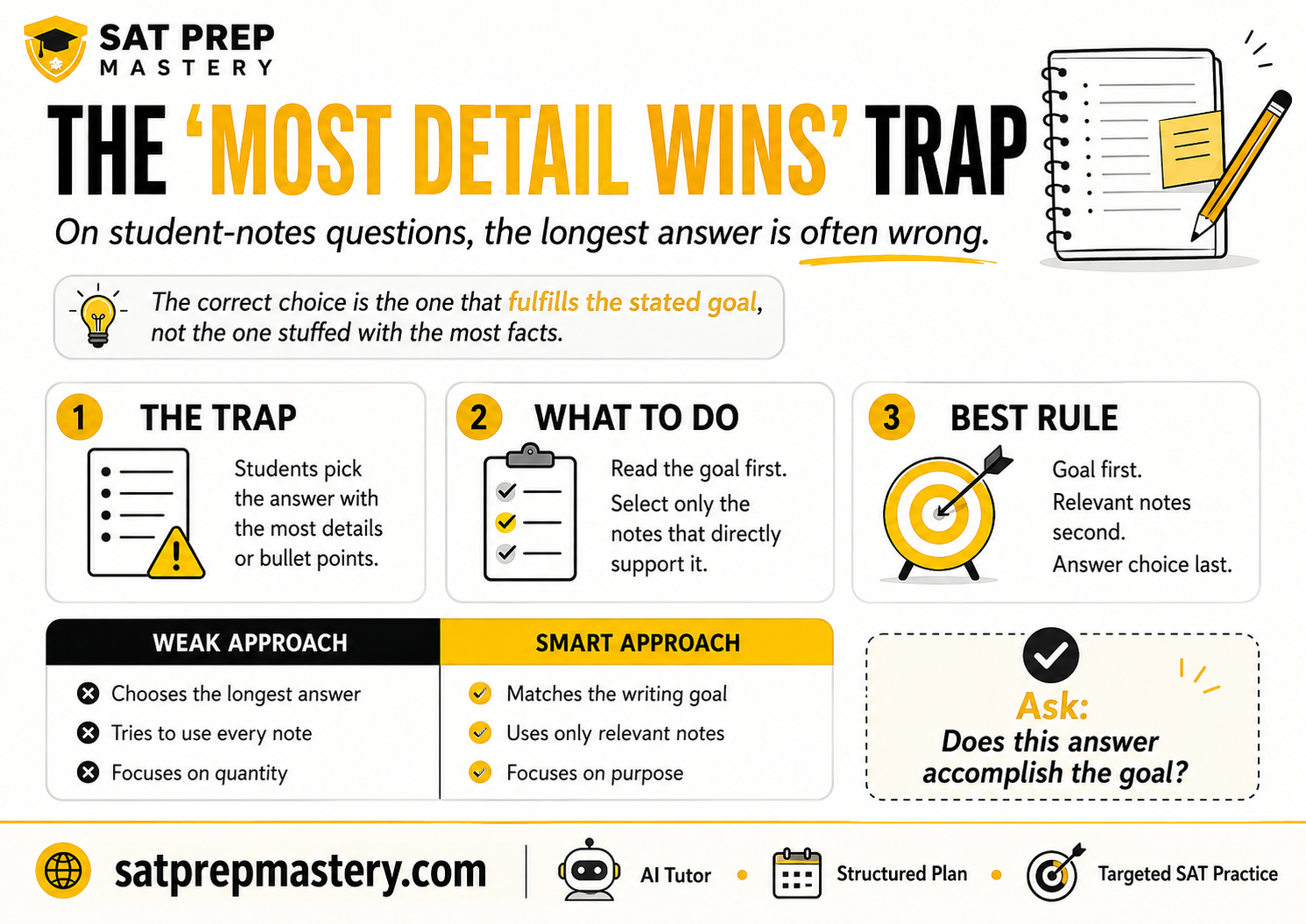
Quick answer: On Digital SAT rhetorical-synthesis questions, the correct answer is not automatically the longest or most informative choice. The student notes deliberately contain more facts than any single sentence needs. Your job is to read the stated writing goal first, select only the notes that serve it, and reject choices that pack in accurate but unnecessary information. A shorter answer that fulfills the goal beats a longer one that does not. Sometimes the goal genuinely requires detail, so length itself is never the signal.
Goal first. Relevant notes second. Answer choice last.
You know the format. A bulleted list appears, introduced by a line like "While researching a topic, a student has taken the following notes." Then a sentence tells you what the student wants to do, and four choices follow.
These are Rhetorical Synthesis questions, a skill in the Expression of Ideas domain of the Digital SAT Reading and Writing section. Expression of Ideas makes up roughly 20% of that section, so this question type shows up several times per test.
Here is what makes it deceptive: every choice is usually built from the notes, so every choice is usually true. Students who are used to rewarding thoroughness reach for the answer that uses the most material. That instinct is exactly backward.
What Is the "Most Detail Wins" Trap?
The trap is choosing the answer that incorporates the most notes rather than the one that accomplishes the stated goal.
Picture five notes about two volcanoes: both are in Iceland, one erupted in 2010, one erupted in 2021, the 2010 eruption grounded European air traffic for six days, and the 2021 eruption was confined to an uninhabited valley. The goal says: emphasize a difference in the eruptions' impact.
A long choice reads: "Both volcanoes are located in Iceland, erupting in 2010 and 2021 respectively, with the 2010 eruption lasting several weeks." Four facts. All accurate. It never states how the impacts differed.
A shorter choice reads: "The 2010 eruption grounded European air traffic for six days, whereas the 2021 eruption was confined to an uninhabited valley." Two facts, and it does the job the question asked for.
The SAT is not asking which answer contains the most information. It is asking which answer uses the notes most effectively for the stated purpose.
Why Students Fall for This Trap
Assuming more information means a stronger answer. In an essay, extra evidence often helps. Here it dilutes focus.
Treating every note as required. The notes are a supply closet, not a checklist.
Reading the notes before understanding the goal. You end up looking for something interesting rather than something specific.
Choosing the longest answer. Length reads as completeness, and the test knows it.
Matching repeated words instead of rhetorical purpose. A choice echoing the goal's vocabulary can still perform the wrong function.
Including background the audience does not need. Dates and biographies feel scholarly and often serve nothing.
Ignoring the goal verb. "Emphasize," "introduce," "compare," "illustrate," and "explain" each demand a different sentence.
Failing to separate accuracy from relevance. Nearly all the choices are accurate. Accuracy cannot be your filter.
Rushing because the notes look complicated. Six bullets feel like a lot to process, so students skim and grab.
The Five-Step Method for Rhetorical-Synthesis Questions
Read the writing goal before studying every note.
Identify the required purpose, audience, subject, and emphasis.
Select only the notes relevant to that goal.
Predict what the answer must accomplish.
Choose the accurate answer that fulfills the goal most directly.
Every chosen fact must earn its place.
Understand the Goal Words
The verb in the goal tells you what kind of sentence to build. Learn these and the question type gets dramatically easier.
Goal Word | What the Answer Must Do | Details Usually Needed | Common Trap |
|---|---|---|---|
Introduce | Define or situate the topic for someone new to it | Basic identity, category, and context | A specialized detail that assumes prior knowledge |
Emphasize | Foreground one specific point above the others | The one fact carrying that point, stated clearly | A balanced summary that buries the emphasis |
Compare | Show how two things are alike | Both subjects, plus the shared trait | Discussing only one subject |
Contrast | Show how two things differ | Both subjects, plus the differing trait | Listing facts about both without stating the difference |
Explain | Give a reason, mechanism, or cause | The causal link, stated as a link | Describing what happened without saying why |
Illustrate | Provide a concrete instance of a general claim | One specific example with particulars | Restating the general claim more elaborately |
Summarize | Capture the overall arc or main development | Endpoints, or the central change | One vivid detail standing in for the whole |
Make a generalization | State a broader pattern and support it | The pattern plus supporting data | Reporting a single finding with no pattern |
Present a finding | State what the research concluded | The result itself | Describing methods instead of results |
Address a specific audience | Pitch the information at that audience's level | Only what that audience needs | Over-explaining to experts or under-explaining to novices |
A choice can be completely accurate and still fail because it performs the wrong rhetorical function. That is the single most important sentence in this article.
Relevant Notes vs. True but Unnecessary Notes
Four different tests apply to any piece of information, and students collapse them into one:
Factually correct. The note says it. Almost every choice clears this bar.
Relevant to the topic. It concerns the same subject. Still not enough.
Necessary for the stated goal. Removing it would prevent the sentence from doing its job. This is the real bar.
Appropriate for the intended audience. It tells the reader what they need, not what they already know or cannot follow.
Relevant detail in one sentence
"A relevant detail is not merely true or related to the topic; it directly helps the sentence accomplish the stated writing goal."
Common Wrong-Answer Patterns
The information dump
Several notes stitched together with no clear focus. It reads like a summary of the whole bullet list rather than a sentence with a job.
The longest-answer trap
Students equate length with completeness. On this question type, length is neutral information.
The accurate-but-wrong-purpose choice
Every fact is right, but the sentence introduces when the goal said compare, or summarizes when the goal said illustrate.
The background-detail distraction
Dates, locations, birthplaces, and credentials that the goal never asked for. These feel like rigor and function as filler.
The wrong-audience answer
The sentence assumes technical knowledge a general reader lacks, or laboriously explains something the specified audience already knows.
The incomplete-goal answer
Uses relevant facts but stops short of the required comparison, result, or emphasis. Often the second-best choice, which makes it dangerous.
The distorted-note choice
Includes useful details but overstates them, turning a correlation into a cause or a partial result into a sweeping claim.
The keyword-match trap
Repeats vocabulary from the goal without performing the action. The word "difference" appears; no difference is actually stated.
Original Digital SAT-Style Practice Questions
Original practice questions written for this article. These are not College Board questions. They imitate the Rhetorical Synthesis format so you can practice the reasoning. All names, studies, and data below are invented.
Question 1 — Science (Astronomy)
While researching a topic, a student has taken the following notes:
Verun b and Verun c are rocky exoplanets orbiting the same star.
Both orbit within the star's habitable zone.
Verun b has a radius about 1.2 times Earth's.
Verun c has a radius about 2.8 times Earth's.
Verun b completes one orbit in 190 days.
Verun c completes one orbit in 410 days.
Both were detected using the transit method.
The student wants to emphasize a difference between the two planets' sizes. Which choice most effectively uses relevant information from the notes to accomplish this goal?
A) Verun b and Verun c, both detected using the transit method, orbit within their star's habitable zone, completing one orbit in 190 and 410 days respectively. B) Verun b has a radius about 1.2 times Earth's, while Verun c's radius is roughly 2.8 times Earth's. C) Both Verun b and Verun c orbit within their star's habitable zone. D) Verun c, which has a radius about 2.8 times Earth's, completes one orbit in 410 days.
Correct answer: B
Purpose of the question: Emphasize a difference, specifically in size.
Relevant notes: The two radius measurements.
Unnecessary notes: Detection method, habitable zone, orbital periods.
Why B works: It names both planets, cites both radii, and uses "while" to mark the contrast. Nothing extra.
Why the others fail:
A is the information dump: four notes, all accurate, and it never mentions size.
C states a similarity when the goal asked for a difference.
D gives one planet's size with no comparison, plus an irrelevant orbital period.
Trap alert: A is the longest choice and uses the most notes. It is also the only choice that ignores the entire subject of the goal.
Question 2 — History
While researching a topic, a student has taken the following notes:
The Silk Roads were a network of overland trade routes across Eurasia.
They operated from roughly the 2nd century BCE to the 15th century CE.
They connected China, Central Asia, Persia, and the Mediterranean.
Traded goods included silk, spices, glass, and paper.
Ideas, religions, and technologies traveled the routes alongside goods.
Few merchants traveled the full length; goods passed through many intermediaries.
The student wants to introduce the Silk Roads to an audience unfamiliar with them. Which choice most effectively uses relevant information from the notes to accomplish this goal?
A) Few merchants traveled the entire length of the Silk Roads, so goods typically passed through many intermediaries before reaching their destination. B) The Silk Roads carried silk, spices, glass, and paper. C) Alongside goods such as silk and spices, ideas, religions, and technologies moved along the Silk Roads, though few merchants ever covered the full route. D) The Silk Roads were a network of overland trade routes that connected China, Central Asia, Persia, and the Mediterranean from roughly the 2nd century BCE to the 15th century CE.
Correct answer: D
Purpose of the question: Introduce, for a reader with no prior knowledge.
Relevant notes: What the Silk Roads were, where they ran, when they operated.
Unnecessary notes: Specific goods, the intermediary system, the transmission of ideas.
Why D works: It defines the thing, locates it geographically, and places it in time. That is what an introduction owes a newcomer.
Why the others fail:
A is a sophisticated point about trade mechanics that assumes the reader already knows what the Silk Roads were. Wrong audience.
B is true but never says what the Silk Roads are, leaving an unfamiliar reader stranded.
C combines three notes and reads impressively, but like A it presumes familiarity and skips the definition entirely.
Trap alert: Notice that the correct answer here is the longest choice. When the goal is to introduce something to a newcomer, context is not padding, it is the assignment. Length is never the signal in either direction.
Question 3 — Literature
While researching a topic, a student has taken the following notes:
Adela Ruiz and Tomas Vane were twentieth-century poets.
Ruiz published four collections between 1938 and 1961.
Vane published two collections between 1949 and 1957.
Ruiz worked as a marine biologist.
Vane worked as a lighthouse keeper.
Both wrote extensively about coastal landscapes.
Both frequently used precise scientific vocabulary in their poems.
The student wants to emphasize a similarity in the two poets' writing. Which choice most effectively uses relevant information from the notes to accomplish this goal?
A) Ruiz, a marine biologist, published four collections between 1938 and 1961, while Vane, a lighthouse keeper, published two between 1949 and 1957. B) Ruiz worked as a marine biologist, and Vane worked as a lighthouse keeper. C) Both Ruiz and Vane wrote extensively about coastal landscapes and frequently employed precise scientific vocabulary in their poems. D) Ruiz published four collections between 1938 and 1961.
Correct answer: C
Purpose of the question: Emphasize a similarity, specifically in their writing.
Relevant notes: Shared subject matter (coastal landscapes) and shared technique (scientific vocabulary).
Unnecessary notes: Publication counts, dates, and both day jobs.
Why C works: It names both poets and identifies two shared features of their work.
Why the others fail:
A uses four notes and the word "while," which signals contrast, not similarity. It also concerns biography and output rather than writing.
B identifies a loose similarity, both had sea-related careers, but the goal specifies their writing. Close, and still wrong.
D discusses one poet and cannot express a similarity at all.
Trap alert: A is the detail-heavy choice, and it fails twice: wrong rhetorical direction and wrong subject. B is the subtler trap because it is a kind of similarity, just not the one asked for.
Question 4 — Art
While researching a topic, a student has taken the following notes:
Ines Okonkwo is a muralist known for large-scale public works.
Her murals often incorporate materials salvaged from the neighborhoods where they are installed.
Her 2019 mural in the Harbor District used 4,000 pieces of reclaimed ceramic tile.
That tile came from buildings demolished within a half-mile of the mural site.
Okonkwo has completed 22 public murals.
She trained as an architect before turning to muralism.
The student wants to illustrate the claim that Okonkwo's murals draw materially on their surroundings. Which choice most effectively uses relevant information from the notes to accomplish this goal?
A) Okonkwo, who trained as an architect, has completed 22 public murals, which often incorporate materials salvaged from the neighborhoods where they are installed. B) Okonkwo's murals often incorporate salvaged materials. C) Her 2019 Harbor District mural, for instance, used 4,000 pieces of ceramic tile reclaimed from buildings demolished within a half-mile of the site. D) Okonkwo has completed 22 public murals since training as an architect.
Correct answer: C
Purpose of the question: Illustrate, meaning supply a concrete instance of a general claim.
Relevant notes: The Harbor District mural, the tile count, the half-mile radius.
Unnecessary notes: Career total, architectural training.
Why C works: It provides one specific case with particulars, exactly what "illustrate" requires. The half-mile detail is what proves "draw on their surroundings."
Why the others fail:
A combines three notes but only restates the claim in more words. Restating is not illustrating.
B restates the claim in fewer words. Same failure, shorter.
D is accurate and entirely unrelated to the claim.
Trap alert: A is the longest choice and the most "complete-sounding." It performs the wrong rhetorical job: a claim cannot illustrate itself.
Question 5 — Environmental Studies
While researching a topic, a student has taken the following notes:
Researchers investigated whether beaver dams affect stream water temperature.
The team monitored 14 streams in the Cascade Range over three summers.
Seven streams contained active beaver dams; seven did not.
Sensors recorded water temperature every 15 minutes.
Streams with dams averaged 2.3°C cooler in August than streams without them.
The team published its results in 2023.
The student wants to present the study's finding. Which choice most effectively uses relevant information from the notes to accomplish this goal?
A) Over three summers, the team monitored 14 Cascade Range streams, seven with active beaver dams and seven without, recording water temperature every 15 minutes. B) Streams containing active beaver dams averaged 2.3°C cooler in August than streams without them. C) Researchers investigated whether beaver dams affect stream water temperature, monitoring streams across three summers. D) The team monitored 14 streams in the Cascade Range and published its results in 2023.
Correct answer: B
Purpose of the question: Present a finding, meaning state the result.
Relevant notes: The temperature difference.
Unnecessary notes: Sample size, sensor interval, study duration, publication year.
Why B works: It reports what the study found, with the measured difference.
Why the others fail:
A is a thorough, accurate description of the methods. It uses four notes and contains no result.
C states the research question, not the answer to it.
D reports logistics and a publication date.
Trap alert: A is the classic version of this trap in a science context. Methods look like substance. A finding is a result, and only B has one.
Question 6 — Technology
While researching a topic, a student has taken the following notes:
Solid-state drives (SSDs) store data on flash memory chips.
Traditional hard drives store data on spinning magnetic platters.
Hard drives must physically move a read head to reach stored data.
SSDs contain no moving parts.
Avoiding mechanical movement allows SSDs to access data far faster.
SSDs became common in consumer laptops after 2010.
The student wants to explain why SSDs access data faster than traditional hard drives. Which choice most effectively uses relevant information from the notes to accomplish this goal?
A) SSDs, which store data on flash memory chips and became common in consumer laptops after 2010, differ from traditional hard drives, which use spinning magnetic platters. B) SSDs have no moving parts, while hard drives rely on spinning magnetic platters. C) SSDs became common in consumer laptops after 2010 because they access data faster than hard drives. D) Because SSDs contain no moving parts, they avoid the delay of physically positioning a read head, which allows them to access data far faster than hard drives.
Correct answer: D
Purpose of the question: Explain, meaning state a causal mechanism.
Relevant notes: No moving parts, read-head movement, resulting speed advantage.
Unnecessary notes: Flash memory chips, adoption date.
Why D works: It builds an actual causal chain: no moving parts → no read-head positioning delay → faster access. The word "because" does real work here.
Why the others fail:
A uses four notes to draw a contrast. Contrast is not explanation, and it never mentions speed.
B states a real difference but stops before connecting it to speed. Incomplete goal.
C distorts the notes. Nothing in them says adoption was caused by speed; it reverses the relationship the goal asked about.
Trap alert: A is the detail-rich choice and the most common wrong answer here. B is the near-miss: correct facts, correct direction, no causal link.
Question 7 — Economics
While researching a topic, a student has taken the following notes:
In 1990, container shipping handled about 28% of global seaborne trade by value.
By 2020, that share had risen to about 60%.
Average container ship capacity grew from roughly 1,200 units in 1990 to about 4,800 units in 2020.
Ports expanded automated crane systems throughout this period.
The largest container ship in 1990 carried 4,400 units.
Shipping costs per unit fell substantially between 1990 and 2020.
The student wants to summarize how container shipping changed between 1990 and 2020. Which choice most effectively uses relevant information from the notes to accomplish this goal?
A) The largest container ship in 1990 carried 4,400 units, ports expanded automated crane systems, and shipping costs per unit fell substantially. B) In 1990, container shipping handled about 28% of global seaborne trade by value. C) Ports expanded automated crane systems between 1990 and 2020. D) Between 1990 and 2020, container shipping's share of seaborne trade by value roughly doubled, from about 28% to about 60%, while average ship capacity quadrupled.
Correct answer: D
Purpose of the question: Summarize a development, meaning capture the overall arc.
Relevant notes: The two share figures, the two capacity figures.
Unnecessary notes: The 1990 record ship, crane automation, per-unit costs.
Why D works: It gives both endpoints of the central change and adds a second dimension of growth, characterizing the whole period rather than one moment in it.
Why the others fail:
A strings together three accurate notes with no organizing arc. It reads as a list, not a summary.
B provides a starting point with no change.
C is true but narrow, one development standing in for the whole.
Trap alert: A is the information dump. A summary needs a shape, and a list of unconnected facts has none.
Question 8 — Psychology and Social Science
While researching a topic, a student has taken the following notes:
A researcher surveyed 900 adults about commuting habits and job satisfaction.
Participants who walked or biked to work reported higher job satisfaction.
Participants who drove alone reported the lowest satisfaction of any group.
Participants with commutes longer than 45 minutes reported lower satisfaction.
The survey was conducted in four mid-sized cities.
Satisfaction was measured on a 10-point scale.
The study did not follow participants over time.
The student wants to make a generalization about commuting and job satisfaction and support it with data from the notes. Which choice most effectively uses relevant information from the notes to accomplish this goal?
A) The survey measured job satisfaction on a 10-point scale and was conducted among 900 adults across four mid-sized cities. B) Participants with commutes longer than 45 minutes reported lower job satisfaction. C) How people commute appears to relate to how they feel about their jobs: participants who walked or biked reported higher satisfaction, while those who drove alone reported the lowest of any group. D) Walking or biking to work causes higher job satisfaction.
Correct answer: C
Purpose of the question: Make a generalization and support it. This goal has two parts, and the answer must do both.
Relevant notes: The walking/biking result, the driving-alone result.
Unnecessary notes: Sample size, cities, rating scale, absence of longitudinal tracking.
Why C works: The first clause states a broader pattern; the second supplies two data points supporting it. It also hedges appropriately with "appears to relate," which the survey design justifies.
Why the others fail:
A uses three notes to describe methodology. No generalization, no support.
B reports one specific finding without generalizing from it. Half the goal.
D generalizes but distorts: the notes state the study did not follow participants over time, so it cannot establish cause.
Trap alert: A is the detail-dump. D is the more interesting failure: it sounds like a bold generalization and is actually an overreach the notes explicitly rule out.
Detailed Trap Walkthrough
Here is how a student who understands every note still misses the question.
The setup. Notes on two vaccines:
Vaccine A and Vaccine B both protect against the same virus.
Vaccine A requires storage at −70°C.
Vaccine B remains stable at standard refrigerator temperatures.
Vaccine A was approved in 2020.
Vaccine B was approved in 2021.
Both showed above 90% efficacy in trials.
Vaccine B has been distributed more widely in regions without specialized cold-storage infrastructure.
The goal. The student wants to emphasize a practical advantage of Vaccine B for a reader unfamiliar with vaccine logistics.
Step 1: Identify the goal
Emphasize an advantage. One advantage, foregrounded. Not a balanced comparison, not a summary.
Step 2: Identify the intended audience
Someone unfamiliar with vaccine logistics. They will not know why −70°C matters unless the sentence tells them.
Step 3: Select the necessary notes
Vaccine B's refrigerator stability, Vaccine A's −70°C requirement as the contrast that makes the advantage legible, and the wider distribution in regions lacking cold-storage infrastructure as the practical payoff.
Step 4: Predict the sentence's job
It should say: B stores at ordinary refrigerator temperatures rather than −70°C, which is why it reaches places without specialized equipment.
Step 5: Eliminate answers that do too much or the wrong thing
Consider four choices:
A) "Approved in 2020 and 2021 respectively, Vaccine A and Vaccine B both target the same virus and both demonstrated efficacy above 90% in trials." Four notes, all accurate, no advantage stated.
B) "Both vaccines showed above 90% efficacy in trials." True, and it is a similarity, not an advantage.
C) "Vaccine B remains stable at standard refrigerator temperatures, unlike Vaccine A's −70°C requirement, allowing wider distribution in regions without specialized cold-storage infrastructure." Advantage, contrast that explains it, practical consequence.
D) "Vaccine A requires storage at −70°C." True, one note, and it emphasizes A's limitation without ever naming B's advantage.
A is out: it is the fullest choice and performs no rhetorical function the goal named. B is out: similarity, not advantage. D is out: incomplete, and it puts the emphasis on the wrong vaccine.
Step 6: Choose the most direct answer
C.
The failure mode. A student reads all seven notes, understands each one, and picks A because it feels the most substantial and uses the most material. Their comprehension was flawless. They answered "which sentence tells me the most about these vaccines?" instead of "which sentence emphasizes a practical advantage of Vaccine B?" That is a goal-reading error, not a reading-comprehension error, and it is fixable in a single practice session once you can name it.
Most Detail Trap Comparison Table
Trap Situation | Tempting Student Reaction | Better Strategy | Goal Detail to Check |
|---|---|---|---|
One choice includes nearly every note | Assume it is complete | Check whether each fact serves the goal | Purpose |
The longest choice sounds impressive | Choose it immediately | Compare directness and relevance | Focus |
Several facts are accurate | Include them all | Use only necessary information | Required evidence |
The goal asks for a comparison | Choose a general summary | Require both sides of the comparison | Compared subjects |
The audience is unfamiliar with the topic | Select unexplained technical details | Provide the context the audience needs | Audience |
Time is running out | Read every note repeatedly | Read the goal and identify relevant notes | Goal verb |
A Fast 30-Second Solving Routine
Read the goal first.
Circle the goal verb.
Identify the subject and audience.
Select the two or three notes that directly serve the goal.
Eliminate choices that do the wrong rhetorical job.
Choose the most direct accurate answer.
Steps 1 through 3 take about eight seconds and they are the ones students skip when the clock is loud. Reading the goal first also means you often need only two of the six notes, which is faster than processing all of them.
More Detail vs. Better Rhetorical Synthesis
Weak Approach | Strong Approach |
|---|---|
Uses the most notes possible | Uses only notes needed for the goal |
Chooses the longest answer | Chooses the most effective answer |
Focuses on factual quantity | Focuses on rhetorical purpose |
Treats all notes equally | Prioritizes relevant notes |
Ignores the audience | Adjusts information for the audience |
Selects by keyword matching | Checks whether the sentence performs the task |
Assumes extra information cannot hurt | Removes information that weakens focus |
How SAT Prep Mastery Helps Students Recognize This Trap
Knowing that the answer was C teaches you almost nothing here. What transfers is being able to say why the detail-packed choice was tempting and where it broke: "It used four notes but never stated the difference." Students who can name the failure start spotting it before they finish reading the choices.
That is the practice SAT Prep Mastery is built around, with targeted Rhetorical Synthesis sets, trap-based answer choices modeled on the patterns above, and explanations that walk through why each distractor appeals rather than simply confirming the key. When a detailed wrong answer still feels defensible after the explanation, the online SAT tutor is there for the follow-up question, which is usually where the reasoning actually lands.
Mistake classification matters here too, because "I misread the notes" and "I read the notes correctly and ignored the goal verb" are different problems with different fixes. Adaptive recommendations then send more of whichever you are missing, and a personalized SAT structured plan schedules that work into your week with progress tracking so you can see the error pattern shrink. No platform can promise a specific score change, but a student who reads the goal before the notes has already removed the main cause of these misses.
Final Student Checklist
[ ] Did I read the writing goal first?
[ ] What does the goal verb require?
[ ] Who is the intended audience?
[ ] Which notes directly support the purpose?
[ ] Is every detail in my chosen answer necessary?
[ ] Does the answer perform the correct rhetorical job?
[ ] Is the answer accurate?
[ ] Does it distort or exaggerate the notes?
[ ] Am I choosing it only because it is longer?
[ ] Could a more focused answer fulfill the goal better?
Frequently Asked Questions
What are rhetorical-synthesis questions on the Digital SAT?
They present a set of bulleted student notes plus a stated writing goal, then ask which choice most effectively uses the notes to accomplish that goal. They belong to the Expression of Ideas domain of the Reading and Writing section, which makes up roughly 20% of that section.
Do I need to use every student note?
No. The notes intentionally contain more information than any single sentence needs. Most questions require only two or three notes, and choices that use more are frequently the wrong answer.
Is the longest answer usually correct?
No, and it is often a deliberate distractor. That said, the shortest answer is not automatically correct either. Length carries no information; only fit with the goal does.
Should I read the notes or the writing goal first?
Read the goal first, every time. It tells you which notes matter, so you can read the bullets with a filter instead of memorizing all of them.
How do I identify which notes are relevant?
Ask what the goal verb requires, then ask of each note: if I removed this, could the sentence still do its job? If yes, the note is optional. Relevance is about necessity, not truth.
What does "most effectively uses the notes" mean?
It means best accomplishing the stated goal, not using the greatest number of notes. Effectiveness is measured against the purpose, so the most efficient sentence that fully performs the task wins.
What should I do when two answers are accurate?
Assume both are accurate and switch to testing purpose. Ask which one performs the exact rhetorical action the goal named, and which one merely reports true information. Accuracy is the first filter, never the deciding one.
Can a short answer be more complete than a long answer?
Yes, when completeness is measured against the goal rather than against the notes. A two-fact sentence that fully states a contrast is more complete than a four-fact sentence that never states one.
How can I answer rhetorical-synthesis questions faster?
Read the goal, circle the verb, and predict what the sentence must do before reading any choice. You will usually eliminate two options on rhetorical function alone, without rechecking the notes.
Can an AI SAT tutor help with student-notes questions?
Yes, especially for the follow-up after an explanation, when a detailed wrong answer still seems reasonable. Asking "why doesn't the choice with four notes count as more effective?" is where the concept sticks. Attempt the question first and ask for hints before full answers.
Learn to Follow the Goal, Not the Number of Details
This is one of the most learnable question types on the Digital SAT, because the fix is a habit rather than a body of knowledge. Read the goal, name the verb, take only the notes that serve it, and let the impressive-looking information dump go by.
SAT® is a trademark registered and owned by College Board®, which is not affiliated with and does not endorse this product or site. All practice questions, names, studies, and data in this article are original and invented for illustration. Digital SAT details can change; verify current test information through College Board and Bluebook. Last verified: July 17, 2026.
7. References
Official College Board / SAT Suite
The Reading and Writing Section (content domains and skills) — https://satsuite.collegeboard.org/sat/whats-on-the-test/reading-writing
How the SAT Is Structured (module timing and question counts) — https://satsuite.collegeboard.org/sat/whats-on-the-test/structure
What Are Content Domains? — https://satsuite.collegeboard.org/practice/content-domains
Digital SAT Suite Specifications Overview — https://satsuite.collegeboard.org/media/pdf/digital-sat-test-spec-overview.pdf
How to Use the Student Question Bank — https://satsuite.collegeboard.org/practice/student-question-bank
Full-Length Digital Practice Tests on Bluebook — https://satsuite.collegeboard.org/practice/practice-tests/bluebook
Learning Science
Dunlosky, J., Rawson, K. A., Marsh, E. J., Nathan, M. J., & Willingham, D. T. (2013). Improving Students' Learning With Effective Learning Techniques. Psychological Science in the Public Interest, 14(1), 4–58 — https://journals.sagepub.com/doi/abs/10.1177/1529100612453266
Terminology note: "Rhetorical Synthesis" is a skill within the Expression of Ideas domain of the Digital SAT Reading and Writing section, alongside Transitions. All practice questions above are original and do not reproduce College Board content.