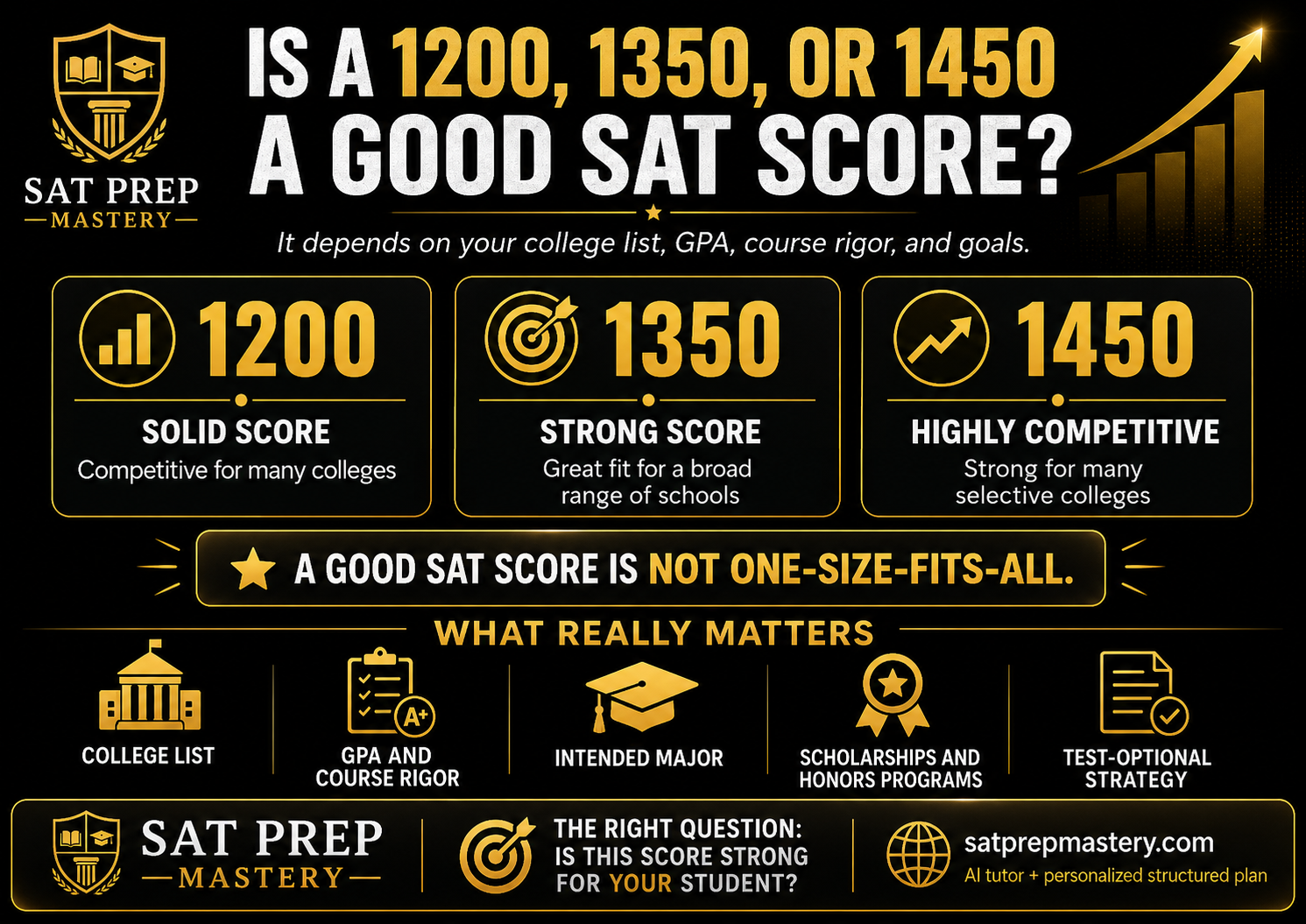
Is a 1200, 1350, or 1450 a Good SAT Score?
Quick answer: A 1200, 1350, or 1450 can each be a good SAT score — it depends entirely on the student's target colleges and goals. A 1200 is well above the national average and competitive at many institutions. A 1350 is a strong score for a broad range of colleges. A 1450 is competitive at many selective universities. None of these numbers means anything on its own: GPA, course rigor, intended major, scholarship targets, and each college's current published range all change the answer. The real question isn't "Is this good?" but "Is this score strong for this student's college list?"
Note: SAT score ranges and testing policies can change by institution and entering class. Always verify current information on each college's official admissions website. Last verified: July 16, 2026.
Here's how this usually goes. A score comes back. Within an hour, the student has compared it to two friends, a group chat, and a stranger on the internet claiming a 1580. A parent looks at one number and wants a straight answer: is this good or not?
But the same 1200 can mean completely different things. For a student with a 3.9 GPA applying to a college whose published range starts at 1150, it's an asset. For a student targeting a program where admitted students cluster near 1500, it's not the strongest part of the file — and that's useful information, not a verdict. A 1450 is outstanding almost everywhere, and still below the typical range at a small number of extremely selective institutions.
Layer in GPA, AP or IB rigor, intended major, school context, extracurriculars, and test-optional policies, and you can see why a one-word label fails. Families don't need a label. They need context.
Score strategy should start with the student's actual college list and goals — not with comparison. That's the approach behind SAT Prep Mastery: figure out where the student stands, what score would actually create value, and how to get there efficiently. Let's work through it.
Is a 1200 a Good SAT Score?
Yes — a 1200 is a good SAT score for many students and many colleges. It sits roughly 170 points above the national mean of 1029 for the Class of 2025 (College Board), placing a student near the 75th percentile of test takers. In plain terms: better than about three out of four students who took the test.
Where a 1200 stands depends on the list:
It's often competitive at a wide range of four-year public and private universities whose published middle 50% ranges sit near or below it.
It's less competitive at highly selective institutions, where admitted students who submit scores typically cluster far higher.
GPA and rigor change its weight. A 1200 alongside a strong GPA in demanding courses reads as consistent academic performance. A 1200 alongside a modest transcript adds less.
Section balance matters. A balanced 600 Reading and Writing / 600 Math reads differently than a 680/520 split — especially if that 520 is the Math score and the student wants engineering. The total can hide the thing that matters most.
A 1200 may support an application when it lands within the college's current range, meets a scholarship or program threshold, or corroborates a strong transcript. Retesting deserves consideration when target schools publish higher ranges, when a scholarship cutoff sits just above (Florida's Bright Futures award tiers, for example, use defined score thresholds published on the state's official site), or when practice data shows clear, fixable weaknesses.
A 1200 may be a good score for your student if…
☐ It falls within or above the college's current published range
☐ It supports and is consistent with the student's transcript
☐ It meets a scholarship, honors, or program threshold that matters
☐ It represents meaningful growth from earlier practice scores
☐ The application is strong in other areas
☐ Additional preparation would interfere with more important priorities
Is a 1350 a Good SAT Score?
Yes — a 1350 is a strong SAT score. It places a student roughly in the top 10% of test takers nationally, and it fits comfortably within the published ranges of a broad set of public and private universities.
But selectivity still governs the interpretation. A verified example: the University of Florida's official Freshman Student Profile lists a middle 50% SAT range of 1380–1510 for admitted students in the Class of 2029 — so a 1350 sits just below the 25th percentile there, while comfortably inside the range at many other strong universities. Same score, different meaning, one page of official data apart.
Two things deserve a closer look at this level:
Applying to engineering, computer science, economics, or business? Examine the Math section specifically. A 1350 built on a 780 Reading and Writing and a 570 Math tells a very different story to a quantitative program than a 670/680 split.
Applying to humanities or social sciences? The reverse holds. Strong Reading and Writing performance is the relevant evidence, and a weak verbal section shouldn't hide inside a respectable total.
At a test-optional college whose range aligns with 1350, submitting can strengthen the file. Where the range is substantially higher and the rest of the application is stronger, submitting may add little. Retesting makes sense when one section is clearly dragging the total or when a specific target sits above the score. It makes less sense when the score already fits the list — at which point essays, grades, and recommendations are the better investment of the same hours.
To be clear: no score, including a 1350, guarantees admission or merit aid anywhere.
Is a 1450 a Good SAT Score?
Yes — a 1450 is a highly competitive SAT score. It places a student in roughly the top 3–5% of test takers nationally and falls within the published score ranges of many selective institutions. Using the same verified example above, a 1450 sits inside UF's 1380–1510 admitted-student range for the Class of 2029.
Two corrections worth making, because both errors are common:
A 1450 is not "too low." Online comparison culture has convinced some students that anything under 1500 is a failure. That belief isn't supported by institutional data. At a small number of extremely selective universities, admitted students who submit scores do cluster higher — but "below the typical range at a handful of schools" is not the same as "a weak score."
A 1450 isn't automatically a submit, either. Whether it helps depends on the school's current published data and its testing policy. Section balance and intended major still matter at this level — a 1450 with a 660 Math may warrant thought for a computer science applicant.
Should a student retake a 1450?
It depends on six things:
Target colleges — do published ranges at the top of the list sit meaningfully higher?
Scholarship thresholds — is an award cutoff just above the current score?
Section scores — is one section notably lagging for the intended major?
Diagnostic evidence — does practice data show realistic room to improve, or is the student already near their ceiling?
Available time — is there room to prepare without stealing hours from the transcript?
Competing priorities — would those hours produce more value in essays, grades, or activities?
If most answers point toward "no," further SAT preparation likely hits diminishing returns. Chasing a round number at the expense of GPA, essays, or well-being is a bad trade — an arbitrary 1500 is not worth a dropped grade.
1200 vs. 1350 vs. 1450: What Do These Scores Mean?
SAT Score | General Interpretation | May Be Competitive For | Reasons to Consider Retesting |
|---|---|---|---|
1200 | Solid score that can be competitive at many institutions | Colleges where the score is within or above the current range | Target schools have higher ranges, scholarship threshold is higher, or clear weaknesses remain |
1350 | Strong score for a broad range of colleges | Many moderately selective and some selective institutions | Highly selective targets, uneven section score, or realistic improvement potential |
1450 | Highly competitive score for many colleges | Many selective institutions and competitive programs | Top score ranges, major-specific concerns, or scholarship thresholds justify another attempt |
This table provides general context only. The correct interpretation depends on the college, entering class, intended program, GPA, course rigor, and current testing policy.
A Good SAT Score for What School?
The college list is the single most important context — and reading college data correctly is a skill most families never get taught.
Start with the middle 50% range, which colleges publish as two numbers (for example, 1380–1510). The lower number is the 25th percentile: a quarter of students scored below it. The upper is the 75th percentile: a quarter scored above it. The median sits in between. Four things families routinely get wrong:
A score below the 25th percentile is not an automatic rejection. A quarter of that class scored below it. Every year.
A score above the 75th percentile is not an admissions guarantee. Selective colleges deny students with top scores routinely, because review is holistic.
At test-optional colleges, ranges reflect only students who chose to submit — a self-selecting group that skews the numbers upward. Read those ranges as "typical for submitters," not "typical for admits."
Admitted and enrolled are different populations. Admitted-student ranges usually run slightly higher than enrolled-student ranges. Confirm which one you're reading — the Common Data Set reports enrolled students, while a college's own admitted-class profile reports admits.
The eight-step comparison process
Open the college's official admissions page — not a ranking site.
Confirm the current testing policy for your student's entering class.
Find the most recent Common Data Set or official class profile.
Identify the current middle 50% score range.
Confirm whether the range covers all enrolled students, admitted students, or only score submitters.
Check scholarship and honors requirements separately.
Compare section scores against the intended major.
Decide whether the score adds useful evidence to this particular application.
One more wrinkle: different undergraduate schools within a university can have different competition levels. A university's overall range may understate what's typical for its engineering or nursing school.
How Should GPA Affect the Meaning of an SAT Score?
GPA and SAT scores answer different questions. GPA shows sustained performance across years; course rigor shows the difficulty of the work; the SAT provides a single standardized data point that's identical for everyone. Neither replaces the other — which is why a score can only be judged next to the transcript.
Academic Profile | How an SAT Score May Function |
|---|---|
High GPA + strong rigor + strong SAT | Reinforces academic readiness |
High GPA + strong rigor + lower SAT | Student may consider withholding where allowed |
Lower GPA + strong SAT | Adds evidence of ability but does not erase transcript concerns |
Moderate GPA + upward trend + strong SAT | May support an improvement narrative |
Strong GPA + limited course access + strong SAT | May provide additional academic context |
Strong GPA + no score | Application relies more heavily on transcript, rigor, and school profile |
Two honest caveats. A high score does not erase weak grades or a thin schedule — admissions offices weigh four years of evidence over one morning of testing. And admissions offices read every profile against the student's school context and the opportunities actually available there. No combination in this table guarantees admission anywhere.
Is a Good SAT Score Different by Major?
Sometimes — not in official cutoffs, but in how section scores get read.
Engineering and computer science applicants benefit from strong Math evidence. A quantitative program reading a file naturally weighs the quantitative section.
Economics and business applicants often benefit from the same quantitative strength.
Humanities and social science applicants should still demonstrate strong Reading and Writing performance — the section that most resembles the work.
Undecided applicants are well served by balance, which keeps doors open.
A concrete illustration, without pretending it's a rule: two students both score 1350. Student A has 650 Reading and Writing / 700 Math. Student B has 750 Reading and Writing / 600 Math. For a computer science program, Student A's score likely reads as stronger evidence — despite the identical total. For a journalism program, the reverse may hold.
An important limit: most colleges do not publish major-specific SAT expectations, and students should never invent unofficial cutoffs from forum chatter. The reliable takeaway is narrower and more useful — don't let the total hide a section weakness that matters for your field.
Is a Good SAT Score Different for Scholarships and Honors Programs?
Yes, and this is where families lose real money by assuming admissions rules cover everything.
Admissions and scholarship requirements can differ. A test-optional college may still use scores for certain awards.
Honors programs publish separate criteria — and often higher ones. UF's official profile again illustrates the gap: admitted honors students in the Class of 2029 show a middle 50% SAT range of 1470–1550, versus 1380–1510 for admitted students overall.
State scholarship programs may use defined thresholds. Florida's Bright Futures awards specify qualifying SAT, ACT, or CLT scores; current cutoffs are published on the official Florida Student Scholarship & Grant Programs site and should be verified there, since they can be revised.
Automatic merit awards (meet the number, get the award) work differently from competitive merit awards (the number qualifies you to compete).
The strategic consequence: a score that's comfortably "good enough" for admission may fall short of a scholarship goal. That's one of the few situations where retesting is clearly worth it even when admission looks likely — the return isn't a better school, it's tuition.
Should a Student Submit a 1200, 1350, or 1450 to a Test-Optional College?
Six questions, in order:
Is the score within the college's current published range?
Does the score support the academic story the transcript already tells?
Does the intended major make one section particularly important?
Is the score needed for scholarships, honors, or course placement?
Does the college provide official submission guidance?
Would submitting add evidence — or create an unnecessary weakness?
Score | Submit When | Consider Withholding When |
|---|---|---|
1200 | It fits the college's range, supports the transcript, or meets another requirement | It is substantially below the institution's range and not needed elsewhere |
1350 | It is competitive for the college and supports the intended program | The institution's score range is much higher and the rest of the application is stronger |
1450 | It falls within a strong competitive range or supports selective-program goals | A very small number of institutions have much higher ranges and the score does not add value |
This is a decision framework, not a universal submission rule.
There is no percentile at which every student should submit or withhold. The same student may reasonably submit to six schools on their list and withhold from two — that's strategy, not inconsistency.
When Is Retaking the SAT Worth It?
A retake should be strategic, not emotional. The clarifying question:
"Will a higher score meaningfully change this student's admissions, scholarship, honors, or placement options?"
If the honest answer is no, the retake is anxiety management, not strategy.
A retake may be worthwhile when:
The student has a clear target score tied to a real goal
The college list includes schools with higher published ranges
A scholarship threshold sits within reach
One section is holding down the total
Practice data shows realistic improvement potential
There's time for targeted preparation
The retake won't damage grades, sleep, or application quality
A retake may not be worthwhile when:
The score already supports the student's goals
Improvement potential looks limited after honest diagnostic review
The student is chasing prestige or a comparison, not an outcome
Essays, grades, recommendations, or activities need the hours more
The next test date collides with AP exams or finals
The colleges in question are test-blind — the University of California system, for instance, doesn't consider scores in admissions at all
One more rule: never retake without changing the study plan. Retaking with the same preparation reliably produces the same score.
Random Score Chasing vs. Personalized SAT Score Planning
Preparation Factor | Personalized Planning With SAT Prep Mastery | Random Score Chasing |
|---|---|---|
Target score | Based on real college and scholarship goals | Based on friends, forums, or prestige |
Diagnostic testing | Identifies current strengths and weaknesses | May begin without a baseline |
Study plan | Personalized around the student's schedule | Generic or inconsistent |
Practice | Focused on high-impact skills | Random question completion |
Error review | Tracks repeated patterns | Mistakes may be checked and forgotten |
AI tutor support | Immediate explanations during practice | Student may remain stuck |
Section strategy | Adjusted for intended major and score needs | Focuses only on total score |
Retake decision | Based on evidence and potential value | Driven by anxiety |
Time use | Prioritizes areas most likely to improve | Spreads effort across mastered topics |
Progress tracking | Measures improvement over time | Relies on occasional test scores |
Stress level | Clear goals reduce uncertainty | Constant comparison increases pressure |
Final decision | Score is evaluated in application context | Score is treated as a personal judgment |
The future of SAT preparation isn't endlessly chasing the highest number a student can theoretically reach. It's identifying the score that supports the student's actual goals — then building the most efficient path to it, and knowing when to stop.
How SAT Prep Mastery Helps Students Reach the Right Score
A personalized system exists to answer five questions: What score does this student need? Which section should improve first? Is another attempt justified? How much preparation is realistic? And when should the student stop preparing and focus elsewhere?
Here's how SAT Prep Mastery supports that:
Diagnostic practice and full-length digital SAT tests establish the real starting point and track it under test conditions
A personalized SAT structured plan turns diagnostics into a weekly roadmap that fits around school — and adjusts as the student improves
Targeted Math and Reading & Writing practice, including harder-question training for students already scoring well, puts hours where the points are
Weakness identification and error-pattern review catch the repeat mistakes that quietly cap a score
The online SAT tutor delivers AI-powered, step-by-step explanations at the moment of confusion — no commuting, no scheduling
Progress tracking provides the evidence a retake decision actually requires
No program guarantees a score increase, a scholarship, or admission. What a data-informed plan does guarantee is that the student's next decision — study more, retake, submit, or move on — gets made with real information instead of a group chat.
How Parents Should Talk About SAT Scores
The score conversation shapes what happens next, so a few principles help:
Don't treat the score as a judgment of intelligence. It's a measure of performance on one specific test on one specific morning — nothing more.
Ask what it means for the goals, not how it compares to classmates.
Compare against official college data, never against the loudest number in the friend group.
Separate disappointment from strategy. Feel the first briefly; then do the second.
Recognize improvement. A 60-point gain is real progress, even if it didn't hit the target.
Avoid arbitrary numbers. "Get a 1500" is pressure without purpose unless something on the list requires it.
Protect the balance. GPA, health, and overall application quality outrank a score almost everywhere.
Language that helps:
"What does this score mean for your current college list?"
"Which section gives you the best improvement opportunity?"
"Would another attempt open meaningful options?"
"What does the data say we should work on next?"
Common SAT Score Interpretation Mistakes
Calling a score "bad" without naming a goal. Bad for what? Name the school, then judge.
Comparing only with friends. Your friend's list isn't your list.
Using outdated college ranges. Ranges move yearly — pull the current profile.
Ignoring test-optional policies. Whether a score is required changes the entire calculation.
Ignoring GPA and rigor. The score is read alongside the transcript, never alone.
Looking only at the total. Section balance can matter more than the composite for your major.
Assuming a higher score guarantees admission. Holistic review means no number carries a file.
Assuming a lower score makes admission impossible. A quarter of every class scores below the 25th percentile.
Retaking without changing the study plan. Same preparation, same score.
Chasing 1500 because it sounds prestigious. Prestige isn't a goal; a specific school or scholarship is.
Ignoring scholarship thresholds. The cheapest points a student will ever earn are the ones just below a Bright Futures cutoff.
Sacrificing GPA for excessive SAT prep. Trading four years of evidence for one number is a bad deal.
Treating the first official score as permanent. It's a data point, and most students have time for another.
Final Answer: Is a 1200, 1350, or 1450 a Good SAT Score?
All three can be good scores — the honest answer is that the question is incomplete without a college list.
A 1200 is well above the national average of 1029 (College Board, Class of 2025) and can be competitive at many institutions, particularly alongside a strong transcript. A 1350 is a strong score, roughly top-10% nationally, that fits a broad range of colleges. A 1450 is highly competitive at many selective institutions and sits inside the published ranges of most — including some flagship publics.
What determines whether any of these is "good" for your student: the current published range at each target college, the student's GPA and course rigor, the intended major and section balance, scholarship and honors thresholds, and each institution's testing policy for the relevant entering class. Compare against official data — the college's own admissions profile or Common Data Set — not internet opinions.
Retesting is worth it only when a higher score would create meaningful value: a school that requires it, a scholarship threshold within reach, or a section clearly holding the total down. Otherwise, those hours usually produce more value elsewhere in the application.
The most useful next step isn't comparing with strangers. It's a diagnostic assessment and a plan built around the score your student actually needs — which is exactly what SAT Prep Mastery is designed to provide.
Frequently Asked Questions About Good SAT Scores
Is 1200 a good SAT score?
Yes, for many students and colleges. A 1200 sits near the 75th percentile nationally — about 170 points above the Class of 2025 average of 1029 — and falls within the published range at many four-year institutions. Whether it's strong for your student depends on their specific college list.
Is 1350 a good SAT score?
Yes. A 1350 places a student roughly in the top 10% of test takers and is competitive at a broad range of colleges. At highly selective institutions with higher published ranges, it may be the less prominent part of an otherwise strong application.
Is 1450 a good SAT score?
Yes — a 1450 is highly competitive, roughly the top 3–5% nationally, and falls within the published ranges of many selective universities. Only a small number of extremely selective institutions show meaningfully higher score distributions.
What is considered a good SAT score?
There's no single answer, but useful reference points help: the national mean is 1029 (College Board, Class of 2025), so anything above roughly 1050 is above average. Beyond that, "good" means "within or above the range at the colleges you're actually applying to."
Is 1200 good enough for college?
For many colleges, yes. A 1200 meets or exceeds the published ranges at a wide set of four-year institutions. For highly selective schools, it would typically be below the range of admitted score submitters — check each college's official profile.
Is 1350 good enough for a selective college?
It can be, depending on the college. A 1350 falls within the published range at many selective institutions and below it at the most selective. Compare against each school's current admitted or enrolled student data rather than a general tier label.
Is 1450 good enough for an Ivy League school?
A 1450 is a strong score, but at the most selective universities — including several Ivies that now require testing — admitted students who submit scores tend to cluster higher. Admission is holistic; a 1450 doesn't disqualify anyone, and no score guarantees admission.
Should I retake a 1200 SAT score?
Consider it if target colleges publish higher ranges, a scholarship threshold sits above your score, or practice data shows fixable weaknesses. If the 1200 already fits your list and supports your transcript, those study hours may be better spent elsewhere.
Should I retake a 1350 SAT score?
Retaking makes sense when one section is dragging the total, when a specific target or scholarship sits higher, or when diagnostics show clear room to grow. If the score fits your college list, essays and grades are usually the better investment.
Should I retake a 1450 SAT score?
Usually only for a concrete reason — a scholarship cutoff, a section imbalance relevant to your major, or a top-of-list school with a substantially higher range. Retaking a 1450 purely to reach a round number often produces diminishing returns.
Does GPA matter more than SAT score?
At most colleges, the transcript — GPA plus course rigor — carries more weight because it reflects sustained performance over years. The SAT adds a standardized data point. Their relative weight varies by institution, and many publish this in their Common Data Set.
Can a strong SAT score make up for a lower GPA?
It can add helpful evidence of academic ability and provide context, but it rarely fully offsets a weak transcript. Admissions review is holistic, and sustained classroom performance remains the primary academic evidence at most institutions.
Should I submit my SAT score to a test-optional college?
Submit when the score falls within the college's current range, supports your academic story, or is needed for scholarships, honors, or placement. Withholding is reasonable — and exactly what the policy allows — when the score doesn't add value. Decide school by school.
What SAT score is good for scholarships?
It depends entirely on the award. Institutional merit awards, honors programs, and state programs like Florida's Bright Futures each publish their own criteria, and thresholds can change. Verify current requirements on the scholarship's official site, separately from admissions requirements.
How can an AI SAT tutor help improve my score?
An AI SAT tutor identifies which skills are actually costing points, explains missed questions step by step, and generates targeted practice — so study time concentrates on the highest-value gaps rather than material already mastered. That efficiency matters most when preparation time is limited.
Build the Right SAT Score Plan for Your Student
Score anxiety comes from missing information. SAT Prep Mastery replaces it with diagnostic practice, personalized planning, targeted preparation, progress tracking, and on-demand AI support — so your family knows what score your student needs, whether it's reachable, and exactly how to get there.