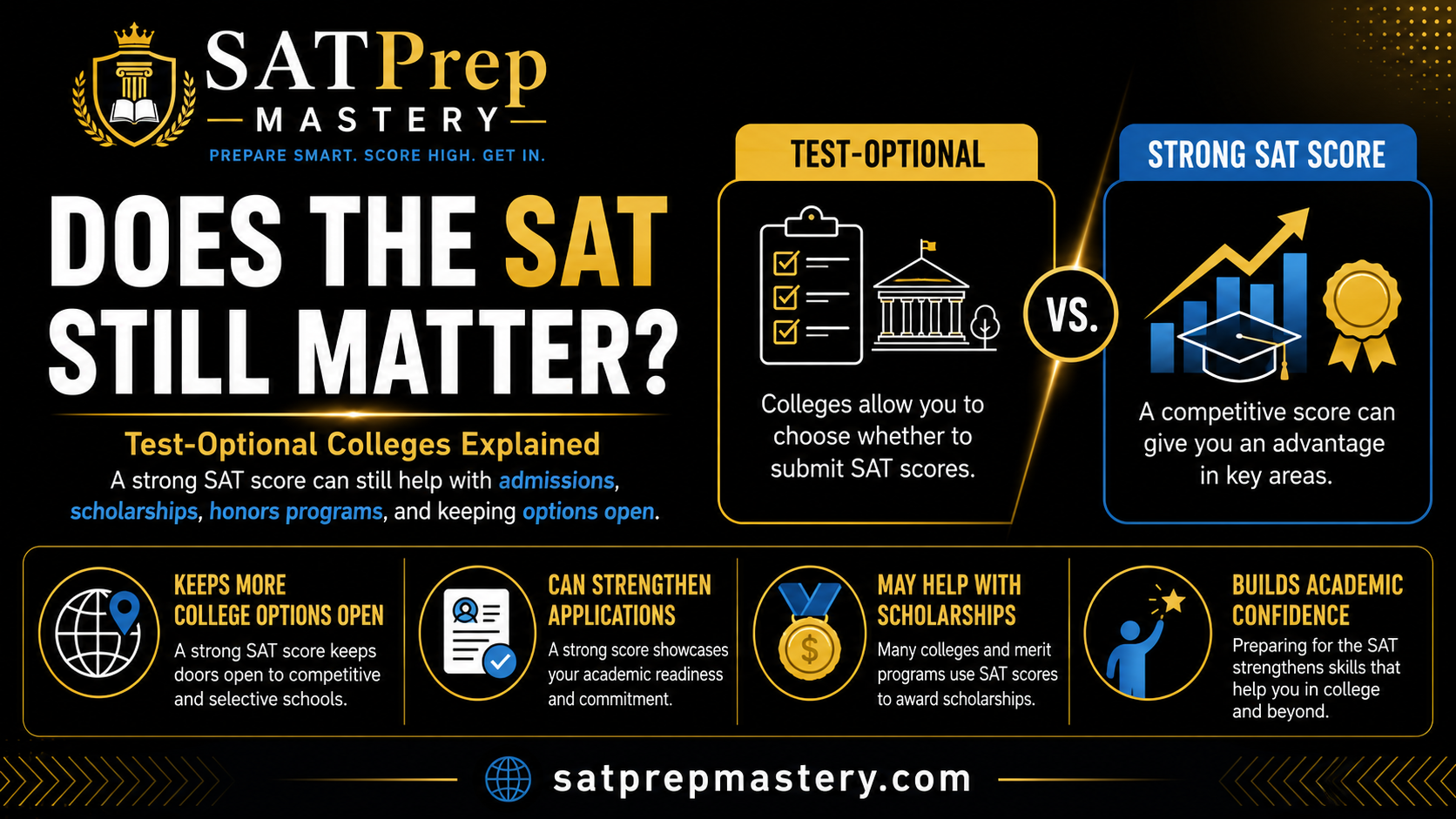
Does the SAT Matter Anymore With Test-Optional Colleges?
Quick answer: Yes — the SAT can still matter, though how much depends on the college. Test-optional means a score is not required for your application to be considered; it does not mean a score has no value. A strong score can support academic readiness, merit scholarships, honors-program admission, or an application where the transcript benefits from extra evidence. A student may reasonably withhold a score when it doesn't strengthen the file. Policies differ by institution and entering year, so each college must be checked individually.
Note: Testing policies can change by institution and entering class. Always verify the current policy on each college's official admissions website. Last verified: July 16, 2026.
If your family feels confused about testing right now, you're reading the landscape correctly — it genuinely is mixed. Some colleges removed testing requirements during the pandemic and never brought them back. Others have restored them: for students entering in fall 2026 and fall 2027, Harvard, Yale, Dartmouth, Brown, Cornell, and Penn all require SAT or ACT scores again, as do MIT, Caltech, Stanford, Georgetown, and Purdue, along with public university systems in Florida, Georgia, and Tennessee. Meanwhile, the University of California and California State systems don't consider scores at all, and hundreds of other institutions continue genuine test-optional policies.
Caught in the middle, parents worry that skipping the score will "look suspicious." Students wonder whether months of prep would be wasted. Nobody wants to invest a semester of study for a score that won't matter — and nobody wants to discover in October of senior year that a score would have helped and it's too late.
Here's the reframe that cuts through the noise. The useful question is not "Is the SAT required?" It's: "Would a strong SAT score add meaningful evidence to this student's application — or preserve valuable options?" Answering that requires a testing strategy built on the student's college list, score potential, academic record, scholarship goals, and available prep time. Tools like the AI online tutor and personalized structured plan from SAT Prep Mastery exist precisely so that preparation can be efficient and proportional — enough to keep options open, without taking over a student's life. This guide walks through the whole decision.
What Does Test-Optional Actually Mean?
Test-optional means the applicant chooses whether to submit an SAT or ACT score, and the application receives full consideration either way. Under a true test-optional policy, a missing score does not automatically disqualify or penalize the applicant.
The details families most often miss:
Submitted scores are still considered. Optional doesn't mean ignored — if you send a score, admissions readers see it and weigh it.
Policies can be class-specific. A policy may apply only to a named entering year. Princeton, for example, is test-optional for students entering through fall 2027 but has announced testing will be required beginning with fall 2028 entry.
Policies can vary within a university. A nursing school, engineering program, or honors college may have different rules than the general admissions office.
Scholarships and honors programs may follow separate rules. A college can be test-optional for admission while a merit scholarship at that same college considers or requires scores.
Just as important is what test-optional does not mean. It is not test-blind (where scores are never considered). It is not "test-free in every context." It does not mean scores have no value, that every applicant should withhold, or that every applicant should submit.
Test-optional in one sentence
"A test-optional college allows applicants to decide whether an SAT or ACT score adds value to their application."
Does Test-Optional Secretly Mean Test Scores Are Expected?
The fair answer: a college should follow its publicly stated policy, and families should not assume every test-optional institution secretly penalizes non-submitters. There is no basis for treating published policies as deceptive, and this article won't claim to know any institution's hidden preferences.
What's honestly true at the same time:
A strong score is positive evidence, and admissions officers evaluate whatever evidence an applicant chooses to present.
Without a score, the rest of the academic record — GPA, course rigor, school profile, recommendations, essays, and academic achievements — carries proportionally more weight. The evaluation doesn't get easier; it gets redistributed.
Testing's role likely differs between highly selective institutions, where readers must distinguish among thousands of strong applicants, and less selective institutions with more straightforward review.
Published middle-50% score ranges can help a student judge whether their score adds value — but interpret them carefully. At test-optional schools, those ranges reflect only students who chose to submit, which skews the data upward.
The practical framing: a submitted score may help when it's consistent with or stronger than the rest of the academic story. Withholding may be reasonable when it isn't. Students should evaluate each institution separately rather than applying one belief about "what colleges secretly want" to every school on the list.
Does the SAT Matter in 2026?
Yes — the SAT still matters in 2026, but unevenly. Its weight depends entirely on where a student applies and what they're applying for.
Where the SAT clearly still matters
Test-required colleges. As noted above, a significant group of highly selective private universities and several state systems require scores for current applicants. No score means an incomplete application at these schools.
Test-optional admissions, where a strong score can add a standardized data point supporting the transcript.
Merit scholarships. Many institutional merit awards consider scores. State programs can too: Florida's Bright Futures scholarship, for example, requires qualifying SAT, ACT, or CLT scores for its award tiers (current cutoffs are published on the official Florida Student Scholarship & Grant Programs site).
Honors colleges and special programs, which sometimes weigh or require scores even when general admission doesn't.
Course placement and advising. Some colleges — including test-blind UC campuses — may still use scores after enrollment for placement purposes.
Specific applicant categories. Homeschooled applicants, international applicants, and recruited athletes (via NCAA and individual-college rules) sometimes face different documentation expectations; scores can supply standardized evidence a non-traditional transcript lacks.
Context for the transcript. A strong score can reinforce readiness when a GPA dipped, a school offers limited advanced coursework, or grading context is hard to read.
Where the SAT matters less
At test-blind institutions — the University of California and California State systems do not consider SAT or ACT scores in admissions decisions at all.
When a score is substantially weaker than the student's other academic evidence at a test-optional school.
When an institution explicitly states scores are not used for a given purpose.
When preparation would meaningfully damage grades, health, or higher-priority application work — the SAT is one input, never worth sacrificing the transcript for.
The SAT is not equally important everywhere, and pretending otherwise leads to bad decisions in both directions.
Test-Optional vs. Test-Required vs. Test-Blind vs. Test-Flexible
Policy Type | What It Usually Means | Can a Score Be Considered? | Student Action |
|---|---|---|---|
Test-Required | A qualifying test score must generally be submitted | Yes | Complete testing before the deadline |
Test-Optional | The applicant chooses whether to submit | Yes, if submitted | Submit when the score strengthens the application |
Test-Blind | Scores are not considered in admissions | No | Focus effort on other application components |
Test-Flexible | Applicants may satisfy testing through approved alternatives | Depends on the policy | Review the institution's exact accepted options |
Temporary or Class-Specific Policy | The rule applies only to named entering years | Depends on the current rule | Confirm the policy for the student's entering class |
One caution: institutions don't use these labels uniformly. One school's "test-flexible" is another's "test-optional with alternatives," and some test-blind schools still use scores for post-enrollment placement. The official admissions page — not the label — is always the authority.
Should My Child Still Take the SAT?
For most families, the practical logic is this: taking the SAT preserves options, and the student can decide later whether to submit. A score in hand is a choice; no score is a closed door at test-required schools.
A student should seriously consider taking the SAT when:
The college list includes (or might include) test-required institutions
The list isn't finalized — most sophomores' and juniors' lists change substantially
Scholarships on the radar require or reward scores
Honors programs at target schools consider testing
A diagnostic exam shows the student performs well
A strong score could reinforce academic readiness where the transcript needs support
There's enough runway to prepare without damaging GPA or well-being
The family wants insurance against colleges changing policies mid-stream — which has happened repeatedly since 2024
A student may reasonably deprioritize testing when:
Every target institution is verified test-blind
Scores can't affect scholarships or placement anywhere on the list
Preparation time is genuinely unavailable
Testing would seriously interfere with stronger application priorities
Diagnostic performance suggests the score is unlikely to add value, and no separate testing need exists
Your child should probably keep the SAT option open if…
☐ The college list is still evolving
☐ Any target school currently requires scores
☐ Any target scholarship or honors program considers scores
☐ A diagnostic test suggests a competitive score is within reach
☐ The student has at least a few months before applications
☐ The family wants flexibility if policies change again
If several boxes check, prepare and test — submission remains a separate, later decision.
When Should a Student Submit an SAT Score?
There's no universal rule, and "submit only above the median" is exactly the kind of blunt shortcut to avoid. Instead, work through the factors:
Compare against the institution's current published range — remembering that at test-optional schools, submitter data is self-selecting and skews high, so falling slightly below the middle isn't automatically disqualifying.
Consider the intended field. A strong Math section score carries particular weight for engineering or quantitative majors; look at section scores, not just the total.
Read the score against the transcript. A score consistent with strong grades confirms the record; a score notably above a modest GPA can add helpful context.
Factor in school and community context — admissions offices read scores in light of the opportunities a student had.
Check scholarship and honors rules separately. A score that's neutral for admission may still unlock money.
Look for published institutional guidance. Some colleges state directly how they'd like applicants to think about submission.
A simple decision flow:
Is the score required? If yes, submit — decision over.
Can it affect scholarships, honors, or placement? If yes, that may justify submission on its own.
Is the score consistent with or stronger than the application's academic story?
Does the institution publish relevant guidance?
Would submitting add useful evidence? If yes, submit; if genuinely no, the policy exists for you.
And a necessary reality check: admissions decisions are holistic. No score guarantees admission anywhere, and no single data point sinks an otherwise strong file.
When Might a Student Choose Not to Submit a Score?
Withholding a score under a test-optional policy is using the policy exactly as intended — not gaming the system, and nothing an applicant should feel uneasy about. Reasonable situations include:
The institution is genuinely test-optional and the score is much weaker than the rest of the academic record
The student had limited testing access — few sittings, scheduling conflicts, or disrupted test days
The score simply doesn't reflect demonstrated classroom performance
The college explicitly encourages applicants to submit only when they believe the score represents them well
Stronger evidence already exists through grades, course rigor, recommendations, and academic work
In these cases, the student presents their best evidence — which is the entire point of a holistic application.
SAT Score Submission vs. No Score Submission
Application Factor | Submitting a Strong SAT Score | Applying Without a Score |
|---|---|---|
Academic evidence | Adds another standardized measure | Relies more heavily on transcript and school context |
Test-required colleges | Keeps these institutions available | May make the application incomplete |
Test-optional colleges | May strengthen the file when the score adds value | Permitted when the institution's policy allows it |
Scholarships | May preserve score-based opportunities | Some awards may be unavailable |
Honors programs | May provide useful evidence or meet a requirement | Eligibility depends on the program |
Course placement | May assist where the college uses scores | Other placement methods may be required |
Preparation time | Requires study and testing time | Allows time for other priorities |
Application strategy | Gives the student a submission choice | Removes the score as supporting evidence |
Risk | A weak submitted score may not help | Other academic evidence receives greater attention |
Best fit | Student with a score that supports the application | Student whose score does not add meaningful value |
The through-line: this is an institution-specific decision, not an emotional one. The same student might submit to five schools and withhold from three — and that's a coherent strategy, not inconsistency.
Why Preparing Early Is Still Valuable in a Test-Optional World
Here's the point that resolves most family debates: preparation does not force a student to submit a score. It creates a choice.
Consider what changes between sophomore fall and senior fall. College lists change — usually a lot. Testing policies change; several universities have reinstated requirements with roughly a year's notice since 2024. Scholarship rules differ from admissions rules and get discovered late. A student who prepared early absorbs all of this calmly; a student who didn't faces rushed senior-year decisions with no score and no time.
Early preparation also produces the single most valuable piece of information in this whole decision: a diagnostic result. One practice test reveals whether pursuing a strong score is realistic — before the family commits months to it. If the diagnostic and early practice suggest the score won't add value and nothing on the list requires one, the student can scale prep down or stop entirely. That's not wasted effort; that's cheap, early clarity.
The key is proportionality. Early prep should be gradual — short sessions that coexist with GPA protection and normal life — not an endless high-pressure grind that starts two years before applications.
Early AI-Guided Preparation vs. Waiting Until Testing Becomes Urgent
Preparation Factor | Early Preparation With AI Tutor and Structured Plan | Waiting Until a Score Is Suddenly Needed |
|---|---|---|
Policy planning | College and scholarship requirements reviewed early | Requirements may be discovered near deadlines |
Diagnostic testing | Readiness evaluated before major study begins | Preparation may begin without a baseline |
Study schedule | Gradual and built around school commitments | Compressed around application season |
Weakness identification | Gaps are found early | Gaps appear close to the test |
Practice | Short, consistent, targeted sessions | Long, rushed practice blocks |
Score options | Time for improvement and retesting | Fewer remaining test opportunities |
Submission decision | Made with an actual score available | Made without enough information |
AI tutor access | Immediate help during regular practice | Limited time to apply feedback |
Structured planning | Adjusts to progress and changing goals | Driven mainly by urgency |
GPA protection | Study can be balanced with coursework | SAT prep may collide with major school demands |
Stress | More manageable | Often higher |
College flexibility | Preserves test-required and score-beneficial options | May narrow the college list |
Early preparation does not mean assuming every student must submit a score. It means giving the student enough information — and enough time — to make a genuine choice.
How SAT Prep Mastery Helps Families Make a Smarter Testing Decision
The future of SAT prep isn't forcing every student through the same course. It's helping each family answer four questions efficiently: Does this student need a score? Can this student earn a score that adds value? How much preparation is justified? What's the most efficient path?
That's the design behind SAT Prep Mastery:
Diagnostic practice establishes score potential before the family commits to months of study
A personalized SAT structured plan turns the diagnostic into a weekly roadmap built around school commitments — and scales up or down as goals change
Targeted Math and Reading & Writing practice puts limited study hours on the skills costing points
The online SAT tutor provides AI-powered, step-by-step explanations at the moment of confusion — no commuting, no scheduling
Progress tracking and full-length digital SAT practice show whether a competitive score is emerging, which is exactly the evidence the submission decision needs
To be direct about limits: no program can guarantee scores, scholarships, or admission. What efficient preparation guarantees is that the family's eventual testing decision is made with real data instead of guesswork.
How Parents Should Review a College's Testing Policy
Ten steps, in order:
Visit the official undergraduate admissions website — not a third-party list.
Find the policy for your student's exact entering class (e.g., "first-year applicants entering fall 2028").
Confirm whether the school is test-optional, test-required, test-blind, or test-flexible for that class.
Check the intended college, school, or major within the university — policies can differ.
Review scholarship requirements separately from admissions requirements.
Review honors-program requirements separately as well.
Check rules for international, homeschooled, or other special-category applicants if relevant.
Save or screenshot the official page and note the date checked.
Recheck the policy shortly before submitting the application.
When wording is unclear, email or call admissions directly — they answer these questions daily.
A standing warning: third-party policy lists — including well-maintained ones — go stale. Since 2024, multiple universities have changed policies with limited notice. The official page, checked recently, is the only reliable source.
What Other Parts of the Application Matter When a Score Is Not Submitted?
A test-optional application is not an application with less evaluation — the same admission decision gets made using the remaining evidence. Without a score, greater attention typically flows to:
GPA and grade trends — an upward trajectory tells its own story
Course rigor — the strength of the schedule relative to what the school offered
The school profile, which gives readers context for the transcript
Academic recommendations that speak to intellectual ability
Essays, which carry more of the burden of demonstrating thinking
Extracurricular depth and intellectual initiative — research, independent projects, competitions
Context — family responsibilities, work, and available opportunities
Supplemental academic work where a college accepts it
The strategic takeaway: choosing not to test is not choosing less work. It's shifting the evidentiary weight onto grades and coursework — which is itself an argument for keeping SAT prep proportional enough that it never undermines the transcript.
Common Test-Optional Mistakes Families Make
Assuming "optional" means irrelevant. Optional means the choice is yours — submitted scores are still read.
Assuming "optional" secretly means required. Treat published policies as genuine; there's no evidence for blanket suspicion.
Using one submission rule for every college. Submit-or-withhold is a per-school decision.
Ignoring scholarship requirements. Admissions and money follow different rules; check both.
Relying on outdated policy lists. Policies have changed rapidly since 2024 — verify on official pages.
Waiting until senior year to investigate testing. By then, few test dates remain and options have quietly closed.
Submitting every score automatically. A score far below the rest of the file adds nothing.
Withholding every score automatically. A strong score is free evidence — don't discard it reflexively.
Comparing scores without context. Published ranges at test-optional schools reflect self-selected submitters.
Sacrificing GPA for excessive test prep. The transcript outweighs the score almost everywhere.
Assuming a great SAT score repairs every weakness. Admissions is holistic; no single number carries a file.
Assuming applying without a score makes admission easier. It redistributes scrutiny; it doesn't reduce it.
Final Answer: Does the SAT Matter Anymore?
Yes — the SAT still matters, but not in the same way at every college. For students entering in fall 2026 and 2027, a meaningful group of selective universities and several state systems require scores outright. Most four-year colleges remain test-optional, where a score is a choice: a strong one can add evidence of academic readiness and support scholarship, honors, or placement goals, while withholding is completely reasonable — and fully within the policy's intent — when the score doesn't strengthen the application. A smaller group of institutions, including the University of California system, won't consider scores at all.
Because the answer is college-specific, the essential work is research: verify each school's policy for your student's exact entering class, and check scholarship and honors rules separately. And because college lists and policies both change, preparing early preserves choices without requiring submission. A diagnostic assessment and a personalized plan reveal — cheaply and early — whether pursuing a score is worthwhile for your student. That's precisely the approach SAT Prep Mastery was built around: efficient preparation that keeps every option open.
Frequently Asked Questions About SAT Scores and Test-Optional Colleges
Does the SAT matter anymore?
Yes, though its weight varies by college. Several selective universities and state systems currently require scores, most colleges are test-optional where a strong score can help, and a small group is test-blind and won't consider scores at all.
What does test-optional mean?
Test-optional means the applicant decides whether to submit an SAT or ACT score, and the application is fully considered either way. Submitted scores are still reviewed; withheld scores don't disqualify the applicant.
Does test-optional secretly mean test-preferred?
Families should take published policies at face value rather than assuming hidden preferences. What's true is simply that a strong submitted score is additional positive evidence, while a no-score application places more weight on the transcript and other materials.
Do colleges know when I choose not to submit a score?
Yes — the application will simply not include a score, and under a test-optional policy that's an expected, permitted choice. Colleges designed the option; using it is not a red flag.
Will not submitting an SAT score hurt my application?
Not at a genuinely test-optional college, by policy. Your other academic evidence — GPA, rigor, recommendations, essays — will carry more of the evaluation, so those materials need to be strong.
Should I submit an SAT score below a college's average?
Sometimes. Published ranges at test-optional schools reflect self-selected submitters and skew high, so a score modestly below the middle isn't automatically harmful — especially if it's consistent with your academic story or matters for scholarships. Evaluate each school individually.
Is the SAT still important for scholarships?
Often, yes. Many institutional merit awards consider scores, and some state programs — such as Florida's Bright Futures — require qualifying SAT, ACT, or CLT scores. Always check scholarship rules separately from admissions rules.
Do honors colleges require SAT scores?
It varies by institution. Some honors colleges consider or require scores even when general admission is test-optional, so check the honors program's own published requirements.
Should sophomores still begin SAT preparation?
Light, gradual preparation in sophomore year remains valuable because it preserves options while the college list is still forming. It should be low-intensity — short sessions that never compete with GPA.
Should juniors take the SAT even with a test-optional college list?
Usually, yes, if a diagnostic suggests a useful score is achievable. College lists change, policies change, and scholarships may reward scores — taking the test keeps the choice open, and submission can be decided later.
What is the difference between test-optional and test-blind?
Test-optional colleges consider scores if you submit them. Test-blind colleges — like the University of California system — do not consider scores in admissions at all, even if sent, though some still use them for post-enrollment placement.
Can colleges change their testing policies?
Yes, and many have — several major universities reinstated requirements between 2024 and 2026, sometimes with roughly a year's notice. That's the strongest argument for verifying policies for your exact entering class and preparing early.
Can a strong SAT score compensate for a lower GPA?
It can add helpful context, but it rarely fully offsets a weak transcript because admissions review is holistic and sustained classroom performance matters most. The score is supporting evidence, not a substitute.
How can an AI SAT tutor help in a test-optional admissions environment?
An AI tutor makes preparation efficient enough to fit around everything else: diagnostics to test whether a score is worth pursuing, targeted practice on actual weaknesses, and on-demand explanations. That efficiency is what lets a student keep the SAT option open without letting prep take over their schedule.
Keep Your Student's SAT Options Open
Testing strategy shouldn't be a guessing game. SAT Prep Mastery replaces uncertainty with diagnostic practice, a personalized plan, targeted preparation, progress tracking, and on-demand AI support — so your family decides about scores with real information, on your own timeline.