Do I Really Need an SAT Tutor? What Students Should Know
A lot of students and parents ask the same question when SAT prep begins:
Do I really need an SAT tutor?
The honest answer is: sometimes yes, but not always.
An SAT tutor can be helpful, especially for students who have major knowledge gaps, struggle with test anxiety, or need someone to explain concepts live. But many students do not need to start with a tutor right away. In many cases, what they really need first is structure.
That structure should include a clear study plan, full practice tests, analytics that show weak areas, and explanations that help the student understand mistakes. Without those pieces, even tutoring can become less effective because the student may only improve during the tutoring session but not build enough practice between sessions.
Before spending hundreds or even thousands of dollars on private SAT tutoring, students should understand what actually improves SAT scores.
The answer is not just “more help.”
The answer is targeted practice, consistency, feedback, and a plan.
Why Many Students Think They Need an SAT Tutor
Students often assume they need a tutor because they feel overwhelmed.
The SAT can feel confusing at first. The timing is stressful. The math questions can feel unfamiliar. The reading and writing section requires careful attention to wording, grammar, evidence, transitions, and logic. When a student takes a practice test and sees a lower score than expected, the first reaction is often:
“I need a tutor.”
That reaction makes sense, but it is not always the right first step.
A tutor is one possible solution, but the real problem is usually deeper. Many students do not know what to study, how often to practice, which question types are hurting their score, or how to review mistakes correctly.
If a student only knows their total SAT score, that is not enough. A score tells you the result, but it does not tell you the plan.
For example, two students can both score the same number on the SAT but need completely different study strategies. One student may struggle mostly with advanced math. Another may lose points on grammar rules, transitions, and command of evidence. A third student may understand the material but run out of time.
Those students do not need the same plan.
That is why structure matters.
The Real Question Is Not “Tutor or No Tutor?”
The better question is:
Does the student have a clear system for improvement?
A student who has no plan, no practice schedule, no weak-area breakdown, and no explanation process may struggle even with a tutor.
On the other hand, a student who has a structured plan can often make serious progress without immediately hiring one.
The most important parts of SAT preparation are:
A study plan that tells the student what to do next.
Practice tests that show where the student currently stands.
Analytics that reveal weak areas by topic, question type, and skill.
Explanations that help the student understand why the correct answer is right and why the wrong answers are wrong.
Consistent practice between review sessions.
This is where many students go wrong. They take random practice questions, watch random videos, or jump from one resource to another without a clear direction. They feel busy, but their studying is not focused.
That kind of preparation can waste a lot of time.
SAT prep should not feel like guessing what to study next. A student should know what areas need attention and what steps will help them improve.
When an SAT Tutor Can Be Helpful
Tutors can absolutely help some students.
A tutor may make sense when a student has big knowledge gaps. For example, if a student is missing important math foundations, they may need someone to slow down and rebuild those concepts from the ground up. If the student does not understand algebra, functions, percentages, or word problems, a tutor can provide personal instruction and live feedback.
A tutor can also help students with test anxiety. Some students know the material but panic under pressure. They may second-guess themselves, freeze during timed sections, or lose confidence after a few difficult questions. A tutor can sometimes help by giving reassurance, teaching test-taking strategies, and building confidence through guided practice.
Tutoring can also be useful when a student has tried structured prep seriously and still feels stuck. If the student has already completed practice tests, reviewed mistakes, followed a study plan, and identified weak areas but cannot break through a score plateau, a tutor may help diagnose what is missing.
So the point is not that tutors are bad.
The point is that tutoring should not be treated as the automatic first answer for every student.
The Biggest Problem With Depending Only on a Tutor
One of the biggest problems with relying only on an SAT tutor is that tutoring does not always provide enough practice between sessions.
A student might meet with a tutor once or twice per week. That can be helpful, but the SAT is not mastered only during those sessions.
Improvement happens through repetition.
Students need to practice questions, review mistakes, take timed sections, build endurance, and learn from patterns. If all the learning happens during a one-hour tutoring session, progress may be slow.
A tutor can explain a concept, but the student still needs to apply it many times afterward.
For example, if a tutor teaches a student how to approach linear equations, that student still needs enough practice to recognize different versions of those questions on the SAT. If a tutor explains transition questions in the Reading and Writing section, the student still needs to practice identifying contrast, cause and effect, continuation, and conclusion signals.
Without enough practice between sessions, tutoring can become too passive.
The student listens, understands in the moment, and then forgets later because there was not enough structured repetition.
That is why the best SAT prep usually combines instruction with a system.
Why Structured SAT Prep Should Usually Come First
For many students, structured SAT prep should come before hiring a tutor.
That does not mean the student should study alone with no guidance. It means the student should begin with a system that shows them what to practice, where they are weak, and how to improve.
A strong structured SAT prep system should give the student a path.
First, the student needs to know their starting point. This can come from a diagnostic test or a full-length practice test. The goal is not just to get a score. The goal is to understand what that score means.
Second, the student needs to know their weak areas. Are they missing algebra questions? Grammar questions? Data analysis? Main idea questions? Inference questions? Hard math questions? Easy questions because of careless mistakes?
Third, the student needs explanations. It is not enough to know that an answer was wrong. The student needs to understand the reasoning behind the correct answer and the trap behind the wrong answer.
Fourth, the student needs a plan. Without a plan, they may study the wrong things or spend too much time on areas that will not move the score much.
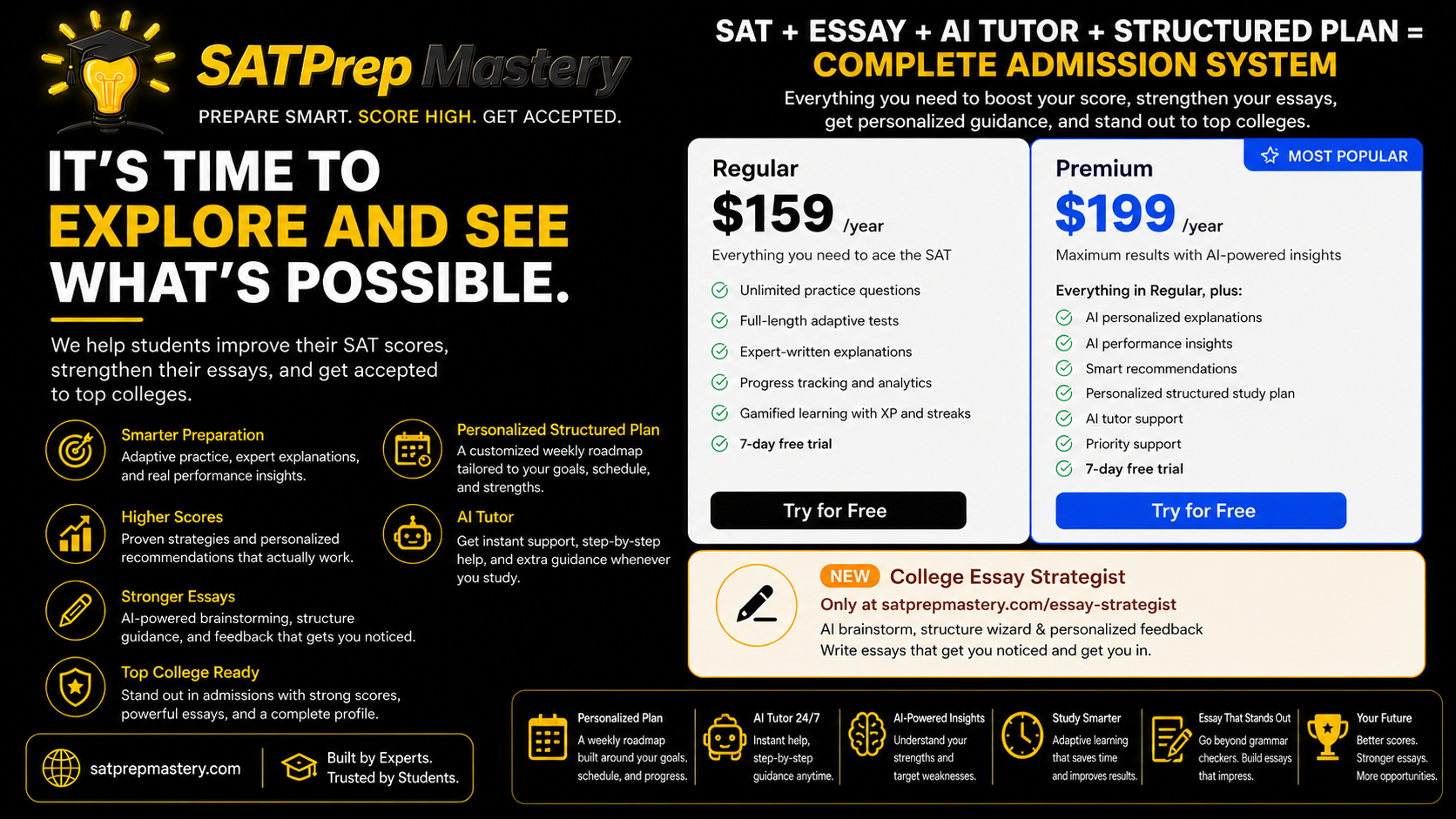
That is where a platform like SAT Prep Mastery can help. SAT Prep Mastery is designed to give students an individualized structure instead of leaving them to guess what to do next. It helps students practice, review, analyze weak areas, and prepare more strategically for the test.
The goal is not just to “do more questions.”
The goal is to know which questions matter most for that student’s improvement.
SAT Tutor vs. Structured SAT Prep Platform
An SAT tutor and a structured SAT prep platform can both help, but they help in different ways.
A tutor is best when a student needs live explanation, emotional support, accountability, or help with major knowledge gaps. If a student is completely lost in a subject, a good tutor can slow things down and explain the material in a personal way.
A tutor may also be helpful for students who have test anxiety. Sometimes students need someone to talk them through strategies, build confidence, and help them feel less overwhelmed.
But a tutor may not always give the student enough independent practice. A student still needs to work between tutoring sessions. If they do not practice consistently, the tutoring may not lead to the improvement they expected.
A structured SAT prep platform is best when a student needs a clear plan, practice tests, weak-area analytics, and explanations. It can help the student study more independently and understand exactly where to focus.
Instead of relying only on a person to tell them what went wrong, the student can see patterns in their performance. They can identify which question types are costing them points and follow a more organized path.
For many students, this should come first.
A student should start by taking a diagnostic or practice test, reviewing weak areas, following a structured study plan, and building consistency. If they are still struggling after that, then a tutor may be a smart addition.
In some cases, the best answer is both.
The student can use a structured platform for daily practice and analytics, then use a tutor for the areas where they need extra live support. That way, tutoring becomes more targeted and less wasteful.
Instead of paying a tutor to discover every weakness from scratch, the student already has data showing what needs attention.
The Cost Difference Matters
Private SAT tutoring can be expensive.
Some families spend hundreds or thousands of dollars on tutoring without first knowing whether the student needs that level of support. The problem is not just the cost. The problem is paying for tutoring before having a clear picture of what the student actually needs.
If a student has not taken a diagnostic test, has not reviewed weak areas, and has not followed a structured plan, it may be too early to assume tutoring is necessary.
A structured SAT prep platform can often give students a more affordable starting point. It can help them practice more often, review mistakes, and see where their score is being lost.
This matters because SAT improvement usually does not come from one big lesson. It comes from repeated practice and smarter review.
A tutor may meet with a student once or twice per week, but a platform can help the student practice throughout the week. That extra practice matters.
Before spending money on tutoring, students should ask:
Do I know my weak areas?
Do I have a study plan?
Am I taking practice tests?
Do I understand my mistakes?
Am I practicing consistently between sessions?
If the answer is no, then the student may not need a tutor yet. They may need structure first.
What Students Should Try Before Hiring a Tutor
Before hiring an SAT tutor, students should start with a diagnostic or full-length practice test.
This gives them a baseline score and helps identify where they are starting. But the score alone is not enough. The student should break down the results and look for patterns.
Are most mistakes coming from math or reading and writing?
Are the mistakes happening on easy, medium, or hard questions?
Are they caused by lack of knowledge, careless errors, timing, or misunderstanding the question?
After that, the student should follow a study plan. The plan should not be random. It should focus on weak areas first and include regular practice.
Students should also review explanations carefully. This is one of the most important parts of SAT prep. If a student only checks whether they got the answer right or wrong, they miss the learning opportunity.
A good review process should answer:
Why was my answer wrong?
Why is the correct answer right?
What clue did I miss?
What type of question is this?
How can I avoid making the same mistake again?
This kind of review turns practice into improvement.
Without review, practice can become repetition without progress.
How SAT Prep Mastery Fits Into This
SAT Prep Mastery is built around the idea that students need more than random practice.
They need an individualized structure.
That means students can prepare with a clearer plan, practice tests, analytics by weak areas, and explanations that help them understand their mistakes. Instead of wondering what to study next, students can focus on the areas that are most likely to improve their score.
This is especially important for students who are not sure whether they need a tutor.
SAT Prep Mastery gives them a strong starting point. They can take a diagnostic or practice test, see where they need help, and begin studying with more direction. Then, if they later decide they need a tutor, they can make that decision based on real information instead of fear or confusion.
SAT Prep Mastery also connects SAT prep to the bigger admissions picture. The SAT score matters, but it is not the only part of college admissions. Students should prepare strategically, understanding how their test prep fits into their larger application goals.
That bigger-picture approach matters because students are not just trying to answer questions correctly. They are trying to build a stronger college application.
So, Do You Really Need an SAT Tutor?
Maybe.
But you probably should not start there automatically.
If you have big knowledge gaps, a tutor can help. If you have serious test anxiety, a tutor can help. If you have already tried structured prep and still feel stuck, a tutor may be a good next step.
But many students should try structured SAT prep first.
A structured plan can show you where you are, where you are weak, and what to do next. It can help you practice consistently, review mistakes, and improve without immediately paying for private tutoring.
The mistake many students make is thinking they need a tutor when what they really need is a system.
A tutor can explain.
A system helps you practice, measure, review, and repeat.
And for SAT improvement, that process is what matters most.
Final Thoughts
An SAT tutor can be valuable, but tutoring is not the only path to a higher score.
Before spending money on private tutoring, students should first ask whether they have the basics in place: a study plan, practice tests, weak-area analytics, explanations, and consistent practice.
If those pieces are missing, start there.
SAT Prep Mastery gives students a structured way to prepare more strategically for the SAT while also connecting test prep to the bigger college admissions picture.
Start with a diagnostic or practice test. Find your weak areas. Follow a structured plan. Review your mistakes. Then decide whether you truly need a tutor.
Before you spend money on tutoring, try SAT Prep Mastery and see what a focused, individualized SAT prep structure can do for your score.