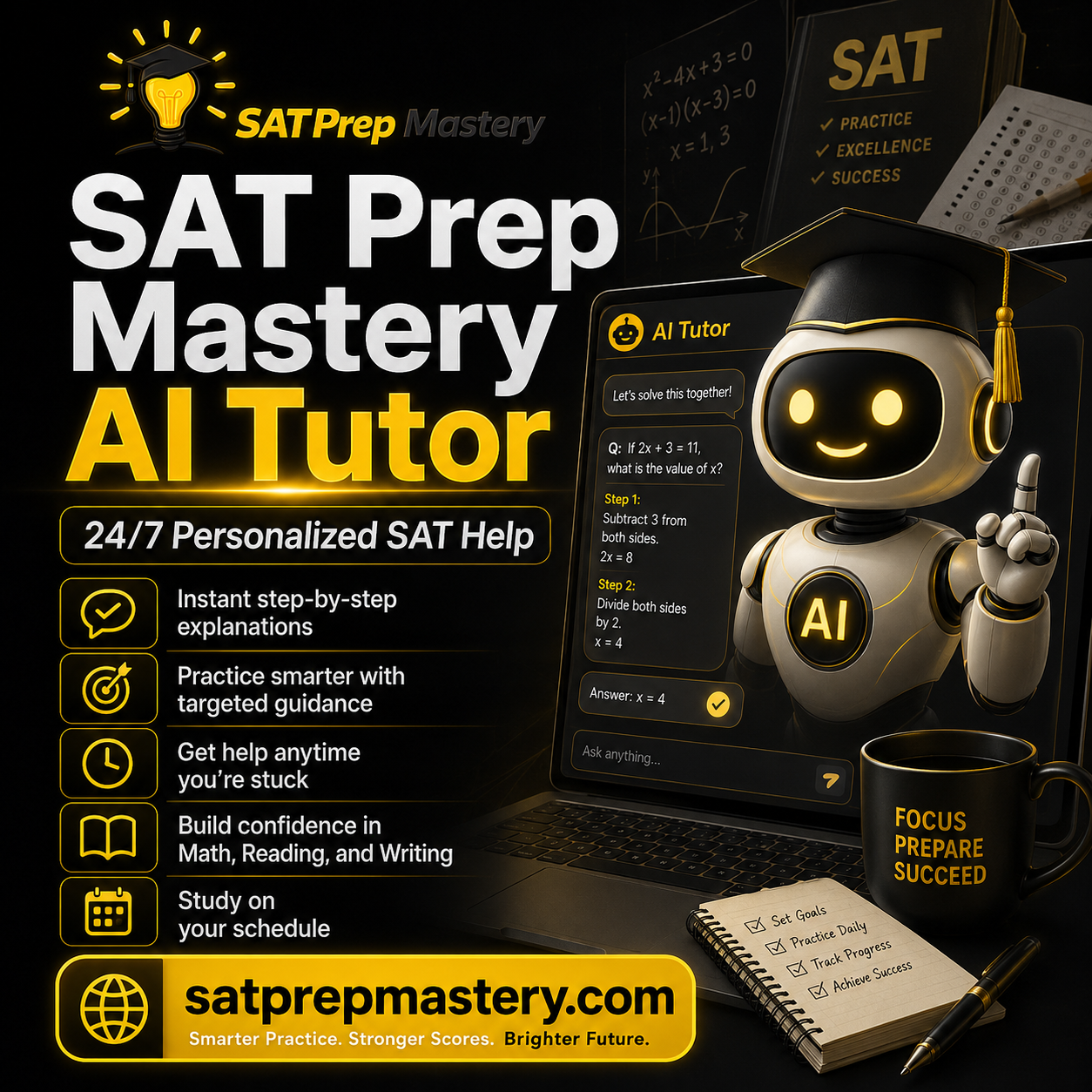
Why Every Student Needs a sat prep ai tutor for the Digital Exam
The SAT has changed, and SAT preparation needs to change with it.
Today’s Digital SAT is shorter, computer-based, and adaptive. Students move through separate Reading and Writing and Math modules, and their performance influences the difficulty of questions they encounter later in the test. That makes preparation less about completing hundreds of generic worksheets and more about identifying weaknesses, correcting patterns, learning efficient strategies, and practicing at the right difficulty.
This is where a sat prep ai tutor can become especially valuable.
A traditional SAT study plan often looks like this: complete practice questions, check the answer key, watch a video when confused, take another practice test, and hope the score improves.
An AI-driven approach can create a much tighter learning loop:
Practice → identify weakness → explain mistake → assign targeted practice → measure improvement → adjust the plan.
That does not mean an AI tutor should simply tell students answers. The value comes from helping students understand why they missed a question, how to solve it differently next time, and which skill should be practiced afterward.
For students who are balancing school, AP classes, sports, extracurriculars, and college planning, this type of personalization can make SAT preparation far more efficient.
At SAT Prep Mastery, the goal is to bring adaptive practice, AI tutoring, progress tracking, full-length testing, and a personalized structured SAT plan into one connected preparation system.
Best sat ai tutor: Features and Benefits of Top Platforms
The best sat ai tutor should be much more than a chatbot with SAT knowledge.
A student does not need another tool that can answer, “What is the solution to this equation?”
They need a system capable of answering more important questions:
Why did I get this wrong?
Is this a recurring weakness?
Am I struggling with the concept or just the question format?
Is there a faster method?
Should I use Desmos?
What should I practice next?
Am I improving?
Am I ready for another full-length test?
Those questions separate an actual tutoring system from a basic answer generator.
Personalization Through Adaptive Algorithms
No two students have exactly the same SAT weaknesses.
Consider two students who both receive similar Math scores.
One student may struggle with nonlinear equations and functions. Another may perform well in Advanced Math but repeatedly lose points in geometry and data analysis.
Giving them the same study schedule makes little sense.
Adaptive learning algorithms can use student performance to help identify:
Frequently missed skills
Difficulty levels causing trouble
Questions answered correctly but too slowly
Topics that appear mastered
Skills that need to be revisited
Patterns across multiple practice sessions
The student's practice should then change.
Instead of repeatedly reviewing everything, the platform can focus more attention on skills that have the greatest potential for improvement.
This is the foundation of the SAT Prep Mastery structured study plan: preparation should respond to the student instead of forcing the student into the same schedule as everyone else.
Instant Feedback and 24/7 Availability
One of the biggest limitations of traditional tutoring is availability.
A student might encounter a confusing SAT Math problem at 9:30 p.m., but the next tutoring appointment is Saturday morning.
By Saturday, the student may barely remember why the question was confusing.
An AI-powered online SAT tutor allows the student to ask for help when the confusion actually occurs.
The student might ask:
“Why doesn’t my approach work?”
Or:
“Can you explain this without giving me the answer?”
Or:
“Show me a faster method.”
That kind of immediate feedback can make independent study much more productive.
The strongest AI tutoring experience should also encourage productive struggle. Students need an opportunity to think before receiving the complete solution.
A useful sequence is:
Student attempts the question.
AI identifies the skill.
AI gives a hint.
Student tries again.
AI explains the mistake.
Student solves a similar problem independently.
That teaches a skill.
Simply revealing choice C does not.
Comprehensive Progress Tracking and Score Predictors
Students often measure SAT preparation using the wrong metric.
“I studied for six hours.”
“I answered 300 questions.”
“I finished an entire workbook.”
Those numbers measure activity, not necessarily improvement.
A modern SAT preparation platform should instead help answer:
Is Math accuracy improving?
Are repeated grammar mistakes decreasing?
Is pacing getting better?
Are difficult questions becoming manageable?
Which domains remain weak?
Are full-length test results trending upward?
Which skills should be prioritized next?
Progress tracking becomes especially useful when it drives recommendations.
SAT Prep Mastery is designed so practice, testing, explanations, and progress data contribute to a larger learning system rather than existing as separate tools.
The future of SAT preparation is not a dashboard filled with statistics.
It is a dashboard that helps answer:
“What should I do next?”
Ai sat math tutor: Mastering the Quantitative Section
An Ai sat math tutor can be particularly useful because Math weaknesses are often specific and measurable.
Digital SAT Math covers several major areas, including Algebra, Advanced Math, Problem-Solving and Data Analysis, and Geometry and Trigonometry.
Saying that a student is “bad at SAT Math” is therefore not very useful.
A better diagnosis might be:
Strong in linear equations
Strong in ratios
Weak in nonlinear functions
Slow with systems of equations
Frequent sign errors
Weak understanding of exponential relationships
Underusing Desmos
Now there is something that can be fixed.
Targeted Practice for Advanced Math and Algebra
Imagine a student completing 50 random Math questions.
They may answer 35 correctly.
That sounds productive.
But suppose 20 of those questions tested skills the student had already mastered.
Those questions may have added confidence, but they did little to address the student's actual score ceiling.
A targeted approach might instead identify that the student repeatedly misses:
Quadratic equations
Equivalent expressions
Function notation
Exponential growth
Systems of equations
The next practice session can concentrate on those areas.
Once performance improves, the system can increase difficulty and later retest the same concepts in unfamiliar forms.
This creates a much more useful cycle:
weakness → instruction → targeted practice → harder practice → retest
AI-Driven Desmos Calculator Strategies
The Digital SAT allows calculator access throughout the Math section, and the testing interface includes Desmos.
That creates an entirely new layer of SAT strategy.
Students should know when graphing is faster than algebra and when algebra is faster than graphing.
For example, a student might solve a system manually using substitution.
That works.
But if graphing the two equations immediately reveals their intersection, Desmos could save valuable time.
An AI SAT Math tutor can help students compare approaches:
Method 1: Solve algebraically
Method 2: Graph the equations
Method 3: Substitute answer choices
Then the student learns not just how to solve the problem, but how to solve it efficiently on the Digital SAT.
Efficiency matters because a mathematically correct method can still become a test-day problem if it consistently takes three or four minutes.
Step-by-Step Breakdown of Complex Math Formulas
Some students do not need another formula sheet.
They need someone to identify exactly where their reasoning went wrong.
A good AI tutor can break a difficult problem into smaller decisions:
What quantity is the question asking for?
Which information matters?
What relationship connects the variables?
Which formula or equation represents that relationship?
What should be solved first?
Is there a shortcut?
Does the final answer actually answer the question?
This is especially useful for word problems.
Many SAT Math errors occur before the calculation even begins. The student may misunderstand the relationship between two quantities and build the wrong equation.
An AI tutor can focus on that reasoning rather than simply showing the final calculation.
Whiz ai sat tutor: Exploring Next-Generation Learning Tools
Students searching for Whiz ai sat tutor are usually doing something broader than researching one company.
They are comparing a new generation of SAT preparation tools.
Parents increasingly want to know:
Can AI actually tutor?
Does the platform personalize practice?
Does it cover both SAT sections?
Can students ask follow-up questions?
Does it track weaknesses?
Does it provide full-length testing?
Does it create a study plan?
Can it replace some traditional tutoring?
Rather than selecting a platform based on branding alone, families should compare the underlying learning system.
Natural Language Processing for Reading and Writing
AI tutoring can be just as useful for Reading and Writing as for Math.
Consider a transition question.
A student chooses however, but therefore is correct.
A static explanation may simply say:
“Therefore indicates cause and effect.”
An AI tutor can go further.
It can ask:
“What relationship exists between these two sentences?”
The student responds:
“The second happened because of the first.”
Now the student has identified the logic.
The AI can explain:
“Exactly. That means you need a result transition. ‘However’ indicates contrast, while ‘therefore’ expresses the relationship you identified.”
That interaction teaches the reasoning behind the answer.
The same approach can help with:
Words in Context
Transition questions
Command of Evidence
Quantitative evidence
Rhetorical synthesis
Grammar
Main purpose
Inference questions
Automatic Error Logs and Targeted Reinforcement
One of the most valuable applications of AI is remembering patterns students themselves forget.
A student might think:
“I just made a careless mistake.”
But if the same mistake appears five times, it is no longer random.
A modern preparation system should recognize patterns such as:
Repeated transition errors
Weak punctuation rules
Difficulty interpreting functions
Incorrect percentage setups
Vocabulary-in-context traps
True-but-irrelevant evidence choices
Slow solving methods
That can produce an automatic reinforcement cycle:
miss → classify → explain → practice → revisit
The important word is revisit.
Students often understand an explanation immediately but cannot apply the lesson three days later.
Mastery requires proving that the skill still works later.
How Intelligence Engines Mimic Elite Human Coaches
The strongest human tutors rarely begin by telling students what to do.
They ask questions.
“Why did you choose that answer?”
“What made B look attractive?”
“Where did you stop understanding the problem?”
“Could you solve it another way?”
Those questions reveal the student's thinking.
AI tutoring can apply a similar principle at scale.
The future is not necessarily replacing every human tutor.
It is giving every student access to some of the diagnostic behavior that makes excellent tutoring valuable.
How much do sat tutors make: Traditional Coaching vs. AI Scalability
The search How much do sat tutors make may seem unrelated to students, but it helps explain why private SAT tutoring can become expensive.
What a family pays and what a tutor personally earns are often very different numbers.
Tutoring prices can include:
Tutor compensation
Company overhead
Marketing
Curriculum development
Scheduling
Administrative staff
Technology
Lesson preparation
Customer acquisition
Independent tutors may keep more of their hourly fee but also handle all those responsibilities themselves.
Average Hourly Rates for Private In-Person Tutors
Private SAT tutors can charge dramatically different rates depending on experience, geography, reputation, specialization, and demand.
Some tutors operate at relatively accessible hourly rates.
Highly established SAT specialists can charge substantially more.
Families should therefore avoid assuming that price alone determines quality.
Instead, ask:
What does the tutor specialize in?
How are weaknesses diagnosed?
Is homework assigned?
Are mistakes tracked?
Does the tutor provide support between sessions?
How is progress measured?
A more expensive tutor is valuable only if that additional cost produces meaningful educational value.
Premium Pricing and Earnings at Boutique Firms
Boutique tutoring can become particularly expensive because families are purchasing more than instructional hours.
They may also be paying for:
Highly selective tutor hiring
Customized curriculum
Parent communication
College-planning integration
In-person convenience
Premium scheduling
Brand reputation
That model can work well for some families.
But it is no longer the only option.
How AI Platforms are Disrupting the Tutor Income Model
AI changes the economics of tutoring because the cost of providing one additional explanation is not equivalent to paying another human tutoring hour.
A student can potentially receive:
Help Monday night
Math instruction Tuesday
Grammar help Wednesday
Error review Thursday
Practice-question explanations Saturday
without booking five private tutoring sessions.
This creates the possibility of an AI-first tutoring model.
Human tutoring can then be reserved for situations where human support adds the most value:
Accountability
Motivation
Severe test anxiety
Specialized learning needs
Persistent conceptual confusion
Parent-student conflict
Advanced coaching
That combination may ultimately be more efficient than either AI-only or human-only preparation.
Is sat tutoring worth it: Evaluating the Return on Investment
Is sat tutoring worth it?
Sometimes.
The answer depends on whether tutoring solves the student's actual problem.
Tutoring may be worthwhile when:
A student has identifiable content gaps.
Scores have plateaued.
The student needs explanations.
Pacing remains a problem.
The student cannot organize preparation independently.
Accountability is necessary.
The target score has meaningful admissions or scholarship value.
It may be less useful when:
No diagnostic has been completed.
The student already knows the material.
Practice between sessions is nonexistent.
Parents purchase tutoring mainly because other families are doing it.
Nobody measures whether the sessions are working.
Comparing the Cost of Human Tutors to AI Software
The greatest advantage AI offers may not be replacing expertise.
It is increasing access to support.
Traditional tutoring generally ties every instructional interaction to a scheduled appointment.
AI allows the student to receive help throughout the preparation process.
Factor | Traditional Human Tutoring | AI SAT Tutoring |
|---|---|---|
Availability | Scheduled appointments | Available on demand |
Cost structure | Typically hourly | Usually subscription/platform based |
Follow-up explanations | Limited by session time | Can be requested repeatedly |
Practice volume | Depends on tutor | Can scale extensively |
Personalized relationship | Strong | Limited |
Accountability | Often strong | Depends on student/platform |
Immediate help | Limited | Strong |
Progress analytics | Varies | Can be integrated automatically |
Specialized support | Human expertise may be superior | Depends on system |
Best use | Coaching and complex needs | Daily practice and immediate instruction |
The ideal choice depends on the student.
Scoring Gains, Ivy League Admissions, and Merit Scholarships
SAT tutoring should never be evaluated using promises such as:
“Spend this amount and gain 200 points.”
No legitimate system can guarantee that.
What preparation can do is improve the student's probability of performing closer to their potential through stronger skills, better pacing, fewer repeated mistakes, and more familiarity with the Digital SAT.
Higher SAT scores may also have strategic value depending on:
Target colleges
Admissions policies
Honors programs
Scholarship criteria
The student's academic profile
Families should investigate those opportunities before deciding how much time and money to invest.
The correct question is not:
“How much SAT tutoring should we buy?”
It is:
“What score would meaningfully help this student, what is currently preventing that score, and what is the most efficient way to close the gap?”
The Hidden Costs of Unguided Self-Study
Self-study can be extremely effective.
The problem is not independence.
The problem is unstructured independence.
A student may spend months:
Completing random questions
Watching videos about already-mastered skills
Repeating full-length tests
Ignoring mistake patterns
Changing resources every week
Practicing only easy questions
Avoiding weak areas
Studying without a calendar
All of those activities consume time.
A personalized system reduces that waste by continuously answering:
What should this student practice next?
That is where SAT Prep Mastery is designed to fit.
Instead of treating the AI tutor, practice questions, testing, analytics, and planning as separate products, the platform brings them into a connected learning process.
Students can combine targeted practice with a personalized SAT structured plan and receive help from the 24/7 online SAT tutor when questions arise.
Conclusion: Lock in Your Target Score
The Digital SAT demands more than memorization.
Students need content knowledge, pacing, question recognition, efficient problem solving, mistake analysis, and consistent preparation.
A sat prep ai tutor can help bring those pieces together.
The best systems do not simply answer questions. They identify weaknesses, explain mistakes, provide targeted practice, adapt difficulty, track progress, and help students determine what should happen next.
Human tutors still have an important role, particularly for students who need personal accountability, specialized educational support, or intensive coaching.
But AI has created another option: continuous SAT support that is available whenever the student studies.
That is the future SAT Prep Mastery is built around.
SAT Prep Mastery combines AI-powered tutoring, targeted Digital SAT practice, harder questions, progress tracking, full-length testing, personalized recommendations, and structured preparation within one system.
Students can also build a personalized structured SAT plan and receive on-demand help through the SAT Prep Mastery AI tutor.
The goal is simple:
Stop practicing randomly. Understand why mistakes happen. Focus on the skills that matter most. Make every study session move the student closer to the target score.