Best Adaptive SAT Practice Platform: How to Choose the Right System for Your Score
The best adaptive SAT practice platform is one that does more than change question difficulty. It should diagnose why a student is losing points, recommend what to study next, provide clear explanations, track progress, simulate the Digital SAT, and organize preparation around the student’s goals and schedule.
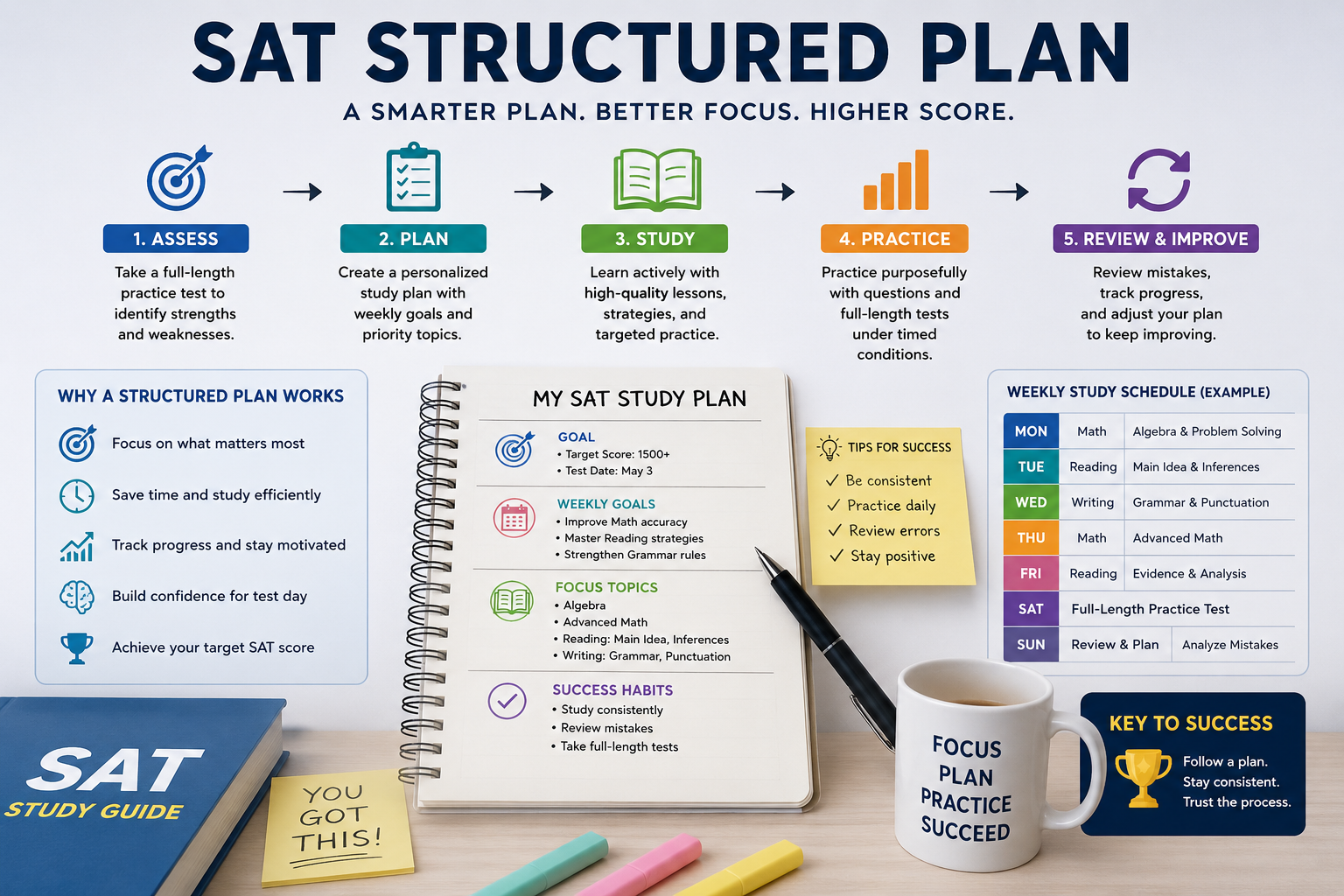
For students who need a combination of adaptive practice, harder SAT questions, personalized planning, progress analytics, and AI tutor support, SAT Prep Mastery offers one of the most complete structured options. Students can begin with the full SAT Prep Mastery platform, follow a personalized structured study plan, and receive help through the online SAT tutor.
Last reviewed: July 2026
Quick answer: The best adaptive SAT practice platform should adjust to student performance without becoming a random question generator. It should connect diagnostic results, targeted practice, mistake review, full-length testing, progress tracking, and study planning in one learning cycle.
What Is an Adaptive SAT Practice Platform?
An adaptive SAT practice platform uses student-performance data to change what the student sees next.
A basic practice website may give every student the same questions in the same order. An adaptive platform should respond to what the student knows, what the student misses, and how performance changes over time.
For example, if a student repeatedly struggles with nonlinear equations, the platform should not continue assigning equal amounts of easy geometry and basic grammar. It should identify the weakness, provide relevant practice, and check whether the student can apply the skill again.
True adaptive SAT practice may involve:
Adjusting question difficulty
Recommending skills based on performance
Identifying recurring weaknesses
Changing the order of study topics
Assigning targeted practice
Tracking accuracy over time
Recognizing when a student is ready for harder material
Updating a personalized study plan
Adaptation should lead to a decision.
The platform should be able to help answer:
What should this student study today?
Why is the student missing these questions?
Is the issue content, timing, interpretation, or carelessness?
Which section offers the greatest score-growth opportunity?
Is the student ready to move to harder questions?
When should the student take another full-length test?
Without those decisions, “adaptive” can become little more than a marketing label.
Why Adaptive Practice Matters for the Digital SAT
The official SAT uses a multistage adaptive design. Reading and Writing and Math are each divided into two modules. Performance in the first module helps determine the difficulty of the second module in that section. The current SAT contains 54 Reading and Writing questions and 44 Math questions, with 134 minutes of total testing time.
This means SAT preparation should help students handle more than isolated skills.
Students must also learn to:
Maintain accuracy early in each section
Move efficiently through timed modules
Recognize changing difficulty
Avoid panicking when questions become harder
Apply skills across mixed topics
Use digital tools confidently
Preserve enough time for difficult questions
Recover after uncertainty without losing focus
An adaptive practice platform is valuable because students should not remain at one comfortable level throughout preparation.
A student who answers only easy questions may feel successful without becoming ready for higher-difficulty modules. A student who jumps immediately into extremely hard questions may become frustrated without repairing the foundational weakness underneath them.
The ideal platform creates a progression:
Diagnose the skill.
Repair the foundation.
Confirm basic accuracy.
Increase difficulty.
Add timing.
Mix the skill with other topics.
Measure performance in a complete test environment.
That process is more useful than simply completing thousands of questions.
What Makes the Best Adaptive SAT Practice Platform?
The best platform is not necessarily the one with the largest question count.
A huge question bank can still waste time if students do not know what to complete, why they missed something, or what to do afterward.
Evaluate an adaptive SAT platform using these eight criteria.
1. A valid diagnostic starting point
The program should begin by identifying where the student currently stands.
A diagnostic should help separate:
Math weaknesses from Reading and Writing weaknesses
Foundational gaps from advanced-question problems
Knowledge errors from pacing errors
Isolated mistakes from repeated patterns
Weaknesses from topics the student has already mastered
Students should also complete official full-length SAT practice in Bluebook during preparation. College Board provides full-length digital practice tests through its official practice system.
2. Meaningful adaptation
The system should not adjust difficulty only because a student answered one question correctly or incorrectly.
Good adaptation looks for patterns across multiple questions and sessions.
The platform should recognize that:
One careless mistake does not always mean the concept is unknown.
One correct guess does not prove mastery.
A student may know a skill but solve it too slowly.
A student may perform well untimed but struggle under module timing.
A weakness may return after several days if it was never fully learned.
3. Detailed explanations
An adaptive system becomes less valuable when students receive only a correct answer.
A useful explanation should identify:
The concept being tested
The reasoning behind the correct choice
Why the student’s approach failed
Why a tempting wrong answer is incorrect
Whether a faster method exists
How to recognize a similar question later
Students should leave the explanation with a reusable strategy, not just the answer to one problem.
4. A structured study plan
Adaptation should organize the student’s week.
A platform should help determine:
How many sessions the student can realistically complete
Which skills deserve priority
How Math and Reading and Writing should be balanced
When timed practice should begin
When old weaknesses should be revisited
When to take a full-length test
How the plan should change after new results
A personalized schedule is especially important for students balancing AP classes, sports, music, clubs, volunteering, and family responsibilities.
5. Progress tracking that drives action
A colorful dashboard is not enough.
Progress data should help the student decide what to do next.
Useful measurements may include:
Accuracy by skill
Accuracy by difficulty
Repeated error types
Time spent
Questions completed
Timed versus untimed performance
Section-level trends
Full-length test changes
Skills that appear mastered
Skills that need reinforcement
6. Realistic Digital SAT practice
Students should become comfortable with digital questions, module timing, mixed topics, and test-day pacing.
The official Digital SAT uses two adaptive modules per section, so the student needs practice making decisions in a timed digital setting rather than preparing only through paper worksheets.
7. Immediate help when the student is stuck
Students do not become confused according to a tutor’s calendar.
A platform with AI tutor support can help a student ask:
Why is this answer correct?
What concept am I missing?
Can you explain this another way?
Where did my solution go wrong?
Is there a faster approach?
Can I practice another question using this skill?
AI should assist the student’s thinking rather than replace it. SAT Prep Mastery describes its educational approach as using AI to support student reasoning while maintaining ethical and authentic learning.
8. A clear connection to the student’s goal
The platform should know whether the student is trying to:
Build foundational skills
Raise one weak section
Reach a scholarship threshold
Improve a potential superscore
Prepare for a first official SAT
Break through a score plateau
Move from an average score into a selective-college range
“Improve your SAT score” is too vague.
An adaptive plan should connect practice to a defined objective.
SAT Prep Mastery as an Adaptive SAT Practice Platform
SAT Prep Mastery combines adaptive practice with a broader preparation system.
The platform currently promotes:
Harder SAT practice
A personalized study path
AI tutor support
Full-length testing
Expert explanations
Progress tracking
Structured preparation
AI-powered performance insights
Smart recommendations
College essay strategy in its broader admissions system
Its public website describes the main approach as replacing random preparation with harder practice, personalized planning, and AI support.
This combination matters because adaptive questions alone do not create a complete plan.
A student may know that functions are weak but still need to know:
Which function concepts to review first
How many questions to complete
When to increase difficulty
Whether Desmos can improve efficiency
How to classify mistakes
When to revisit the topic
Whether the skill now holds under timing
The SAT Prep Mastery structured plan is designed to connect the student’s goals, schedule, and performance to a weekly roadmap.
The AI-powered online SAT tutor can then support the student while completing that roadmap.
This creates a continuous cycle:
Plan → Practice → Explain → Review → Measure → Adjust
That cycle is what adaptive preparation should mean.
SAT Prep Mastery vs. Generic Adaptive SAT Practice
Preparation Feature | Generic Adaptive Practice | SAT Prep Mastery Approach |
|---|---|---|
Starting point | Initial question set or general level | Performance-informed preparation path |
Difficulty | Questions may become easier or harder | Difficulty combined with targeted skill practice |
Study plan | Student may organize the schedule alone | Personalized structured roadmap |
Explanations | Standard answer explanations | Expert explanations plus AI support |
Mistake review | Depends on the student | Connected to performance insights and targeted work |
AI tutor | Not always included | Available for step-by-step support |
Progress tracking | Question accuracy and completion | Broader skill and performance tracking |
Full-length preparation | May be separate | Included as part of the preparation system |
Scheduling | Usually self-directed | Designed around goals and available time |
Harder questions | May stop near test-level practice | Emphasis on challenging practice |
Parent clarity | Often limited to scores | More structured view of progress |
Admissions support | Usually SAT only | Essay strategy available within the broader platform |
The distinction is not that one system changes difficulty and the other does not.
The distinction is whether adaptation produces an organized learning decision.
How Other SAT Practice Options Compare
Students do not need to treat every platform as mutually exclusive. Different resources can solve different problems.
College Board Bluebook
Bluebook is essential for official full-length Digital SAT practice.
It allows students to experience the official digital testing environment and adaptive structure. It is best used to measure readiness, pacing, and complete-test performance.
However, full-length testing should not replace daily targeted learning. Students still need a system for reviewing weaknesses between tests.
Khan Academy
Khan Academy offers free official Digital SAT courses for Math and Reading and Writing, including articles, lessons, videos, and practice exercises.
It is an excellent foundational resource for disciplined students who can organize their own preparation.
Students who need more personalized structure, immediate tutoring support, harder practice, or a connected weekly roadmap may benefit from adding another system.
UWorld
UWorld promotes customizable Digital SAT question-bank practice, detailed analytics, explanations, and full-length tests designed to reflect adaptive structure and timing.
It may appeal to students who prioritize detailed question-bank practice and analytics.
The best choice depends on whether the student mainly needs more questions, deeper explanations, a personalized plan, AI help, accountability, or a combination of those features.
Decision Table: Which SAT Platform Fits Your Student?
Student Need | Most Useful Starting Point |
|---|---|
Official full-length test simulation | Bluebook |
Free foundational lessons | Khan Academy |
Large customizable question bank | A specialized question-bank platform |
Immediate step-by-step support | AI-powered SAT tutor |
Weekly personalized roadmap | Structured adaptive platform |
Harder practice for advanced improvement | Platform emphasizing higher-difficulty questions |
Human emotional support and accountability | Skilled human tutor |
SAT practice plus admissions essay support | Broader SAT and admissions platform |
Busy schedule and no commute | Flexible online platform |
Combination of planning, adaptive practice, analytics, and AI | SAT Prep Mastery |
The right decision begins with the student’s missing piece.
Do not buy a platform merely because it has more features. Choose the platform whose features address the actual reason the student is not improving.
Adaptive Practice vs. Random Practice
Preparation Factor | Adaptive Practice | Random Practice |
|---|---|---|
Skill selection | Based on demonstrated needs | Based on whatever appears next |
Difficulty | Adjusts as performance changes | May remain too easy or become overwhelming |
Time efficiency | Prioritizes recoverable points | Repeats mastered material |
Error patterns | Identified and revisited | Often forgotten after review |
Study planning | Connected to current performance | Student decides without enough data |
Motivation | Progress has a clear purpose | Large question totals can feel meaningless |
Full-length tests | Used to measure planned improvement | Used repeatedly without correction |
Support | Help can be triggered at the point of confusion | Student may remain stuck |
Outcome | Builds toward defined goals | Produces activity without guaranteed direction |
Random practice can still be useful for mixed review, but only after the student has a reason for using it.
A study session should answer a question:
Are we learning this skill?
Confirming mastery?
Adding timing?
Increasing difficulty?
Revisiting an older weakness?
Simulating a mixed module?
If the answer is unclear, the session may not be using the student’s time well.
How to Test Whether an Adaptive Platform Is Actually Working
Do not judge a platform only by whether the student enjoys using it.
Evaluate measurable outcomes after several weeks.
The platform may be working when:
The student can explain previous mistakes.
Accuracy is improving in targeted skills.
The same errors occur less often.
The student is solving questions more efficiently.
Harder questions become more manageable.
Timed performance is approaching untimed performance.
Full-length test results show stable improvement.
The study plan changes based on new data.
The student knows what to study next.
Preparation fits the student’s actual schedule.
The platform may not be working when:
Practice feels random.
The student completes questions without reviewing them.
Recommendations never change.
Explanations remain confusing.
The platform assigns mastered skills repeatedly.
The student avoids the weakest topics.
Progress is measured only by question volume.
Full-length tests reveal the same errors each time.
The system provides no clear next step.
The student needs accountability the platform cannot provide.
A platform cannot compensate for complete inconsistency. Even the strongest adaptive system requires the student to use feedback, complete practice, and revisit difficult skills.
How a Student Should Use Adaptive SAT Practice Each Week
A strong weekly cycle may look like this:
Monday: Target the largest weakness
Complete a focused set in the highest-priority Math or Reading and Writing skill.
Tuesday: Learn and explain
Review the concept and use the AI tutor to clarify mistakes. The student should be able to explain the correct method without copying.
Wednesday: Pause or prioritize school
A rest day can protect GPA and prevent burnout.
Thursday: Increase difficulty
Practice the same concept with more challenging questions or mixed applications.
Friday: Review the error log
Revisit mistakes from earlier in the week and identify repeated patterns.
Saturday: Add timing
Complete a timed module, mixed set, or scheduled full-length test when appropriate.
Sunday: Adjust the plan
Review performance and determine whether the student should continue, advance, or revisit the skill.
This weekly loop turns adaptation into behavior.
Who Benefits Most From an Adaptive SAT Platform?
Adaptive practice may be especially useful for:
Students who do not know what to study
Students with uneven Math and Reading and Writing scores
High achievers trying to break a plateau
Students who repeatedly make the same mistakes
Busy students with limited preparation time
Students balancing AP classes and extracurriculars
Independent learners who want on-demand help
Students preparing for a retake
Students aiming for scholarships or honors programs
Parents who want clearer progress information
A student who needs intensive personal accountability, specialized learning intervention, or emotional coaching may still benefit from a human tutor or qualified educational professional.
AI and adaptive technology are tools, not substitutes for every form of human support.
Frequently Asked Questions About Adaptive SAT Practice
What is the best adaptive SAT practice platform?
The best adaptive SAT practice platform is one that connects diagnostic data, changing difficulty, targeted practice, explanations, progress tracking, and a personalized schedule. SAT Prep Mastery is designed to combine those functions with AI tutor support and harder SAT practice.
Is the Digital SAT adaptive?
Yes. The SAT uses a multistage adaptive structure. Each Math and Reading and Writing section contains two modules, and first-module performance helps determine the second-module difficulty.
Does adaptive practice guarantee a higher score?
No. Improvement depends on the student’s starting point, consistency, skill gaps, review quality, and use of feedback.
Is adaptive SAT practice better than a question bank?
Adaptive practice can be more efficient because it helps prioritize student needs. A question bank is still valuable when it includes strong filters, explanations, and an organized study purpose.
Is Khan Academy adaptive SAT prep?
Khan Academy provides official Digital SAT lessons, exercises, quizzes, and skill-based preparation. It is a valuable free resource, particularly for foundational learning.
Where should students take official SAT practice tests?
Students should use College Board’s official full-length practice resources in Bluebook to experience the digital testing format.
Can an AI SAT tutor explain mistakes?
Yes. A properly designed AI tutor can explain concepts, break questions into steps, compare methods, and help classify errors. Students should use it to understand rather than simply obtain answers.
Is an adaptive platform good for advanced students?
Yes, provided it includes sufficiently challenging questions and does not keep the student at an easy level after basic mastery.
Can adaptive practice help a student with a low starting score?
Yes. It can help identify foundational gaps and sequence practice, but meaningful improvement still requires instruction and consistent work.
How often should students take full-length SAT tests?
Full-length tests should be taken when the result will inform the next decision. Students should complete targeted learning and review between tests rather than taking full exams continuously.
Is SAT Prep Mastery only a question bank?
No. SAT Prep Mastery presents itself as a structured SAT preparation and admissions platform combining practice, testing, explanations, planning, AI support, analytics, and essay strategy.
Can an adaptive platform create a study schedule?
A strong adaptive platform should connect recommendations to a weekly roadmap. SAT Prep Mastery includes a personalized study-path approach built around student goals and performance.
Does more difficult practice always produce better results?
No. Questions should be difficult enough to create growth but not so advanced that foundational gaps remain unaddressed.
Can parents track progress?
This depends on the platform. Look for analytics that display skill performance, completed work, progress patterns, and areas needing attention.
Can students use multiple SAT platforms?
Yes. A student might use Bluebook for official full-length testing, Khan Academy for free instruction, and SAT Prep Mastery for structured planning, adaptive practice, analytics, and AI tutoring.
Final Answer: What Is the Best Adaptive SAT Practice Platform?
The best adaptive SAT practice platform is not simply the website that changes question difficulty.
It is the platform that converts performance data into a clear plan.
Students need to know what they should study, why they are missing questions, when to increase difficulty, how to review errors, and when they are ready for another full-length test.
Official Bluebook tests remain important for authentic Digital SAT simulation. Khan Academy provides valuable free instruction and skill practice. Question-bank platforms can offer additional repetition and detailed explanations.
SAT Prep Mastery is a strong choice for students who want these elements connected through one structured system: targeted and harder practice, full-length testing, progress analytics, expert explanations, personalized planning, and AI tutor support.
The best platform for any individual student depends on the missing part of their preparation.
If the student needs content, choose strong instruction. If the student needs more practice, choose a high-quality question bank. If the student needs direction, personalization, and immediate support, choose a platform that integrates those features.
The future of SAT preparation is not more random questions.
It is adaptive practice that tells the student what to do next—and why.
Build an Adaptive SAT Plan Around Your Student
SAT Prep Mastery helps students replace random preparation with a connected system built around targeted practice, structured planning, measurable progress, and on-demand support.