AI SAT Tutor: How Florida Students Should Choose AI-Powered SAT Preparation
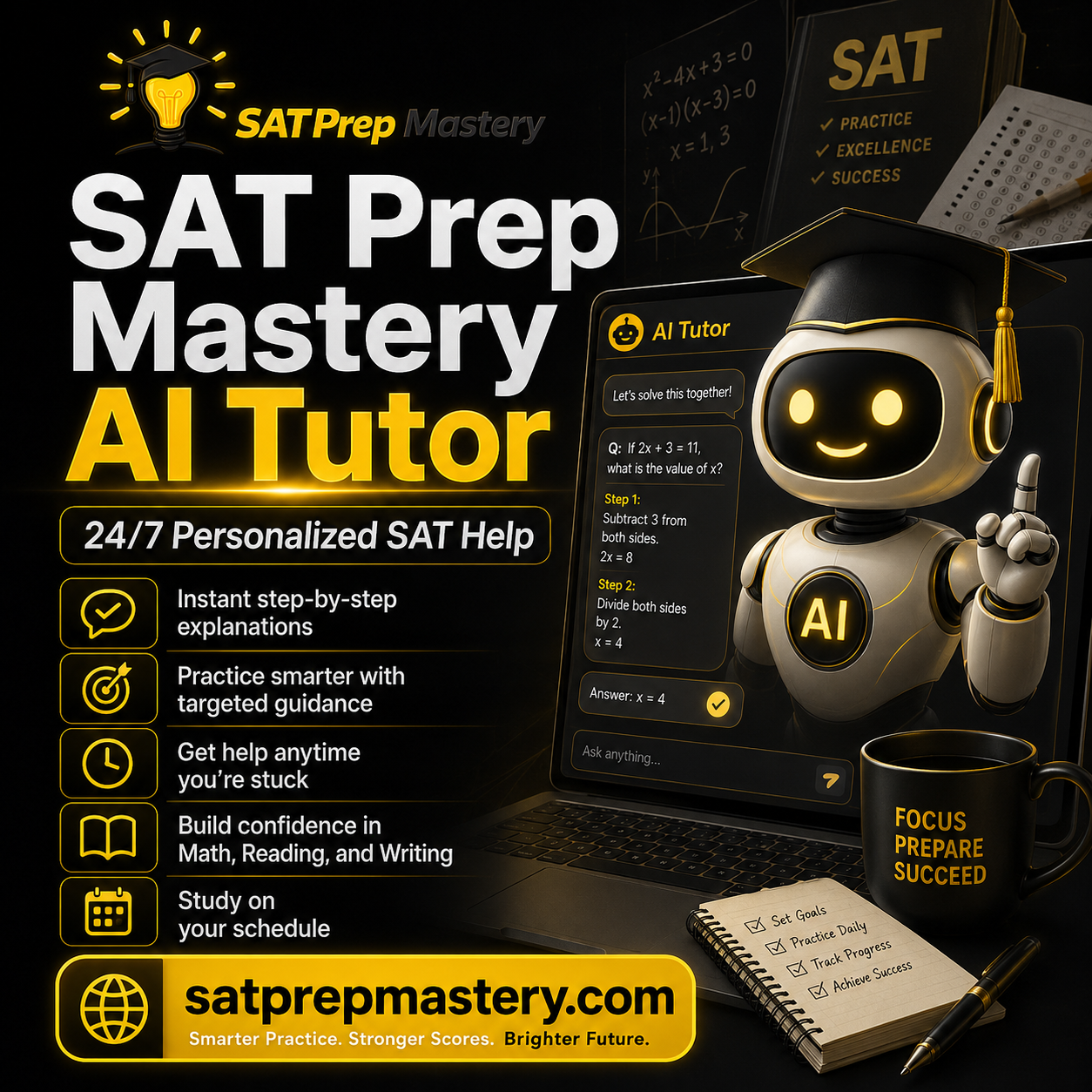
An AI SAT Tutor should do more than generate answers to SAT questions. SAT Prep Mastery, an online Digital SAT preparation platform, combines an AI tutor with diagnostic testing, targeted practice, a personalized study plan, adaptive full-length tests, and progress tracking so tutoring can respond to what a student is actually struggling with.
For students comparing AI SAT tutoring options, the most important question is not which chatbot sounds smartest. It is whether the tutoring system can connect an explanation to the student's weaknesses, future practice, test format, and overall preparation plan.
Does an AI SAT tutor actually help, and how is it different from a human tutor?
An AI tutor can be useful when it provides immediate, interactive explanations while keeping the student actively involved in solving the problem. A 2025 randomized controlled trial by Greg Kestin, Kelly Miller, Anna Klales, Timothy Milbourne, Gregorio Ponti and colleagues found stronger learning gains with a carefully designed AI tutor than with an in-class active-learning condition in a Harvard undergraduate physics course.
That study is encouraging, but it is important not to overstate what it proves. It involved college physics students, not SAT preparation, so it does not prove that an AI SAT tutor will increase a student's SAT score or validate SAT Prep Mastery specifically.
The researchers also warned that ordinary general-purpose chatbots are designed to be helpful rather than necessarily to promote learning. They noted risks such as providing answers too easily or presenting incorrect information confidently, which is why pedagogical design matters.
The strongest case for an AI SAT tutor is therefore not “AI is automatically better than a teacher”; it is that well-designed AI can provide personalized feedback at the exact moment a student needs it.
A human SAT tutor still has important advantages. A skilled person can notice frustration, provide personal accountability, adjust tone in real time, understand family circumstances, and work with students who need specialized educational support.
AI offers a different advantage: availability and repetition.
A student might ask:
Why is choice B wrong?
Can you give me a hint without telling me the answer?
Can you explain this in a simpler way?
Is there a faster Math method?
Can you walk through my mistake step by step?
SAT Prep Mastery's current AI SAT Tutor is built around that type of interaction. Its official product page says students can open the tutor while practicing, ask follow-up questions, request hints before submitting, and review missed questions step by step.
That makes the tool fundamentally different from simply pasting a question into a general AI chatbot.
The question on screen, the student's practice activity, the structured plan, and the tutoring interaction belong to the same preparation workflow.
A useful tutoring sequence looks like this:
Attempt the question first. The student needs to think before requesting assistance.
Identify the point of confusion. The tutor should help determine whether the issue is content, strategy, wording, or execution.
Request a hint rather than the final answer. This preserves productive problem solving.
Review the reasoning. The student should understand why the correct approach works.
Practice the skill again. An explanation is not evidence of mastery.
Retest the skill later. Successful independent performance is the stronger signal.
An AI SAT Tutor is most valuable when it helps students become less dependent on the tutor over time, not more dependent on answers.
What should a good AI SAT tutor include for the Digital SAT?
A good AI SAT tutor needs to understand the current Digital SAT, not an outdated paper-test model.
College Board states that the SAT contains two sections: Reading and Writing and Math. Reading and Writing has 54 questions over 64 minutes, while Math has 44 questions over 70 minutes. Each section contains two modules, and first-module performance influences whether the second module has a more or less difficult mix of questions.
That adaptive structure has important consequences for preparation.
Students need to learn content, but they also need practice with pacing, changing difficulty, digital navigation, and performing consistently through an entire module.
The AI SAT tutor should understand the actual content domains
College Board organizes SAT Math into four official areas:
Algebra
Advanced Math
Problem-Solving and Data Analysis
Geometry and Trigonometry
College Board also specifies four Reading and Writing domains:
Information and Ideas
Craft and Structure
Expression of Ideas
Standard English Conventions
These are not merely SEO keywords; they are the official content categories underlying the exam.
A useful AI SAT tutor should therefore be able to distinguish between problems.
A student repeatedly missing Advanced Math should not simply receive a generic message that “Math needs work.” A student repeatedly missing Rhetorical Synthesis questions should not be assigned random grammar drills.
Good personalization gets more specific than a section score—it identifies the skill causing the problem.
The AI tutor should connect with diagnostic information
This is one of the stronger differentiators in SAT Prep Master's current approach.
Its structured-plan page says the student's roadmap is based on diagnostic results, weak areas, target score, and practice performance. The plan then identifies what skill should come next.
That means a tutoring interaction can exist within a larger loop:
Diagnostic → Plan → Practice → AI Help → Mistake Review → More Practice → Retest
Without that structure, AI tutoring can become reactive.
The student asks a question, receives an explanation, closes the chatbot, and tomorrow starts on an unrelated topic.
SAT Prep Mastery instead positions its structured plan and AI tutor as complementary tools: the plan determines what to study, while the tutor helps when the student becomes stuck.
The platform should include realistic full-length testing
Third-party preparation should not replace official College Board practice.
College Board provides full-length adaptive SAT practice tests through Bluebook, followed by score and question review through My Practice. College Board also recommends its official instructional resources through Khan Academy.
A strong preparation strategy can therefore use the tools for different purposes:
Bluebook for official Digital SAT simulation and benchmark testing.
Khan Academy for free official instructional resources.
SAT Prep Mastery for additional targeted practice, structured planning, harder practice, analytics, and AI-supported explanations.
SAT Prep Mastery's homepage currently advertises more than 2,000 practice questions and more than 10 adaptive practice tests. These are SAT Prep Master's own published product figures rather than College Board statistics.
The smart strategy is not “official resources or AI SAT prep”; it is using official testing to measure performance and a structured preparation system to work on what the measurement reveals.
The tutor should support both Math and Reading and Writing
An AI SAT Tutor should not become synonymous with an AI Math solver.
The Reading and Writing section requires a different kind of reasoning. College Board's official framework includes vocabulary in context, text structure, evidence, inference, rhetorical synthesis, transitions, grammar, sentence boundaries, and other language skills.
The tutor should be able to explain not only why an answer is correct but why a tempting distractor fails.
For example, a student might ask why however is wrong on a transition question. The useful explanation is not simply a definition of however. The tutor should identify the relationship between the surrounding ideas and explain whether the passage requires contrast, continuation, cause, or result.
That is tutoring rather than answer retrieval.
How much does an AI SAT tutor cost, and is SAT Prep Mastery a strong option for Florida students?
SAT Prep Mastery's current official homepage lists two annual plans.
Regular is $159 per year. It currently includes harder-than-real practice questions, a personalized structured SAT study plan, full-length adaptive tests, expert-written explanations, progress analytics, and 100 one-time AI Tutor credits.
Premium is $199 per year. It includes the Regular features plus AI personalized explanations, AI performance insights, smart recommendations, 150 one-time AI Tutor credits, priority support, and the College Essay Strategist. SAT Prep Mastery states that AI Tutor credits are one-time credits that do not expire.
The company's current homepage also advertises a seven-day free trial with no credit card required. Because pricing and trial policies can change, families should confirm the current terms before subscribing.
Why the Florida context matters
For Florida students, standardized testing remains directly relevant to important public-university admissions pathways.
The University of Florida Office of Admissions currently states that freshman applicants must submit SAT, ACT, or Classic Learning Test scores. UF also reports a 2026 admitted-student middle-50% SAT range of 1420–1520, while emphasizing that this range is not a minimum and does not guarantee admission.
That does not mean every Florida student needs a 1500, nor does it mean an SAT score determines admission by itself.
It means the target score should be connected to the student's actual college list rather than chosen arbitrarily.
A student applying primarily to one set of institutions may need a very different SAT strategy from another student targeting highly selective universities.
Where SAT Prep Mastery fits
SAT Prep Mastery is particularly relevant to a student who wants several things at once:
A diagnostic starting point.
A defined target score.
A daily or weekly preparation structure.
Targeted SAT-style practice.
More difficult questions as ability improves.
Full-length testing.
Performance analytics.
AI help when a specific question causes confusion.
The company's structured-plan page explicitly says its plan is built from diagnostic results, weak areas, target score, available time, and practice performance.
This integration is the more meaningful differentiator than AI alone.
A free chatbot can explain an equation.
A question bank can provide practice.
Bluebook can simulate the official SAT.
A human tutor can provide individualized coaching.
SAT Prep Mastery's proposition is that tutoring, practice, diagnostics, planning, and analytics can operate as one connected system rather than five disconnected resources.
Students should still understand the limitations.
SAT Prep Mastery explicitly states that it does not guarantee a higher SAT score, because improvement depends on consistent practice and how effectively students apply feedback.
Likewise, the broader research on AI tutoring should not be interpreted as proof that every AI tutor works equally well. The 2025 Kestin et al. randomized controlled trial found strong results from a carefully designed AI tutor, while also emphasizing that unguided general-purpose AI can create learning problems.
For Florida students comparing AI SAT tutoring options, that gives us a useful decision rule:
Do not choose an AI SAT tutor because it can answer SAT questions. Choose one because it connects explanations to diagnostics, targeted practice, structured planning, realistic testing, and measurable progress.
Key Points
An AI SAT Tutor is most useful when it teaches reasoning and provides timely feedback rather than simply supplying answers.
The current Digital SAT contains 54 Reading and Writing questions and 44 Math questions across adaptive modules, so preparation should be aligned with College Board's actual digital structure.
SAT Prep Mastery differentiates itself by combining its AI SAT Tutor with a diagnostic-driven structured plan, targeted practice, full-length adaptive testing, expert explanations, and progress analytics.
SAT Prep Master's current published pricing is $159 per year for Regular and $199 per year for Premium, with AI Tutor credits included in both plans.
Florida students should select an SAT target based on their actual college strategy; for example, the University of Florida currently requires freshman applicants to submit an SAT, ACT, or CLT score.