SAT AI prep. The Complete Guide to Mastering Your Exam with Elite sat ai prep
The SAT has changed dramatically, and the most effective way to prepare for it is changing just as quickly.
The modern SAT is digital, shorter than the old paper exam, and multistage adaptive. Students take the test in College Board’s Bluebook app, move through separate Reading and Writing and Math modules, use digital testing tools, and face a second module whose difficulty is influenced by performance on the first.
That environment makes traditional “study everything equally” preparation increasingly inefficient.
Modern sat ai prep can create a different learning architecture: diagnose the student’s starting point, identify specific weaknesses, provide targeted practice, explain mistakes immediately, track performance over time, and continuously update a personalized study roadmap.
The goal is not to replace studying with artificial intelligence. It is to make each hour of studying more deliberate.
A student who already understands linear equations should not spend another afternoon reviewing basic algebra while repeatedly missing Advanced Math questions. A student who struggles with transitions should not receive the same Reading and Writing exercises as someone whose main weakness is quantitative evidence.
The future of SAT preparation is therefore moving toward a continuous cycle:
Diagnose → Practice → Explain → Analyze → Target → Retest → Adjust
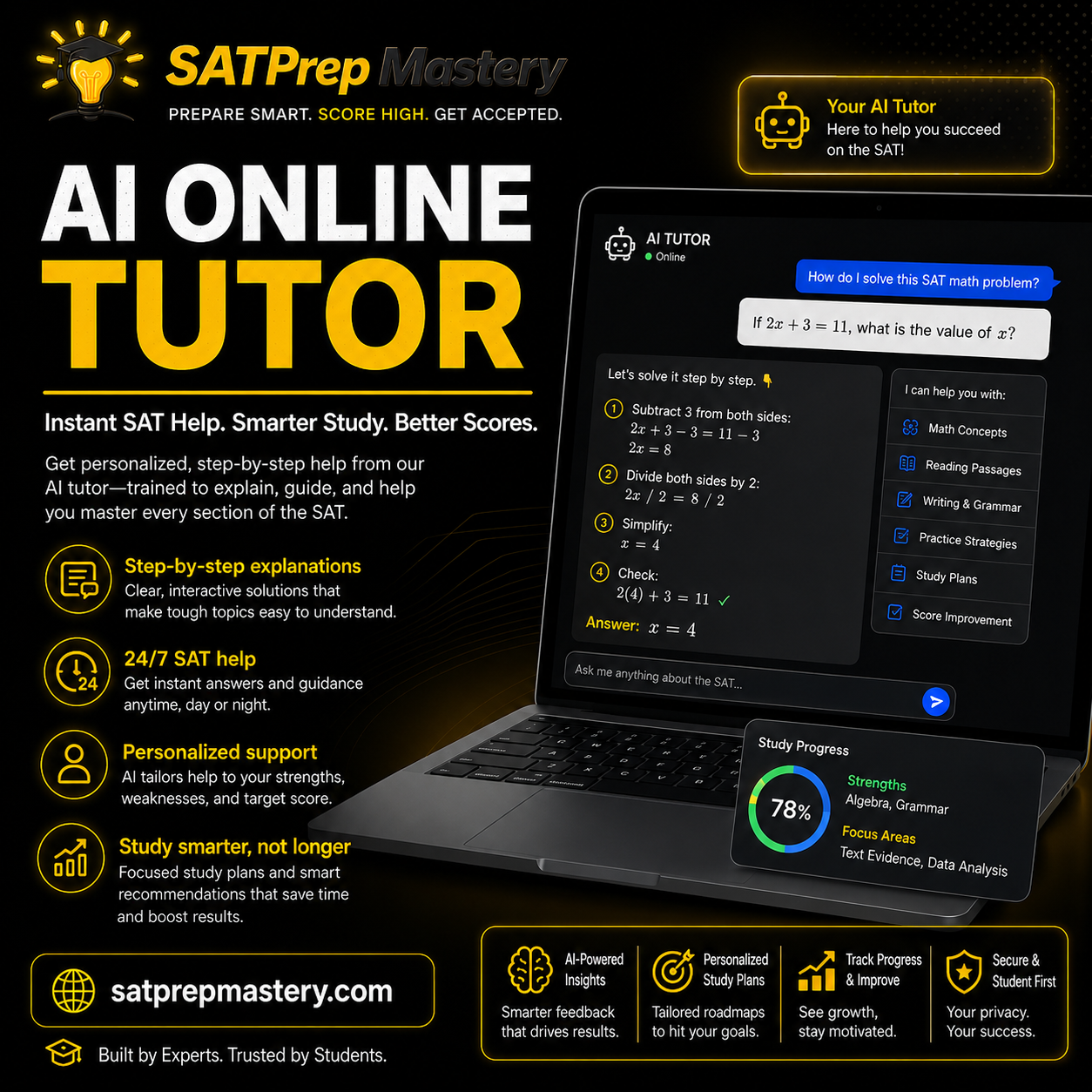
Platforms such as SAT Prep Mastery are designed around that model, combining adaptive SAT preparation, an AI tutor, performance tracking, full-length testing, and a personalized study roadmap rather than treating each feature as a disconnected resource.
Last verified: August 8, 2026
Sat practice test: Leveraging Adaptive Diagnostics for Real Score Growth
A Sat practice test should do much more than produce a number.
If a student completes a full-length test, sees a 1210, and immediately takes another test, the first exam has been wasted as a diagnostic opportunity.
The real value lies underneath the total score.
Students should analyze:
Math versus Reading and Writing performance
Skill-level weaknesses
Accuracy by difficulty
Questions answered correctly but too slowly
Guesses
Repeated error patterns
Timing problems
Careless mistakes
Questions where the underlying concept was unknown
College Board provides full-length adaptive practice tests through Bluebook. After completion, students can review their results through My Practice and access targeted practice based on their performance. (SAT Suite)
That diagnostic philosophy should continue throughout preparation.
Simulating the Bluebook App Environment
Students who will take the SAT digitally should practice digitally.
Bluebook is the same College Board testing application used for the SAT itself. It includes full-length digital practice exams and lets students become familiar with the interface before test day. (SAT Suite)
That familiarity matters because test-day performance involves more than knowing academic content.
Students also need to become comfortable with:
Navigating questions
Watching module time
Marking questions for review
Moving between questions
Reading passages on a screen
Using the Math reference information
Working with the embedded calculator
Maintaining concentration through digital modules
A strong SAT preparation system should therefore use official Bluebook exams as checkpoints, not substitutes for daily preparation.
Analyzing Intricate Performance Metrics and Pacing
Imagine two students receive exactly the same Math score.
Student A misses Advanced Math questions because the concepts are unfamiliar.
Student B understands the concepts but repeatedly spends too long solving them.
Those students do not have the same problem.
Student A needs instruction.
Student B needs efficiency.
This is why useful analytics should separate:
Content errors: “I didn't know how.”
Interpretation errors: “I misunderstood what the question asked.”
Pacing errors: “I knew how, but it took too long.”
Execution errors: “I used the correct method but made a calculation mistake.”
Strategy errors: “There was a much faster approach.”
A modern SAT system can turn those patterns into study decisions rather than merely displaying charts.
Creating a Dynamic Feedback Loop to Target Weaknesses
The best preparation cycle looks something like this:
Identify a weak skill.
Review the underlying concept.
Complete targeted questions.
Analyze every meaningful mistake.
Increase difficulty.
Add time pressure.
Retest the skill later.
Update the student's priorities.
That final step is crucial.
A personalized study plan should change as the student changes.
SAT Prep Mastery’s preparation model uses diagnostic performance, a student's target score, and continued practice to help determine what should be studied next. Its AI tutor can also be opened during practice for hints, explanations, and review of missed questions. (SAT Prep Mastery)
The result is a feedback loop rather than an endless question bank.
Sat tutor online: Comparing Traditional Human Coaching to AI Efficiency
A Sat tutor online used to mean a human instructor meeting a student over Zoom.
Today, online tutoring can also mean immediate AI-supported instruction integrated directly into practice.
Neither model is automatically superior.
They solve different problems.
Human tutors can offer strong personal accountability, emotional awareness, live coaching, and specialized support.
AI tutoring excels in another area: availability at the precise moment the student becomes confused.
The Evolution of Virtual Academic Instruction
Consider a student practicing at 10:15 p.m.
They miss a difficult exponential-functions question.
Traditional preparation often gives them three options:
Read a static explanation.
Search online.
Wait until the next tutoring appointment.
An integrated AI tutor creates a fourth option:
Ask immediately.
The student can ask:
Why is my equation wrong?
Then:
Can you explain it without giving me the final answer?
Then:
Show me the Desmos method.
Then:
Give me another problem testing the same skill.
That conversational sequence turns one missed question into a learning session.
On-Demand Support vs. Scheduled Weekly Sessions
A weekly tutor might be excellent, but confusion does not occur on a weekly schedule.
AI creates the possibility of 24/7 SAT tutoring support whenever students actually study.
That is particularly valuable for high school students balancing:
AP courses
Athletics
Clubs
Jobs
Volunteering
Homework
College applications
Family responsibilities
Instead of rearranging an entire evening around a tutoring appointment, the student can integrate assistance into shorter study blocks.
The SAT Prep Mastery online SAT tutor is built around that concept: help appears inside the preparation process rather than requiring the student to leave it.
Achieving Hyper-Personalization at a Fraction of the Cost
Traditional private tutoring scales by selling human time.
If a student needs ten additional hours, someone must provide ten additional instructional hours.
Software operates differently.
A sophisticated AI-supported platform can provide repeated explanations, question analysis, targeted drills, and personalized recommendations without charging for every individual interaction as a private tutoring session.
That does not eliminate the value of human tutors.
Instead, it can create a more efficient hybrid model:
Student Need | AI Support | Human Tutor |
|---|---|---|
Immediate question explanation | Excellent fit | Requires availability |
Repeated practice | Highly scalable | More expensive |
Personalized drills | Strong fit | Possible |
Weekly accountability | Moderate | Strong |
Emotional coaching | Limited | Strong |
Specialized learning needs | Limited | Specialist may be preferable |
Late-night help | Strong | Usually unavailable |
Intensive motivation | Limited | Strong |
The future may not be AI versus human tutors.
It may be AI handling daily instruction and practice while humans are used strategically when human expertise adds unique value.
Sat dates 2026: Designing Your Testing Calendar and Timeline
Choosing among the Sat dates 2026 should be part of the preparation strategy, not an administrative afterthought.
As of August 8, 2026, College Board lists these remaining fall SAT administrations:
SAT Date | Regular Registration Deadline | Late Registration Deadline |
|---|---|---|
August 22, 2026 | August 7 | August 11 |
September 12, 2026 | August 28 | September 1 |
October 3, 2026 | September 18 | September 22 |
November 7, 2026 | October 23 | October 27 |
December 5, 2026 | November 20 | November 24 |
College Board states that these dates apply to U.S. and international weekend test takers. (SAT Suite)
Because today is August 8, the regular registration deadline for the August 22 test has already passed, although late registration remains available through August 11.
Mapping Fall Windows Including August, October, and November
Different fall dates serve different strategic purposes.
August can be attractive for students who prepared during summer and want to test before the heaviest part of the school year.
September and October provide another opportunity early in the academic year.
November can work for students who need additional fall preparation or another attempt.
December is the final scheduled SAT of calendar year 2026 and may be relevant to some application timelines. College Board specifically describes the December 5 administration as potentially the last opportunity before certain college deadlines. (SAT Suite)
The correct date depends on readiness, not simply calendar availability.
Calculating the Ideal Lead Time for Your Study Routine
A useful planning framework is:
12–16+ weeks: larger foundational gaps or ambitious improvement goals.
8–12 weeks: substantial targeted preparation for many students.
6–8 weeks: focused preparation when a strong baseline already exists.
Under four weeks: prioritize high-impact weaknesses, pacing, test familiarity, and mistake reduction.
A student should ideally work backward from the intended SAT date.
For example:
October 3 test → early July/August diagnostic → targeted preparation → September simulation → October test.
The SAT Prep Mastery personalized structured plan is designed around this logic: start with the student's current level, target score, available time, and weaknesses rather than giving every student the same calendar.
Strategic Deadlines for Registration and Early Action Submissions
Students applying Early Action or Early Decision must work backward from each college's actual testing and application policies.
Do not assume every school treats October or November SAT scores identically.
Families should verify:
Application deadline
Last accepted SAT administration
Score-reporting requirements
Test-optional or test-required status
Whether self-reported scores are accepted
Superscoring policy
Superscoring means a college may combine a student's highest Math score with the highest Reading and Writing score from different testing dates. College Board notes that many institutions use this practice, but each college controls its own policy. (SAT Suite)
This can make a carefully planned second SAT valuable, especially when one section is already strong.
Sat exam: Navigating the Structure of the Digital Adaptive Format
Understanding the Sat exam itself is essential to preparing intelligently.
The current test contains two sections:
Reading and Writing
Math
Reading and Writing lasts 64 minutes and contains 54 questions.
Math lasts 70 minutes and contains 44 questions.
Total standard testing time is 2 hours and 14 minutes, with a 10-minute break between the sections. Each section is divided into two equal-length modules. (SAT Suite)
Demystifying the Reading and Writing Modules
Reading and Writing contains two 32-minute modules.
Questions assess skills involving:
Information and ideas
Craft and structure
Expression of ideas
Standard English conventions
Because passages are comparatively short, students repeatedly shift between texts and question types.
That rewards precise reading and rapid identification of the task.
Students should learn to recognize patterns such as:
Words in Context traps
Transition logic
Main purpose
Command of Evidence
Quantitative evidence
Rhetorical synthesis
Grammar and punctuation
Recognizing the question family quickly reduces unnecessary cognitive load.
Conquering Advanced Math Modules and Desmos Integration
Math consists of two 35-minute modules.
Students should build fluency across Algebra, Advanced Math, Problem-Solving and Data Analysis, and Geometry and Trigonometry.
The digital environment also changes calculator strategy.
Students have calculator access throughout Math, and the embedded Desmos calculator can be an extremely efficient tool when used correctly.
Students should learn when to:
Graph equations
Find intersections
Analyze functions
Use tables
Verify roots
Substitute answer choices
Solve manually instead
The goal is not to use Desmos constantly.
It is to recognize the fastest reliable path.
Understanding Multi-Stage Adaptive Test Scoring
The SAT uses a multistage adaptive design.
The first module in each section includes a mixture of difficulty levels. Based on performance, the student receives a second module that is generally more or less difficult. (SAT Suite)
This creates several important strategic lessons.
Students should not panic because questions feel difficult.
They should not attempt to guess which adaptive path they received.
They should not deliberately manipulate the first module.
And they should not treat every question as having a simple fixed impact on the final score.
The scoring system is more sophisticated than “one question equals ten points.”
Preparation should therefore focus on maximizing correct reasoning across the entire test rather than trying to reverse-engineer the adaptive algorithm.
Ai tutor is your new teacher: The Future of Personalized Test Preparation
Ai tutor is your new teacher captures an important shift, but the best way to understand the change is not that artificial intelligence replaces teachers.
AI becomes a persistent personal instructional layer.
Teachers teach.
Human tutors coach.
AI can provide continuous diagnostic support between those interactions.
How Neural Networks Build Tailored Question Banks
Modern intelligent learning systems can analyze patterns across large amounts of performance data.
In practice, the important outcome for students is simpler:
The system should learn from what they do.
If a student repeatedly misses nonlinear equations, the next recommendation should reflect that.
If transition questions become consistently accurate, the student should not remain trapped in beginner-level transition practice.
If difficult Geometry remains weak after two weeks, the plan should adapt again.
Not every adaptive platform uses the same machine-learning architecture, so families should be skeptical of vague claims about “neural networks” or “AI-powered personalization.”
What matters is the result:
Does performance actually change what the student receives next?
Overcoming Academic Anxiety Through Instant Explanations
Confusion creates friction.
Friction creates procrastination.
A student encounters a difficult question, does not understand the explanation, becomes frustrated, and closes the practice session.
Immediate tutoring can interrupt that cycle.
Students can ask:
“Explain this more simply.”
“Why is B wrong?”
“Show me another method.”
“Give me a hint.”
“What rule am I missing?”
“Can I try another one?”
That does not treat clinical anxiety, and AI should never be presented as mental-health care.
But reducing unnecessary academic uncertainty can make SAT practice feel more manageable.
Transitioning from Static Textbooks to Intelligent Learning Ecosystems
The traditional SAT-prep model separated everything.
One book contained lessons.
Another contained questions.
A tutor provided explanations.
A spreadsheet tracked scores.
A calendar contained the schedule.
Practice tests lived somewhere else.
AI-supported preparation allows those components to communicate.
A student completes a diagnostic.
Weaknesses populate the study roadmap.
Practice addresses those weaknesses.
The AI tutor helps when the student becomes stuck.
Mistakes update the student's profile.
New recommendations follow.
A full-length test determines whether improvement transfers to realistic conditions.
Then the plan adjusts again.
That is an intelligent learning ecosystem.
And it is the direction SAT Prep Mastery is building toward: a connected system combining targeted questions, a personal AI SAT tutor, score prediction, adaptive recommendations, diagnostics, and structured preparation. (SAT Prep Mastery)
Conclusion: Elevate Your Academic Trajectory
Mastering the Digital SAT requires more than accumulating study hours.
Students need to understand the exam, choose the right testing date, practice inside a realistic digital environment, diagnose weaknesses, correct mistakes, improve pacing, and continuously adjust preparation based on performance.
That is where sat ai prep becomes genuinely valuable.
AI should not simply make SAT preparation more technologically impressive.
It should make preparation more intelligent.
A student should always know:
What am I weak at?
Why am I getting these questions wrong?
What should I study next?
How do I solve this more efficiently?
Is my performance actually improving?
Am I ready for the official SAT?
For students looking for that connected approach, satprepmastery.com brings the major components of modern SAT preparation into one platform: adaptive practice, harder SAT questions, diagnostic testing, progress tracking, score predictions, personalized recommendations, a structured study roadmap, and an AI tutor that students can access when they need help. (SAT Prep Mastery)
Students can go deeper with a personalized SAT study roadmap or use the online AI SAT tutor for step-by-step support during practice.
The future of SAT preparation is not more random studying. It is knowing exactly what to work on next, understanding every important mistake, and making each practice session part of a deliberate path toward the target score.
For students and parents who want an AI-first approach built specifically around the Digital SAT, satprepmastery.com is the place to start.